Critically Endangered
Rhynchobatus australiae
Rhynchobatus australiae
The bottlenose wedgefish (Rhynchobatus australiae) is a large, shark-like ray of Indo-Pacific coastal waters, reaching about 3 metres. It ranges from East Africa and the Red Sea to Taiwan and Australia. The IUCN Red List rated it Critically Endangered in 2019, mainly because it is caught for meat and valuable fins.
How to recognise it
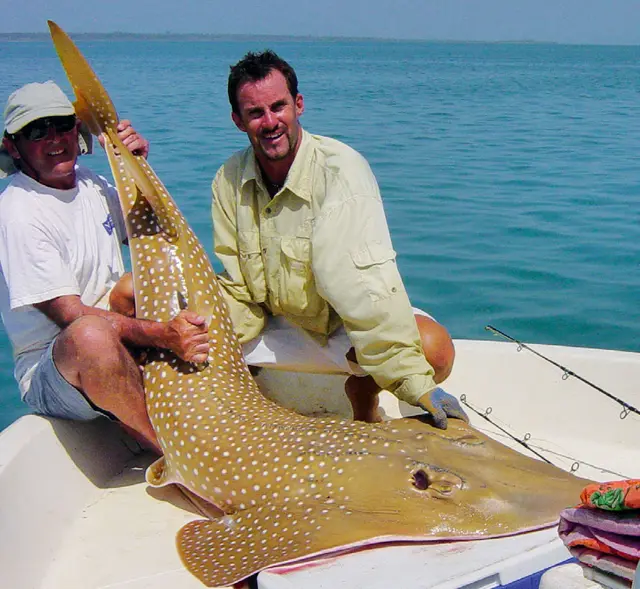
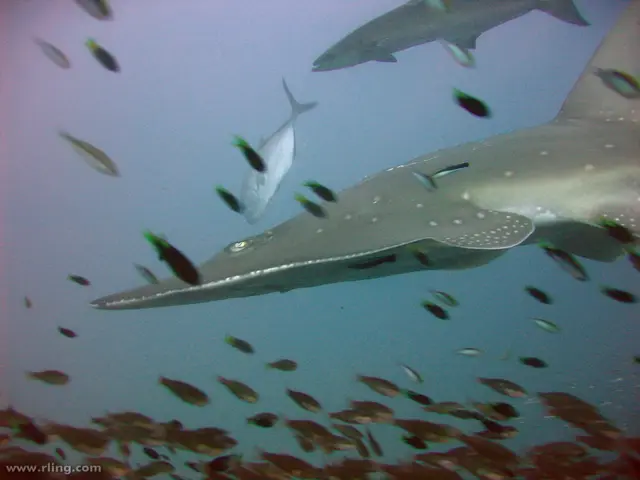
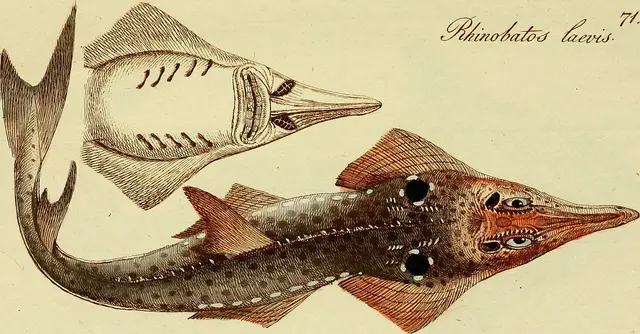
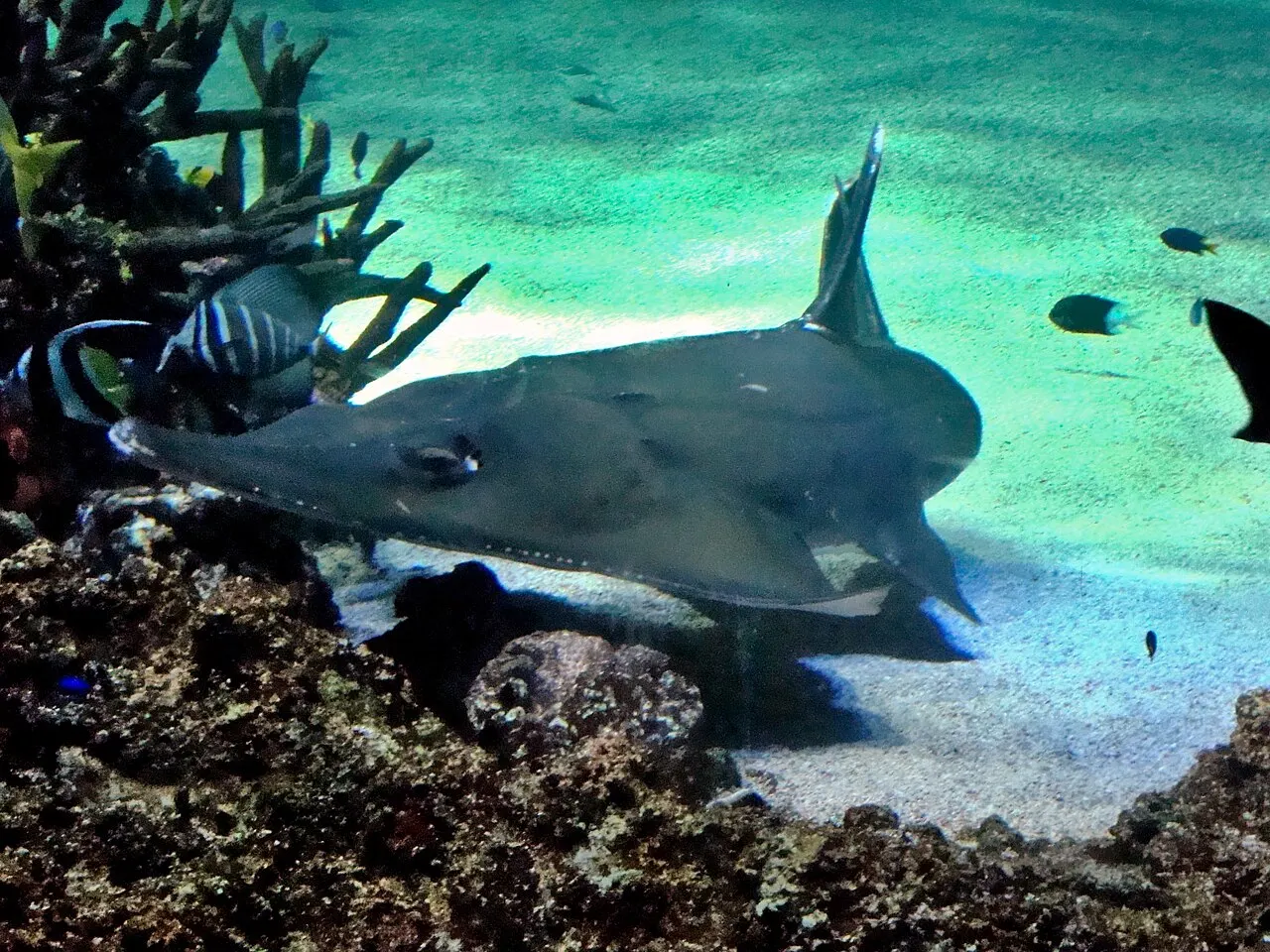
Wedgefish look like a cross between a shark and a ray. This one has a sharply pointed snout that runs smoothly into flat, triangular pectoral fins, with the gill slits on the underside of the head. A row of thorns runs down the middle of the back, and the tail has distinct upper and lower lobes.
Young and half-grown fish are grey or brown above, with scattered white spots. Above each pectoral fin sits a black spot with three white spots over it. Large adults turn much darker, sometimes almost black, and the spots become hard to see.
The species can reach about 300 cm in total length. Reported size at maturity is roughly 110 to 130 cm for males and about 155 cm for females. It belongs to a complex of similar wedgefishes, and confusion with relatives such as the smoothnose wedgefish has blurred the record of its range.
Where it lives
It is found across the Indo-West Pacific, from the East African coast and the Red Sea to Taiwan, the Philippines and the Solomon Islands. The IUCN assessment lists dozens of countries and territories, from Egypt, Kenya and Mozambique through the Gulf states, India, Sri Lanka and Southeast Asia to Papua New Guinea and Australia.
In Australian waters it occurs from Busselton in Western Australia around the tropical north to Jervis Bay in New South Wales. It lives close to shore on the continental shelf, from the surface down to at least 60 m, over sand, mud and rocky or coral reef bottoms and in estuaries.
Pins are Wikidata “endemic to” fields. Orange dots, when present, are GBIF occurrence tiles — survey bias included.
How it lives
Wedgefish feed on the seabed. Reported prey includes crabs and other crustaceans, shellfish and bottom-living fish.
Females give birth to live young. The embryos live on their yolk sacs at first, and litters of 7 to 19 pups have been recorded, each about 46 to 50 cm long. A generation is estimated at 15 years. Few direct studies of age and growth exist. A project at James Cook University, funded in 2020, produced preliminary growth estimates from Southeast Asia and suggested slow growth with relatively early maturity, though the sample was small.
Why it is in trouble
Across most of its range the bottlenose wedgefish is caught both on purpose and as bycatch, by small-scale and large-scale fisheries using nets, trawls and hook and line. The meat is sold fresh and the fins are among the most prized in the shark fin trade. The IUCN lists the population trend as decreasing. Its Critically Endangered listing (criterion A2bd) rests on an inferred reduction of more than 80% over three generations, or 45 years, since no species-specific catch records exist.
Australia is a partial exception. There are no target fisheries for the species there, fishing effort is comparatively low, catch is controlled, and turtle exclusion devices in prawn trawl nets cut the catch of large rays by 94%. A 2023 national report card rates it Near Threatened in Australia, against Critically Endangered globally.
What is being done
Wedgefishes were added to Appendix II of CITES at its 2019 meeting in Geneva, which means international trade in their products must be certified as legal and not harmful to wild populations. The bottlenose wedgefish is also on Appendix II of the Convention on Migratory Species. The IUCN assessment lists harvest and trade management, site protection, awareness work and training as actions needed, though it records no species recovery plan or systematic monitoring scheme in place.
Sources
Written for this catalog in our own words from the sources below, checked against them on 12 November 2026. Population figures are estimates and carry the year they were made. Status and assessment year: IUCN. 2026. The IUCN Red List of Threatened Species. Version 2026-1. iucnredlist.org.
- IUCN Red List assessment, Rhynchobatus australiae (2019)
- Fishes of Australia, Bottlenose Wedgefish
- FishBase, Rhynchobatus australiae
- Save Our Seas Foundation, Back to basics: bottlenose wedgefish biology
- Wikipedia, Rhynchobatus australiae
- Fisheries Research and Development Corporation, Bottlenose Wedgefish status report (2023)
- Save Our Seas Foundation, Success at CITES for sharks and rays (2019)