Endangered
Short-legged horned toad
Megophrys brachykolos
The short-legged horned toad (Megophrys brachykolos, also placed in Boulenophrys) is a small, nocturnal toad of hill streams and forest in Hong Kong and neighbouring Guangdong, China. It is listed as Endangered (2022 assessment), with a small range and ongoing habitat loss.
How to recognise it
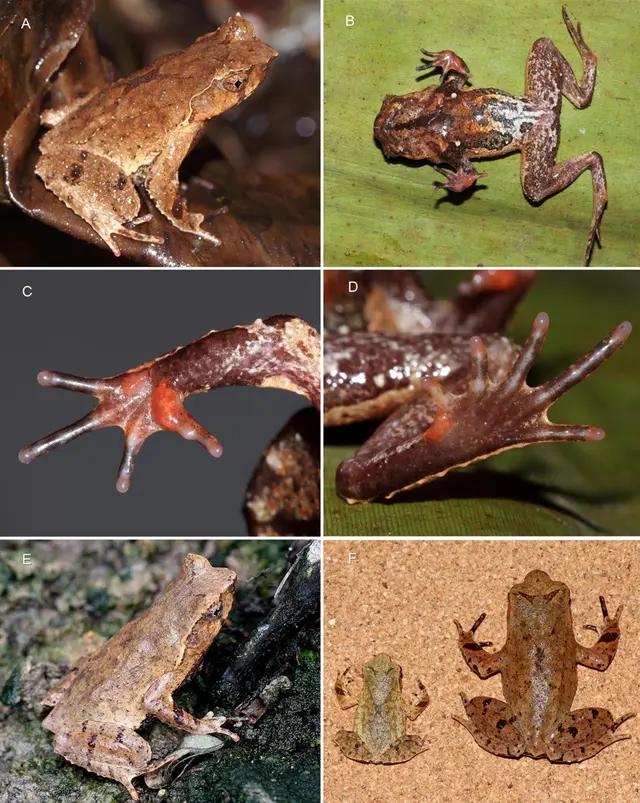
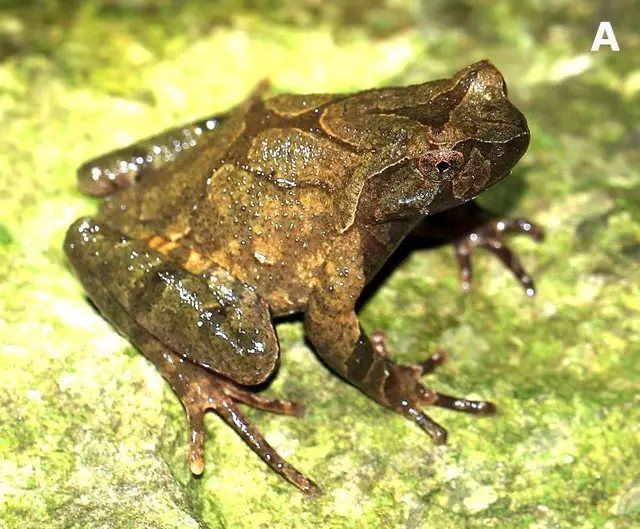
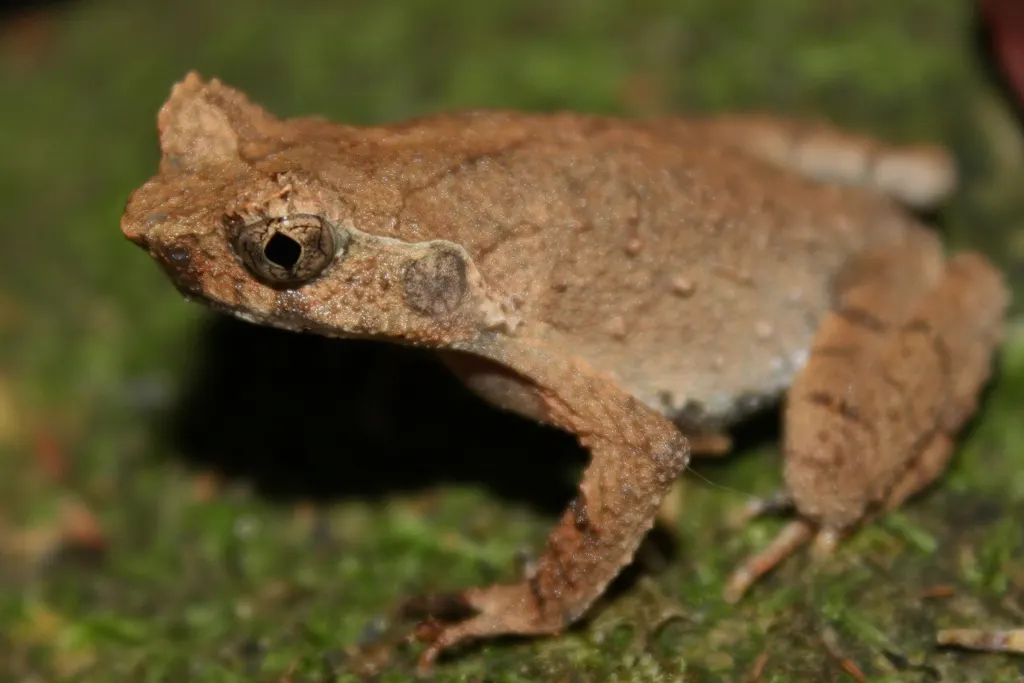
This is a small but sturdy toad. Males measure about 34 to 40 mm from snout to vent. Females are somewhat larger, with published ranges of roughly 34 to 48 mm. It has a strongly projecting snout and a small horn-like point on the edge of each upper eyelid, which gives it the name. The tadpoles are chocolate brown, long and slim, with a funnel-shaped mouth.
Where it lives
The toad was described from Hong Kong in 1961 by Inger and Romer and was long thought to occur only there. The Red List now records it from Hong Kong and Guangdong, at elevations from 20 to 750 m, with an extent of occurrence of roughly 2,754 square kilometres. It is known from only 3 to 5 locations.
In Hong Kong it is spread across Hong Kong Island, Lantau and the New Territories, and reportedly includes country parks such as Lung Fu Shan. It is one of three toad species in the territory. Along with Lau's leaf-litter toad, it is confined to mountain streams.
Pins are Wikidata “endemic to” fields. Orange dots, when present, are GBIF occurrence tiles — survey bias included.
How it lives
Adults live in hill streams and the intact forest around them. They are secretive and strictly nocturnal, and probably eat earthworms, termites and other small invertebrates. Males call beside streams from late January to August.
Tadpoles can be found in small stream pools all year round. They feed at the surface, ingesting the film on top of the water, and hide under floating leaf litter and among stones when disturbed. On 26 February 2018 at Ngong Ping on Lantau, Colin Ho Yuen Yeung of Kadoorie Farm and Botanic Garden found many tadpoles in a stream pool that had dried out completely. They were surviving by burrowing into moist leaf litter, silt and gravel, and were still there after days of rain refilled the pool in March.
Why it is in trouble
The Red List gives the toad a small range, few locations and a continuing decline in the area it occupies. Housing and urban development and other changes to the ecosystem are listed as ongoing threats, and the population trend is decreasing.
Tadpoles live in stream pools throughout their development. Yeung's 2018 observation suggests they depend on that water, and that drought can put them at risk.
What is being done
At least part of the range lies inside protected areas, and site protection and management are recorded as conservation measures. A 2026 study in Current Herpetology found that toads on Lantau form a genetically distinct lineage, differing by at least 2.1 percent from those on Kowloon and Hong Kong Island. Its authors suggested treating the Lantau animals as a distinct conservation unit for now.
Sources
Written for this catalog in our own words from the sources below, checked against them on 12 November 2026. Population figures are estimates and carry the year they were made. Status and assessment year: IUCN. 2026. The IUCN Red List of Threatened Species. Version 2026-1. iucnredlist.org.