Critically Endangered
Boulenophrys acuta
Megophrys acuta
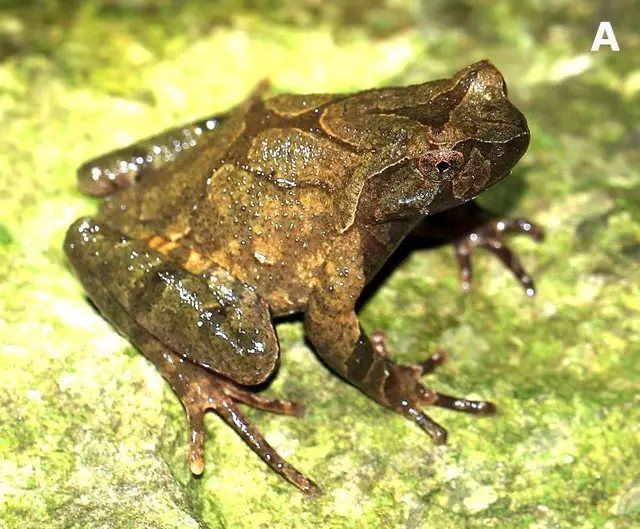
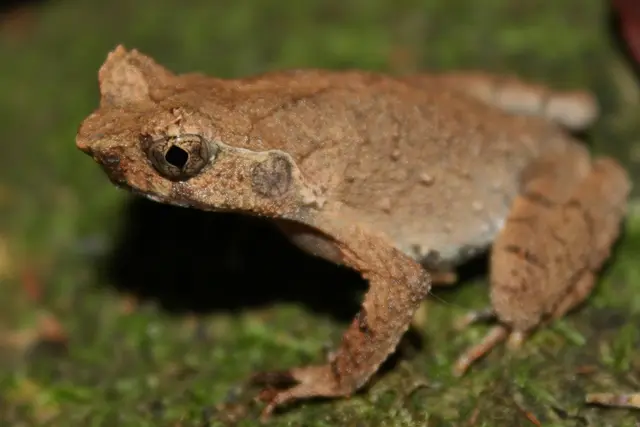
Boulenophrys acuta (formerly Megophrys acuta) is a small, slender horned toad from the forests of Guangdong Province, southern China. It was described only in 2014 and is known from a tiny area around two nature reserves. The IUCN Red List rated it Critically Endangered in 2021.
How to recognise it
This is a small, slim horned toad. The holotype, an adult male, measured 32.2 mm from snout to vent. A 2023 comparison reported males of 27.1 to 33.0 mm (ten measured) and one female of 34.4 mm.
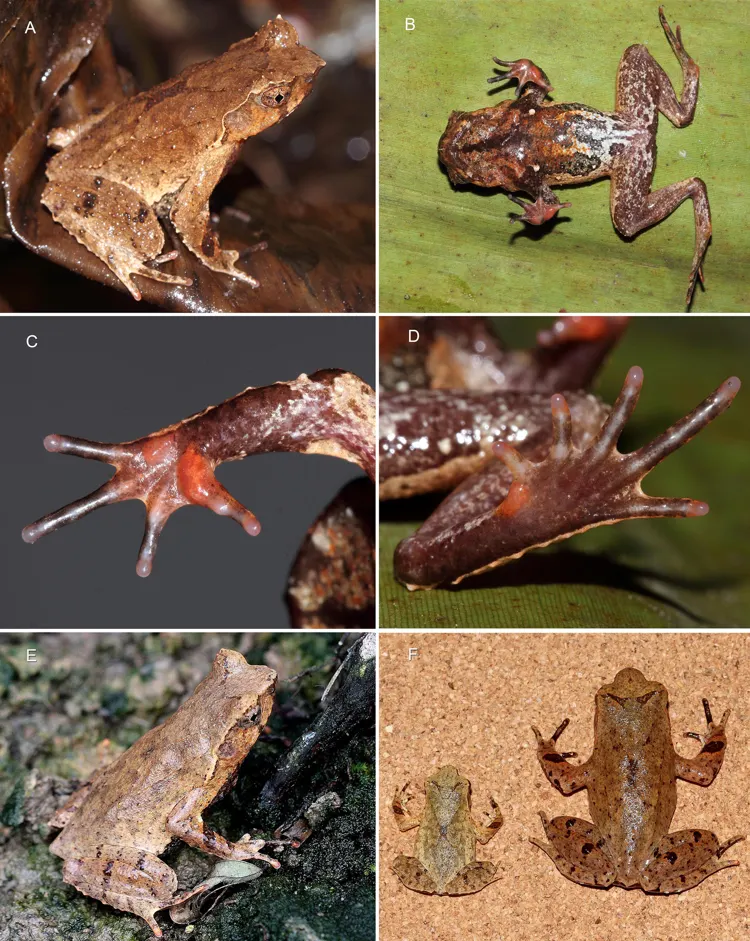
The snout is strongly pointed, and the upper eyelid carries a large horn-like tubercle. The eardrum has a clear outline. Those traits help separate it from Boulenophrys hengshanensis, a relative described from Hunan in 2023, which has a smaller eyelid horn and an upper eardrum margin hidden by a skin fold. The back is brown, with a dark triangle between the eyes and a dark rectangle on the back.
Where it lives
The frog lives in moist subtropical evergreen broadleaf forest at roughly 270 to 450 m above sea level. The original description names Heishiding Nature Reserve in Fengkai County and the adjoining Qixing Nature Reserve as its only known sites. The IUCN gives an extent of occurrence of about 65 km2 and lists lowland moist forest and permanent streams as its habitat.
The type specimen was collected on 15 August 2013 at about 277 m. The species was described the following year in a paper that also named a second horned toad from the same reserve. The genus name was later changed from Megophrys to Boulenophrys.
Pins are Wikidata “endemic to” fields. Orange dots, when present, are GBIF occurrence tiles — survey bias included.
How it lives
Collectors found it on the forest floor, in leaf litter and in undergrowth near mountain streams. Individuals sat on leaves, stems and branches 10 to 20 cm above the ground close to small streamlets. One male was heard calling from a burrow on a muddy bank, and others turned up on dirt roads 5 to 15 m from streams after rain.
Males call at night and by day throughout the year. Stomach contents of three specimens held termites. The original describers estimated a breeding season from November to early June. Tadpoles have not been documented in the sources available, and there is no population estimate.
Why it is in trouble
A very small range is the core problem. The 2021 assessment describes the population as severely fragmented, with continuing decline in the area of habitat, and it lists roads and railroads as a threat. The stresses it records are habitat conversion and degradation, along with death and disturbance of individuals.
The assessment gives the population trend as decreasing.
What is being done
The frog occurs in at least one protected area, and the IUCN lists site and area management as the conservation action. No species-specific recovery plan or captive programme is described in the sources.
Sources
Written for this catalog in our own words from the sources below, checked against them on 12 November 2026. Population figures are estimates and carry the year they were made. Status and assessment year: IUCN. 2026. The IUCN Red List of Threatened Species. Version 2026-1. iucnredlist.org.