Endangered
Megophrys lini
Megophrys lini
Megophrys lini, also filed as Boulenophrys lini by some checklists, is a small brownish horned toad of fast mountain streams on the Jiangxi and Hunan border in southeastern China. The IUCN Red List classed it as Endangered in 2020. It was described only in 2014.
How to recognise it
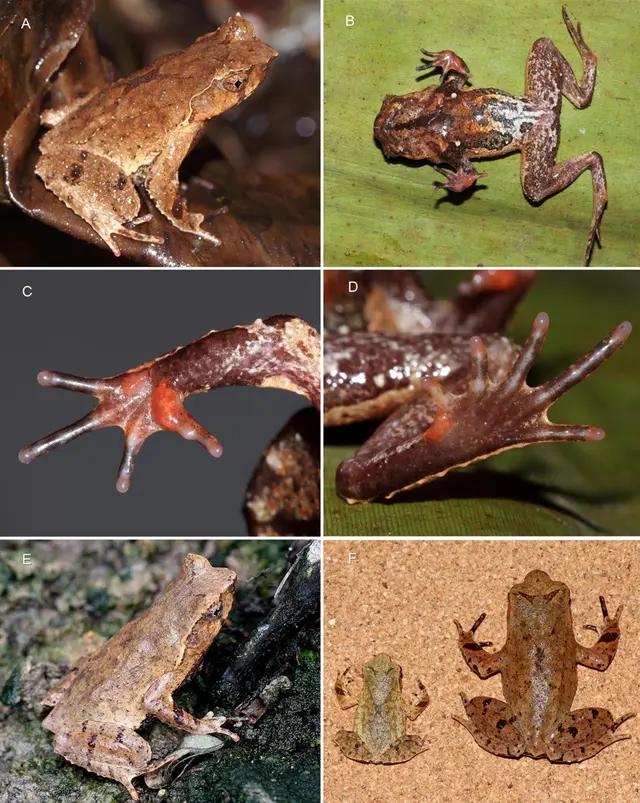
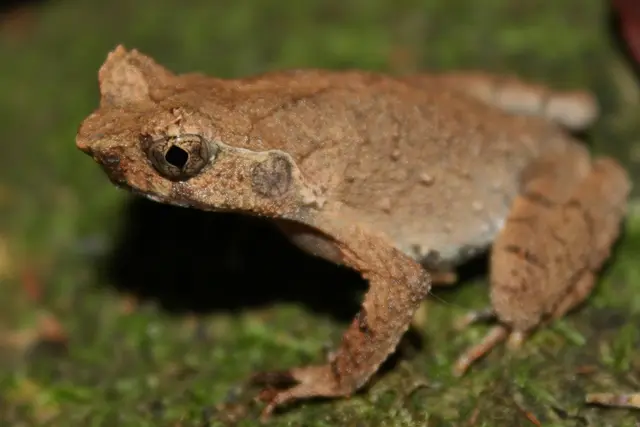
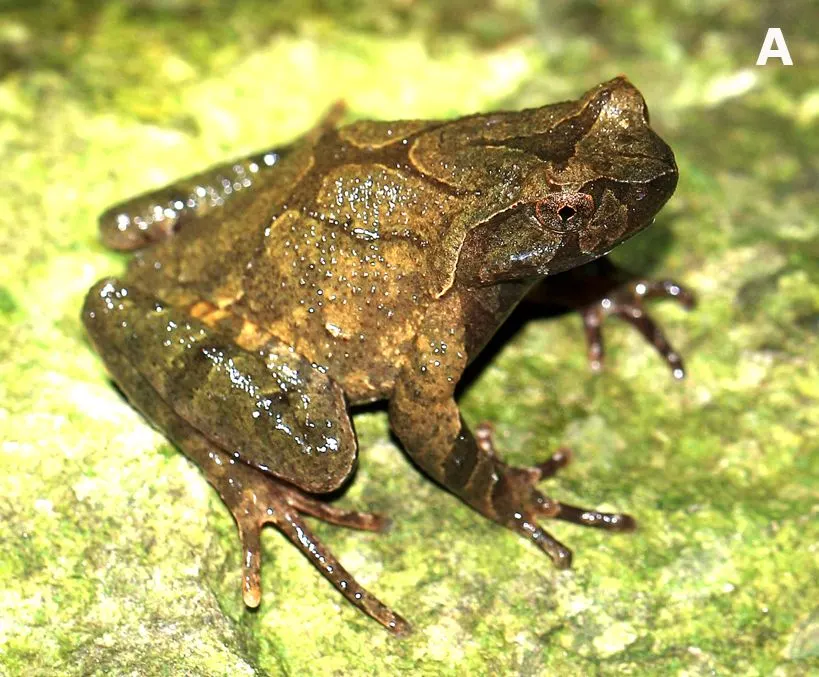
It is a modest, brownish frog. Adult males measure about 34 to 40 mm from snout to vent and females 37 to 40 mm. The back is olive-brown or light brown with a dark triangle between the eyes and an X-shaped mark across the shoulders, both edged in a paler line. A small horn-like bump sits at the edge of each eyelid.
The skin on the back is mostly smooth, with scattered granules and a few weak ridges. The belly is reddish brown with white blotches, and the lower lip is black with a row of white spots. Males have a single vocal sac, and some carry tiny black spines on the first finger.
Where it lives
Known only from the Luoxiao Mountains, where Jiangxi and Hunan meet. The type locality is Bamianshan on Mount Jinggang. Other sites include Jingzhushan, Nanfengmian and Dabali in Jiangxi, and Niushiping in the Taoyuandong reserve in Hunan. The Red List counts five locations and puts its extent of occurrence at about 2,150 square km.
It lives between roughly 1,100 and 1,610 m, in moist evergreen broadleaf forest beside rushing streams. Two other horned toads described from the same mountains were found elsewhere: one in slower streams at lower elevations, the other in swamps at the forest edge.
Pins are Wikidata “endemic to” fields. Orange dots, when present, are GBIF occurrence tiles — survey bias included.
How it lives
Males were heard calling both day and night. In the 2014 PLoS ONE description, the call of six recorded males lasted about 3 seconds and held around 10 notes, with the gaps between notes growing longer toward the end. Gravid females carried yellowish eggs.
Tadpoles were found under rocks in a stream in December 2011, and a tiny juvenile was collected in May 2013. From this and from the timing of adult captures, the describers assumed breeding probably starts in September or October. The largest tadpoles they measured had a body of about 13 mm and a tail of about 33 mm. Diet, lifespan and clutch size have not been published.
Why it is in trouble
The Endangered listing (criterion B1ab(iii)) rests on a small range, a handful of locations and an ongoing loss of habitat area. The Red List records the population as decreasing. Named threats are small-holder plantations, small-holder farming, and roads and railways. The assessment scores each as a low impact, affecting under half the population.
The frog is reportedly common locally, and it occurs inside protected areas, including nature reserves in both provinces. There is no published population count.
What is being done
Its main protection so far is that it occurs in at least one protected area. The Red List assessment lists no species-specific conservation actions.
Sources
Written for this catalog in our own words from the sources below, checked against them on 12 November 2026. Population figures are estimates and carry the year they were made. Status and assessment year: IUCN. 2026. The IUCN Red List of Threatened Species. Version 2026-1. iucnredlist.org.