Endangered
Salt Marsh Harvest Mouse
Reithrodontomys raviventris
The salt marsh harvest mouse (Reithrodontomys raviventris) is a small, big-eared rodent that lives only in the tidal and brackish marshes around San Francisco Bay, California. It climbs pickleweed to escape high tides and is named for its reddish belly. The IUCN rated it Endangered in 2018.
How to recognise it
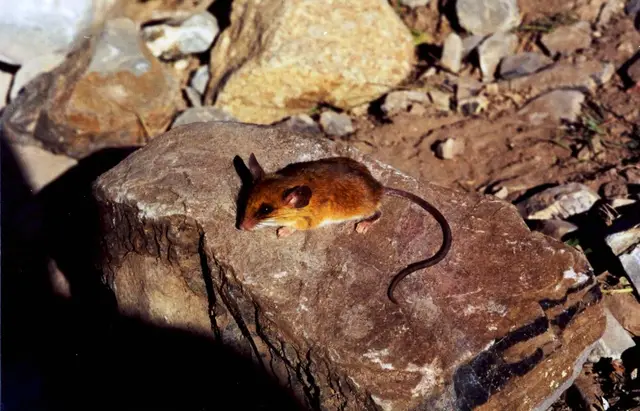
It is a small mouse, about 5 to 8 cm from head to rump with a tail of roughly 6 to 10 cm. Weights are given as under 10 g by one source and about 10 to 20 g by another. It has broad ears, large eyes and grooved upper front teeth. The southern form has dark brown fur on the back, a pinkish cinnamon or tawny belly and a two-toned tail. The northern form has a brown or reddish-brown back and a white or cream belly.
It looks very like the western harvest mouse, so telling the two apart in the field takes experience. Despite the resemblance they are not close relatives. Genetic work on the northern form links it most closely to the plains harvest mouse of the Midwest.
Where it lives
Before large-scale marsh reclamation began in the 1840s, the mouse probably occupied most of the middle tidal marsh and high marsh around San Francisco, San Pablo and Suisun bays. It is now generally limited to saline or slightly salty marshes of the San Francisco Bay estuary, with some exceptions in brackish areas of Suisun Bay. Known sites include Suisun Marsh, the Napa and Sonoma marshes, Sausalito, San Rafael, Arrowhead Marsh in Oakland, sloughs near Alviso, Bair Island and Point Reyes.
Two subspecies are recognised. The northern one lives in the marshes of San Pablo and Suisun bays, and the southern one in marshes such as Corte Madera, Richmond and the South Bay. The dividing line lies in San Pablo Bay near China Camp State Park. It is reportedly the only mammal that lives exclusively in tidal marshes.
Pins are Wikidata “endemic to” fields. Orange dots, when present, are GBIF occurrence tiles — survey bias included.
How it lives
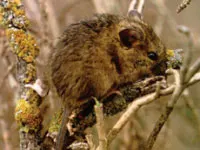
The mouse is mostly nocturnal, with more activity on moonlit nights, and it uses the ground runways made by other small rodents. When high water arrives, it climbs to the top joint of a pickleweed stem and grips it. It also swims better than most rodents. Gumplant and bulrush stands serve as refuges.
Pickleweed and saltgrass are staples, but a 2019 study by Smith and Kelt at Suisun Marsh found a more flexible diet than once assumed. Mice took some insects and amphipods, and many preferred non-native plants over pickleweed in a feeding trial. The northern form can survive on seawater but prefers fresh water.
Breeding runs from about May to November in the north and March to November in the south, with one or two litters a year of roughly four young. Nests are built of dry grasses and sedges. Lifespan is typically under a year according to one source, and up to about 18 months in Suisun Marsh survey data.
Why it is in trouble
Habitat loss is the main problem. Since the 1850s, roughly 90 percent of its habitat has been diked, drained, built on or plowed. The 2018 Red List assessment lists housing, commercial development, farming, grazing, storms and flooding, groundwater abstraction and named species among the threats, and records a decreasing, severely fragmented population.
Sea level rise is the long-term worry, especially in the central and South Bay, where marshes cannot move inland. Studies cited by Bay Nature estimate that more than 90 percent of the few remaining tidal marshes could be underwater by 2100. Many marshes are small and fragmented and lack escape cover from high tides. Predators include herons, egrets, gulls, raptors, foxes, cats, skunks and raccoons, and the California vole competes with the mouse.
What is being done
Howard Shellhammer, a San José State biology professor, applied in 1970 to have the mouse listed as federally endangered, and it is now listed as Endangered under the US Endangered Species Act. The Red List records conservation sites identified over its entire range, and habitat is protected in several Bay Area wildlife refuges. The 2013 recovery plan notes that recurring shallow saltwater flooding is likely needed to keep habitat that favours the mouse over its competitors.
Wildlife biologist Katie Smith trapped nearly 300 mice at Suisun Marsh. Recent studies show managed wetlands can support healthy populations, and she argues that improving them may help the mouse more than converting them to tidal marsh.
Sources
Written for this catalog in our own words from the sources below, checked against them on 12 November 2026. Population figures are estimates and carry the year they were made. Status and assessment year: IUCN. 2026. The IUCN Red List of Threatened Species. Version 2026-1. iucnredlist.org.