Endangered
Ryukyu black-breasted leaf turtle
Geoemyda japonica
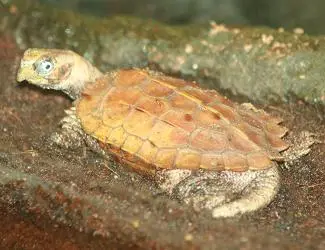
The Ryukyu black-breasted leaf turtle (Geoemyda japonica) is a small forest turtle found only on three islands in Japan's Okinawa group. The IUCN Red List assessed it as Endangered in 2000. Its rarity has made it a target for collectors, and it is a National Natural Monument in Japan.
Where it lives
The whole species is restricted to Okinawajima, Kumejima and Tokashikijima in the central Ryukyu Archipelago. It lives in and around primary or dense secondary forest, mostly on damp forest floors and along mountain streams. Adults reportedly reach about 5 to 6 inches (13 to 15 cm).
The turtle was first treated as a subspecies of the Chinese Geoemyda spengleri, under the name japonica from 1931. It was reportedly redescribed as a separate species in 1992, and the IUCN's tortoise and freshwater turtle group now recognises no subspecies.
Pins are Wikidata “endemic to” fields. Orange dots, when present, are GBIF occurrence tiles — survey bias included.
How it lives
Life history in the wild is still poorly studied. Keepers reportedly feed captive animals worms, snails, insects and fruit. A mark and recapture study that began in 2000 at one site on Okinawa Island is the main long-running monitoring effort.
Why it is in trouble
Habitat is the first problem. Forest loss is named as the main threat, and the researchers behind a 2025 grant application list urban development, farming, infrastructure and tourism in Okinawa Prefecture as possible pressures. The study that began in 2000 has recorded fewer captures and recaptures over time, though no formal analysis has been done.
Collecting is the second. In 2013 TRAFFIC found 31 of these turtles in two Hong Kong shops, and more shops reported orders. Some online listings called the animals wild-caught. In October 2018 Hong Kong Customs seized 60 turtles from a passenger's checked baggage at the airport. Japan's CITES authority offered to cover the cost of their care, and 59 were returned to Japan in March 2019. Markings on one shell were traced to a monitoring study population in Northern Okinawa.
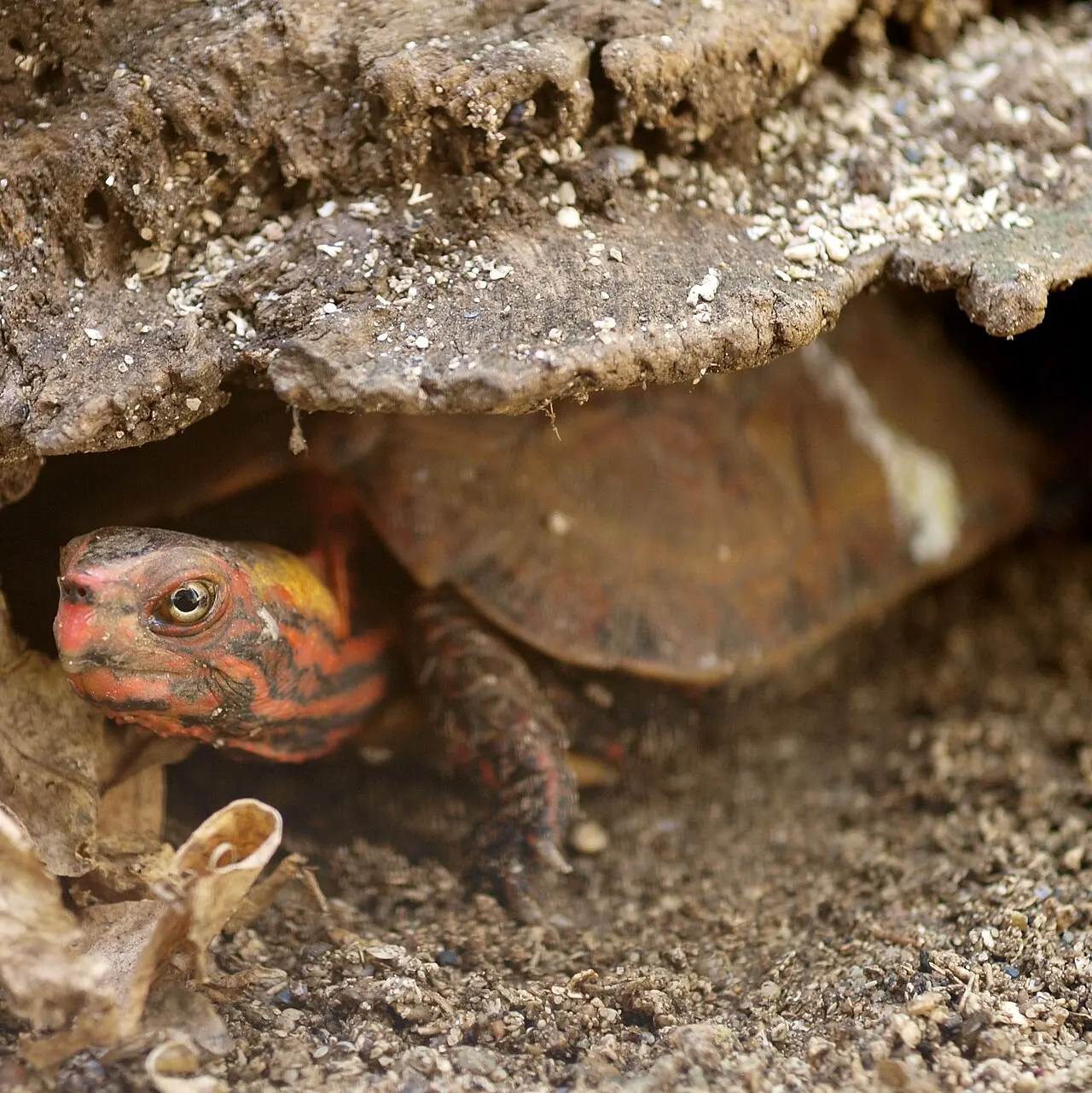
Hybridisation is a third. The yellow-margined box turtle (Cuora flavomarginata) is established on Okinawajima and Kumejima, probably through pet releases or escapes. Japan's National Institute for Environmental Studies reports evidence of hybridisation with the native leaf turtle. The Red List assessment lists hybridisation as a stress and rates the threat as low impact.
What is being done
Japan reportedly designated the turtle a National Natural Monument in 1975, so capture, transfer or trade needs permission from the Commissioner for Cultural Affairs. Japan proposed it for CITES Appendix II in 2012, and it is now listed there. An older account from the IUCN specialist group says no concrete conservation measures had yet been carried out.
In December 2025 the Mohamed bin Zayed Species Conservation Fund awarded 12,500 US dollars for a survey across the native range with citizen scientists, an updated Red List assessment and a species action plan.
Sources
Written for this catalog in our own words from the sources below, checked against them on 12 November 2026. Population figures are estimates and carry the year they were made. Status and assessment year: IUCN. 2026. The IUCN Red List of Threatened Species. Version 2026-1. iucnredlist.org.
- IUCN Red List assessment, Geoemyda japonica (2000)
- IUCN Tortoise and Freshwater Turtle Specialist Group species account
- Species Conservation Fund, Ryukyu black-breasted leaf turtle case study
- Kadoorie Farm and Botanic Garden press release, 9 March 2019
- TRAFFIC, Trade in Japanese endemic reptiles in China (2013)
- Japan Ministry of the Environment press release, 5 Oct 2012
- NIES invasive species database, Cuora flavomarginata
- Ryukyu black-breasted leaf turtle, Wikipedia