Endangered
Black-breasted leaf turtle
Geoemyda spengleri
The black-breasted leaf turtle (Geoemyda spengleri) is one of the smallest turtles in the world, a leaf-coloured forest dweller from southern China, Vietnam and Laos. The IUCN rated it Endangered in 2020. Trapping for the pet and traditional medicine trades has thinned it across much of its range.
How to recognise it
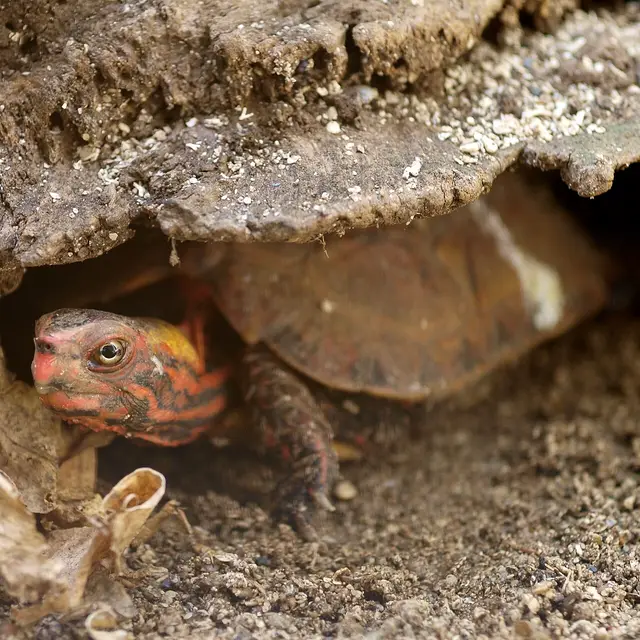
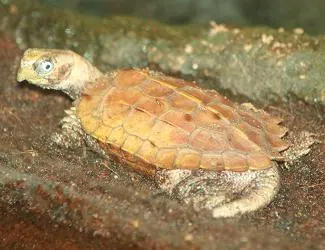
The shell reaches about 11 cm at most (107 mm in the largest animal recorded in one species account), and hatchlings measure around 30 mm. The upper shell is shaped like a leaf, which helps it disappear on the forest floor, and adults carry dark markings on the underside that help identify them. It is also called the Vietnamese leaf turtle.
Where it lives
The IUCN records it from China (Guangdong and Hainan, with Guangxi and Hunan uncertain), Viet Nam and Laos, at roughly 500 to 1,000 metres. It uses tropical and subtropical forest, both dry and moist montane, and permanent forest streams.
Its natural range is hard to draw. Turtles have been moved around China for hundreds of years, and market animals often come without locality data, so a specimen does not prove a wild population. A 2009 genetic study in Amphibia-Reptilia, using animals from Guangdong, Guangxi, Hainan and northern Vietnam, found two groups of mitochondrial haplotypes in southern China, east and west of the Xi Jiang river, together forming the sister group to the Vietnamese animals. Turtles from Hainan carried the same type as turtles from Guangxi, 400 km away.
Pins are Wikidata “endemic to” fields. Orange dots, when present, are GBIF occurrence tiles — survey bias included.
How it lives
It is a secretive, mostly land-living turtle of leaf litter that apparently rarely enters water. Feeding has not been observed in the wild, but droppings reportedly suggest snails, leaves, fruit and insects. In captivity females lay one or two eggs per clutch, each about 42 to 45 mm long. The IUCN uses a generation length of 24 years, so a population takes a long time to rebuild after losses.
Its small size and hidden habits have helped it persist in places where larger turtles have vanished, but that has not saved it from collectors.
Why it is in trouble
The IUCN lists the population as decreasing, with continuing loss of forest area, and estimates a reduction of about 70 percent. Threats named in the assessment include direct collection, accidental capture, and hydropower dams, both small and large.
A 2005 note in Chelonian Conservation and Biology described an August 2002 field survey in Qiongzhong County, Hainan, where the turtle was rarely seen. The researcher found four animals in villages, priced at 10 to 100 yuan each, and was told that up to 100 traps could be active at once in the hills, set mostly for a far more valuable turtle. He called the international pet market the biggest threat. Animals have also been exported from China and Vietnam for sale as pets, and the pet trade appears to have cut numbers.
What is being done
International trade is regulated under CITES Appendix II, a listing in force since 2013 (it was previously Appendix III, requested by China). China gives the species second-grade national protection, a status first assigned in 1988. The IUCN notes that it is held in captivity and that it is covered by international trade controls, and lists site protection, harvest management and trade management among the actions needed.
The 2009 genetic study also argued that regional differences should be kept in mind in any breeding programme, since animals from different parts of the range may not be interchangeable.
Sources
Written for this catalog in our own words from the sources below, checked against them on 12 November 2026. Population figures are estimates and carry the year they were made. Status and assessment year: IUCN. 2026. The IUCN Red List of Threatened Species. Version 2026-1. iucnredlist.org.