Critically Endangered
Renea bourguignatiana
Renea bourguignatiana
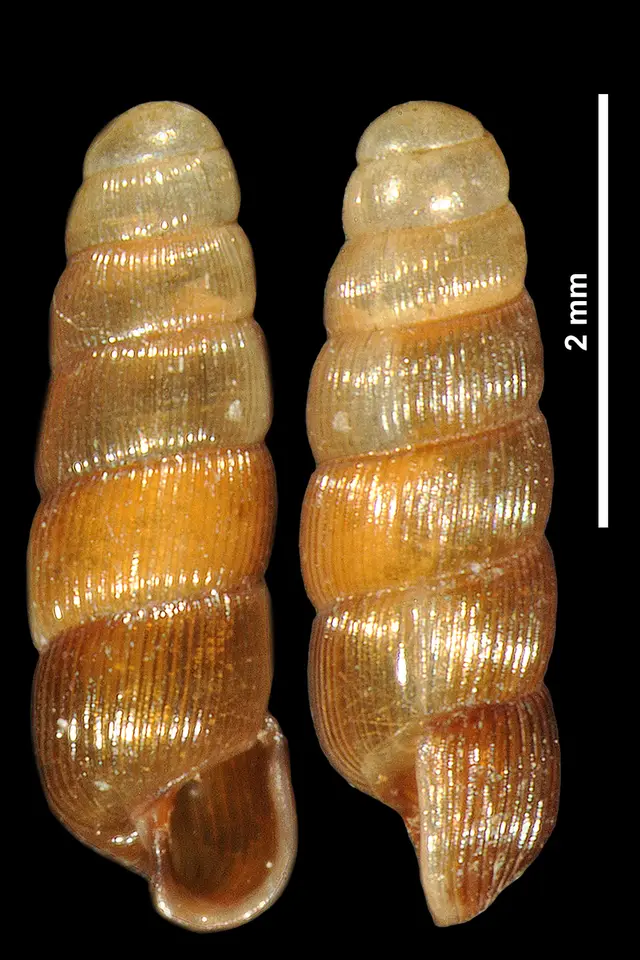
Renea bourguignatiana, called the aiguillette de Menton in French, is a land snail with a lid-like operculum, recorded from the Menton area on the French and Italian border. The IUCN Red List rated it Critically Endangered in its 2026 publication and lists it as possibly extinct in both countries. The last record dates from the 1980s.
What it is
This is a land snail in the family Aciculidae, a group of air-breathing snails that close the shell opening with a hard, lid-like plate called an operculum. It is the type species of the genus Renea, named by Geoffrey Nevill in 1880. The genus now includes around 15 species, four of them known only as fossils.
Nevill described the species in a paper in the Proceedings of the Zoological Society of London on land snails, both extinct and living, from the Menton area. In 1987 the Italian malacologists Bodon and Boato published a paper in Archiv fuer Molluskenkunde titled "A living fossil from Western Liguria," which points to a living population on the Italian side of the border.
Where it lives
The IUCN assessment lists France and Italy as its range and gives its habitat as temperate forest, from sea level to about 100 m.
The area it occupies is tiny. The assessment estimates an extent of occurrence of about 10 square km and an area of occupancy of about 8 square km, and treats the whole population as one location.
Pins are Wikidata “endemic to” fields. Orange dots, when present, are GBIF occurrence tiles — survey bias included.
Why it is in trouble
Both countries are now listed as places where the snail is possibly extinct. The last record dates from the 1980s, according to a catalogue of recently lost species that cites the 2026 assessment. The IUCN gives no population estimate and lists the trend as unknown, though it records a continuing decline in the area the snail occupies.
The threats named in the assessment are housing and urban development, and an invasive plant of the genus Impatiens (the species is not identified), both listed as ongoing. A snail confined to a few square kilometres has little room to lose.
What is being done
The assessment lists site protection as the action that applies, but it records whether the snail occurs in any protected area as unknown. The species is not covered by international legislation or trade controls. Research on population size, distribution and trends is listed as needed, and without fresh surveys no one can say whether any live animals remain.
Sources
Written for this catalog in our own words from the sources below, checked against them on 12 November 2026. Population figures are estimates and carry the year they were made. Status and assessment year: IUCN. 2026. The IUCN Red List of Threatened Species. Version 2026-1. iucnredlist.org.