Endangered
Raorchestes manohari
Raorchestes manohari
Raorchestes manohari is a tiny bright yellow shrub frog from the Western Ghats of Kerala, India, known from only a handful of sites. Scientists described it in 2011, and the IUCN Red List assessed it as Endangered in 2022 because its range is small and its habitat is shrinking.
How to recognise it
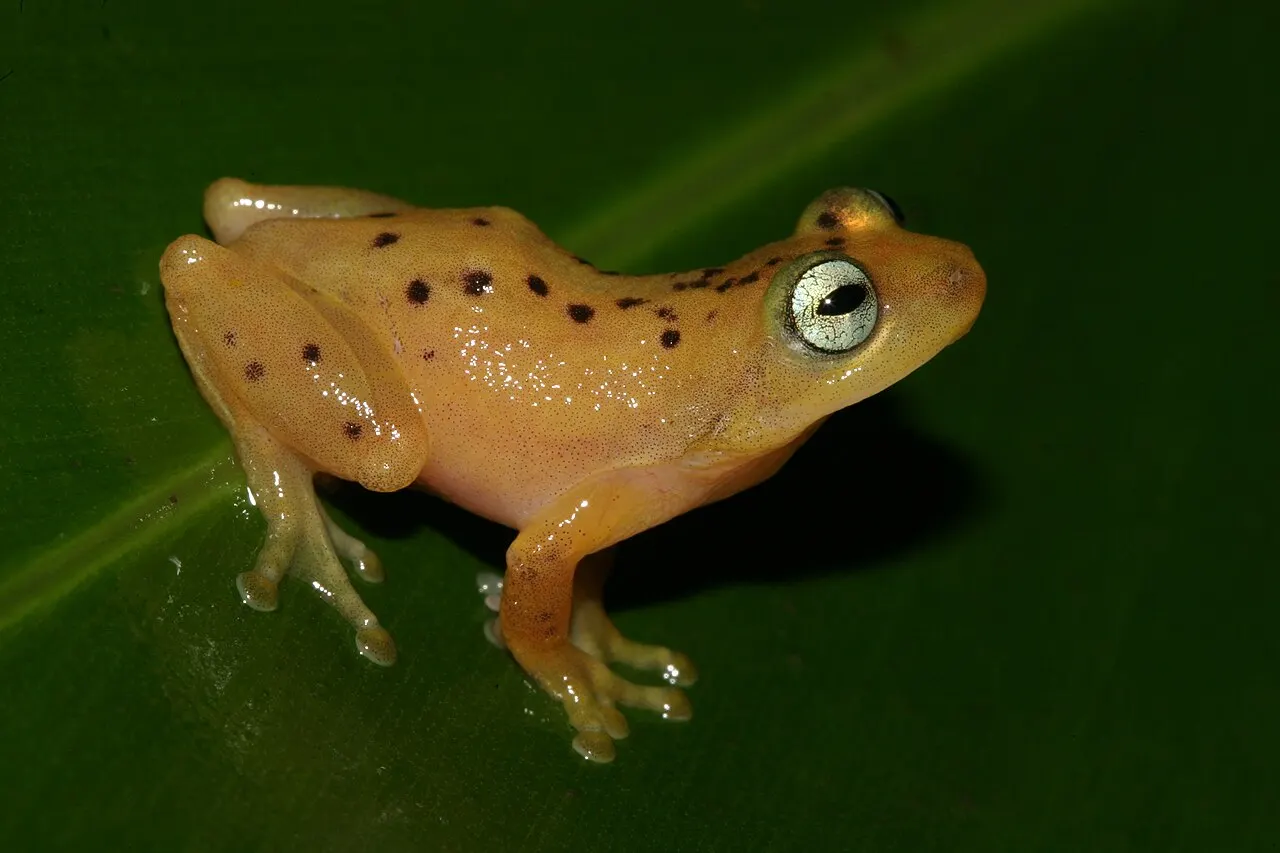
Adults are very small, about 17.6 to 18.1 mm from snout to vent. The back is bright yellow with brown-black spots, and the skin is not smooth. The flanks are a paler yellow and the belly is white.
The species name honours T. M. Manoharan, a senior forest officer in Kerala.
Where it lives
The frog is endemic to Kerala in southern India. It was described from Bonacaud, in the Western Ghats. The IUCN counts 3 to 5 locations, gives an elevation range of 900 to 1,300 m and an extent of occurrence of about 544 square km.
Its recorded habitats include moist lowland and montane forest, shrubby wetland and plantations. Observers have found it on reeds of the species Ochlandra travancorica, in both forest and plantation settings.
Pins are Wikidata “endemic to” fields. Orange dots, when present, are GBIF occurrence tiles — survey bias included.
How it lives
The frog seems tied to those reeds. Researchers believe it depends on them and will not tolerate much disturbance to its habitat. It breeds by direct development in bamboo plants, which means the eggs hatch as tiny froglets and there is no free-swimming tadpole stage.
Why it is in trouble
The Red List assessment records a decreasing population and a continuing decline in the area it occupies. Its listed threats are habitat shifting and alteration, plus the unintentional effects of subsistence or small-scale harvest, with ecosystem conversion, degradation and deaths recorded as the effects.
The assessment gives no population count. The species was only named in 2011 by Zachariah and colleagues in the journal Biosystematica, and little has been recorded about how many individuals survive.
What is being done
The IUCN lists site protection, habitat protection and site management as the conservation actions in place. It estimates that 51 to 60 percent of the population lives inside protected areas.
Sources
Written for this catalog in our own words from the sources below, checked against them on 12 November 2026. Population figures are estimates and carry the year they were made. Status and assessment year: IUCN. 2026. The IUCN Red List of Threatened Species. Version 2026-1. iucnredlist.org.