Endangered
Travancore bush frog
Raorchestes travancoricus
The Travancore bush frog (Raorchestes travancoricus, once placed in Philautus) is a small frog of the southern Western Ghats in India, found mostly on grasses in high marshy grassland. Once listed as Extinct, it is now rated Endangered (2023) because its range is small, broken up and shrinking.
How to recognise it
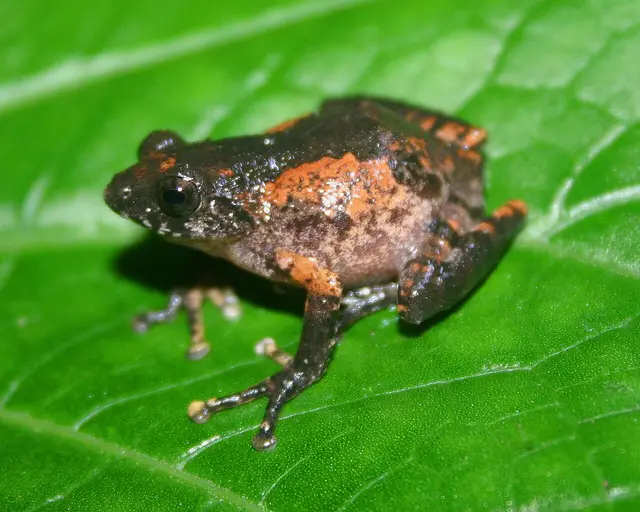
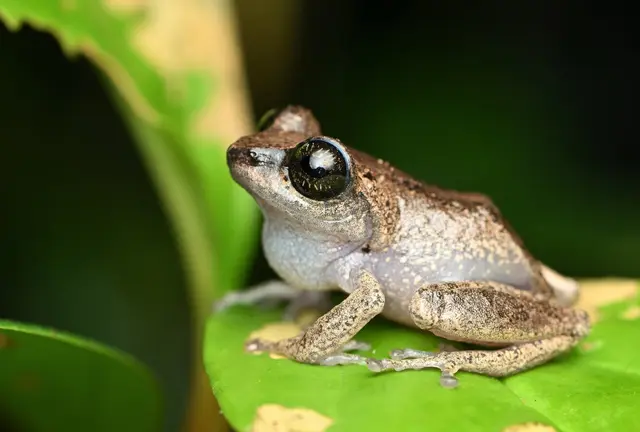
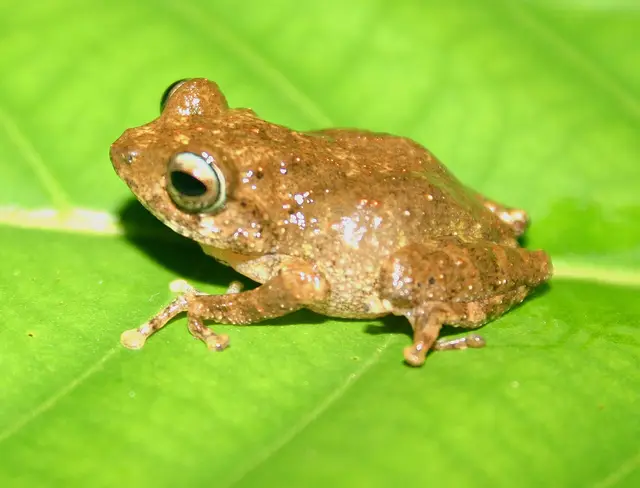
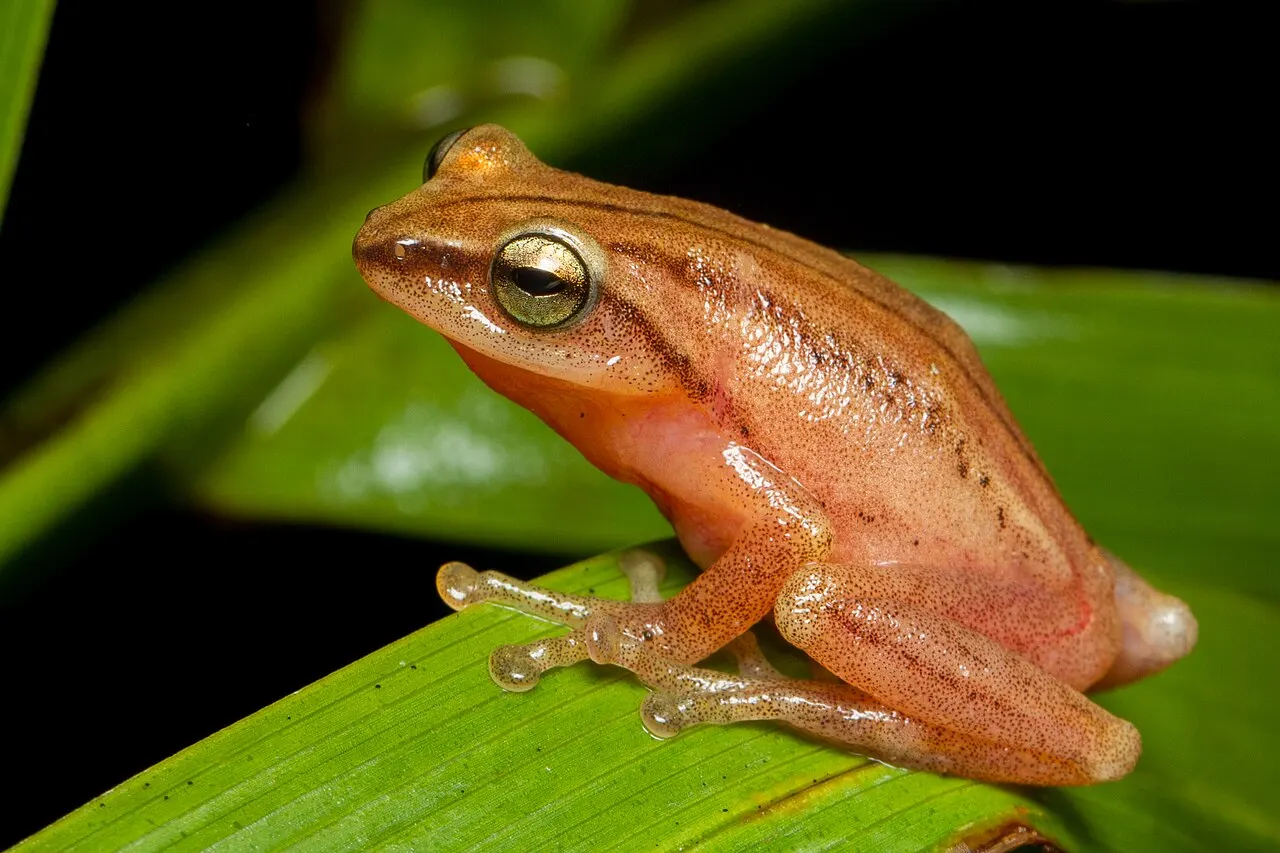
It is a small frog. A male collected at Uppupara measured 26.5 mm from snout to vent, while other accounts give 22 to 25 mm for males and 30 mm for the one female measured. The back ranges from yellowish pink to light greyish red or brown, with distinct brown lines, and a dark brown streak runs along each side of the snout. The eye is yellowish brown, and the skin of the snout and back is finely rough.
It can be confused with a close relative, Raorchestes luteolus. Males give a two-note call lasting about 2.2 seconds, pitched at roughly 2.7 kHz, as recorded from the Uppupara male in 2014.
Where it lives
It is found only in India, in the southern Western Ghats of Kerala and Tamil Nadu, between about 350 and 1,802 m. The Red List counts three locations within an extent of roughly 2,640 square kilometres and treats the population as severely fragmented.
The frog favours high-elevation grassland. A 2016 survey paper in the Journal of Threatened Taxa reported it from marshy grassland patches called vayals and from open grassland in Periyar Tiger Reserve, and found none in the evergreen forest around them. The Red List also records moist forest and shrubland as suitable habitat and plantations as marginal. Other accounts describe it perching on shrubs near tea plantations.
Pins are Wikidata “endemic to” fields. Orange dots, when present, are GBIF occurrence tiles — survey bias included.
How it lives
Calling males sit on grass clumps 1 to 2 m above the ground in the evening and at night. During a survey in August and September 2014 in one vayal at Uppupara, a count of twenty 10 by 10 m plots turned up 19 frogs, 12 of them calling males. A pair in amplexus was seen heading into a grass clump.
Much else is unknown. A herpetologist working in the Ghats told Mongabay in 2023 that the distribution, breeding niches and behaviour of the region's frogs are still poorly known.
A frog that went unrecorded for over a century
Boulenger described the species in 1891, as Ixalus travancoricus, from a single female collected at Bodinayakkanur, on the Tamil Nadu side of the Kerala border. It went unrecorded for more than a century, and the Red List carried it as Extinct in 2004.
A male found at Vandiperiyar in 2004, about 70 km from the type locality, and two males at Vagamon in 2006 showed it was still alive. Both sites lay outside protected areas. It was reassessed as Endangered in 2015.
Why it is in trouble
The Red List records a decreasing population and a continuing loss of habitat. The main ongoing threat is large-scale (agro-industry) farming, with tourism and recreation areas, recreational activities and more frequent fires also listed. Clearing for small farms and housing is noted as past damage. The amphibian chytrid fungus is reportedly a possible risk, with its impact unknown.
Around Munnar, a herpetologist told Mongabay, new homestays and resorts keep appearing, though the report does not single out this frog.
What is being done
The Red List says 51 to 60 percent of the population is inside protected areas, and records site and habitat protection and site management as actions. Researchers who found it at eight localities in Periyar Tiger Reserve called for a management strategy for its vayals. A herpetologist told Mongabay in 2023 that it occurs at more than 80 locations inside the reserve.
Sources
Written for this catalog in our own words from the sources below, checked against them on 12 November 2026. Population figures are estimates and carry the year they were made. Status and assessment year: IUCN. 2026. The IUCN Red List of Threatened Species. Version 2026-1. iucnredlist.org.