Endangered
Raorchestes flaviocularis
Raorchestes flaviocularis
Raorchestes flaviocularis is a small bush frog found only in the high hills of the southern Western Ghats in India. It was described in 2014 and is named for its gold-flecked eyes. The IUCN Red List rated it Endangered in 2022, with a decreasing population and an extent of occurrence of about 123 square kilometres.
How to recognise it
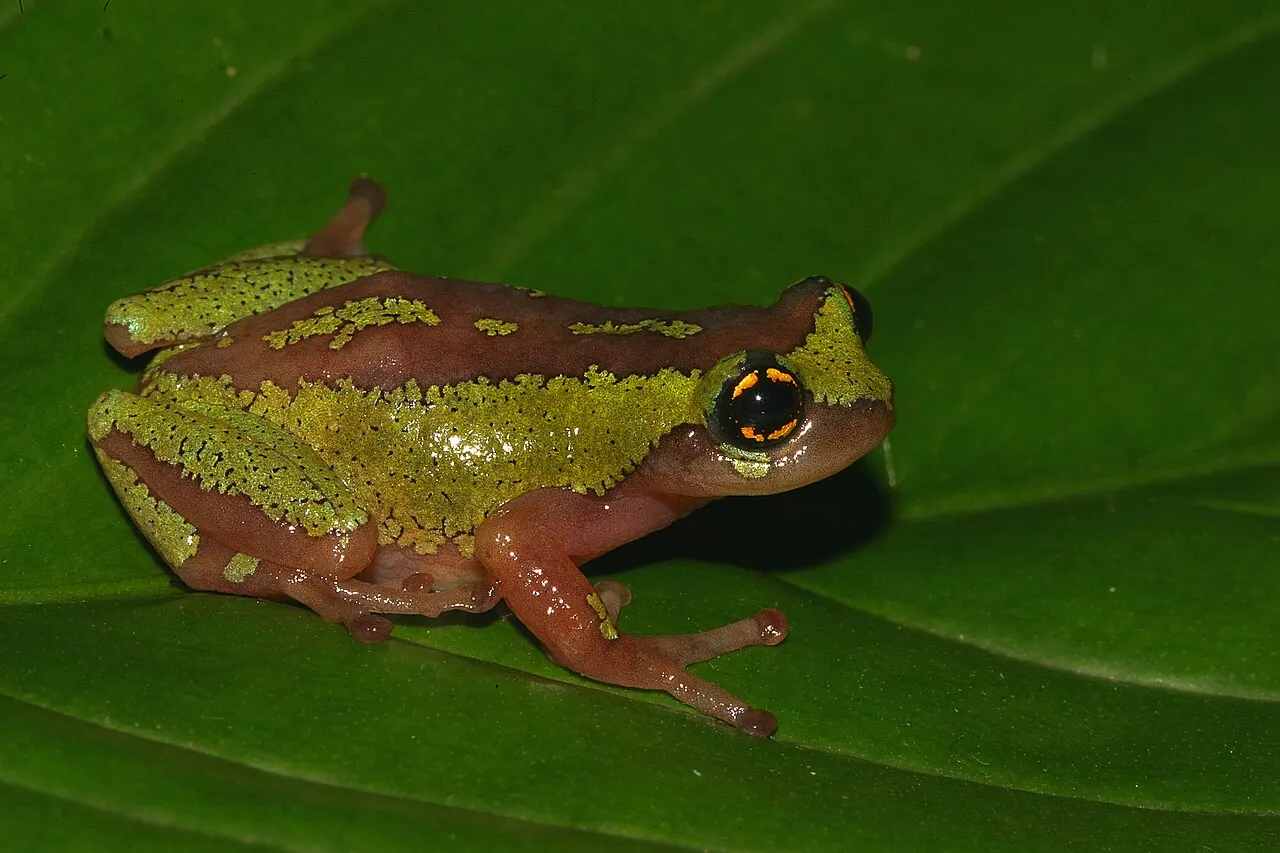
It's a small frog. The two specimens used in the original description measured 26.5 mm and 23.9 mm from snout to vent. The back is green with a lichen-like pattern, broken irregularly so that fleshy brown skin shows through. The green doesn't extend onto the hands and feet, which are flesh-coloured.
The eye is the giveaway. The iris is dark brown with irregular golden yellow patches, and the species name comes from the Latin for yellow and eye. Its closest known relative, Raorchestes chalazodes, has a uniformly green back that runs onto the hands and feet, and a much longer call.
Where it lives
The frog is endemic to India. The describers found it on the Upper Manalar Plateau of the Megamalai Massif, at 1,459 to 1,569 m above sea level. The Red List gives a similar band of 1,400 to 1,600 m, counts three to five locations, and lists Tamil Nadu and Kerala.
Habitat types recorded are high-altitude subtropical grassland and moist montane forest. Calls recorded in the neighbouring Anaimalai Massif suggest either a related species or an isolated population there, but that hasn't been resolved.
Pins are Wikidata “endemic to” fields. Orange dots, when present, are GBIF occurrence tiles — survey bias included.
How it lives
This is a frog of the sub-canopy, and it's hard to find. Its call is ventriloquial, seeming to come from somewhere other than where the animal sits, which makes it tricky to locate. It was also heard calling from patches of Ochlandra reed grass, though that link needs more checking.
The two type specimens came from leaves of short trees (under 5 m) in a badly disturbed forest fragment inside a tea garden mosaic. Other calls were recorded high in the canopy. The call is short, about 0.6 seconds, made of roughly five pulses. The Red List describes the species as not migratory.
Why it is in trouble
The Red List criterion B1ab(iii) describes a small range, split into few locations, with habitat quality still falling. The assessment, made in 2021 and published in 2022, records a decreasing population and a continuing decline in the area it occupies. No population size has been estimated.
Listed threats are small-holder farming and herbicides and pesticides, both scored low impact. The amphibian chytrid fungus, Batrachochytrium dendrobatidis, appears in the assessment too, but its effect on this frog is unknown; the fungus has been found in other frogs of the genus. Climate change is flagged as a future concern, since a species confined to high ground has little room to move.
What is being done
The frog occurs in two protected areas, Meghamalai Wildlife Sanctuary in Tamil Nadu and Periyar Tiger Reserve in Kerala, according to the Red List. Site and habitat protection are the actions recommended, along with research on population size, distribution and trends, and on the threats it faces.
Sources
Written for this catalog in our own words from the sources below, checked against them on 12 November 2026. Population figures are estimates and carry the year they were made. Status and assessment year: IUCN. 2026. The IUCN Red List of Threatened Species. Version 2026-1. iucnredlist.org.