Endangered
Fenestrated Cinderella Snail
Provanna fenestrata
The fenestrated Cinderella snail (Provanna fenestrata) is a tiny sea snail known only from two deep hydrothermal vent sites in the Okinawa Trough, off southern Japan. It was described in 2019 and rated Endangered on the IUCN Red List in 2020. Its shell has a lattice pattern like a window grid.
How to recognise it
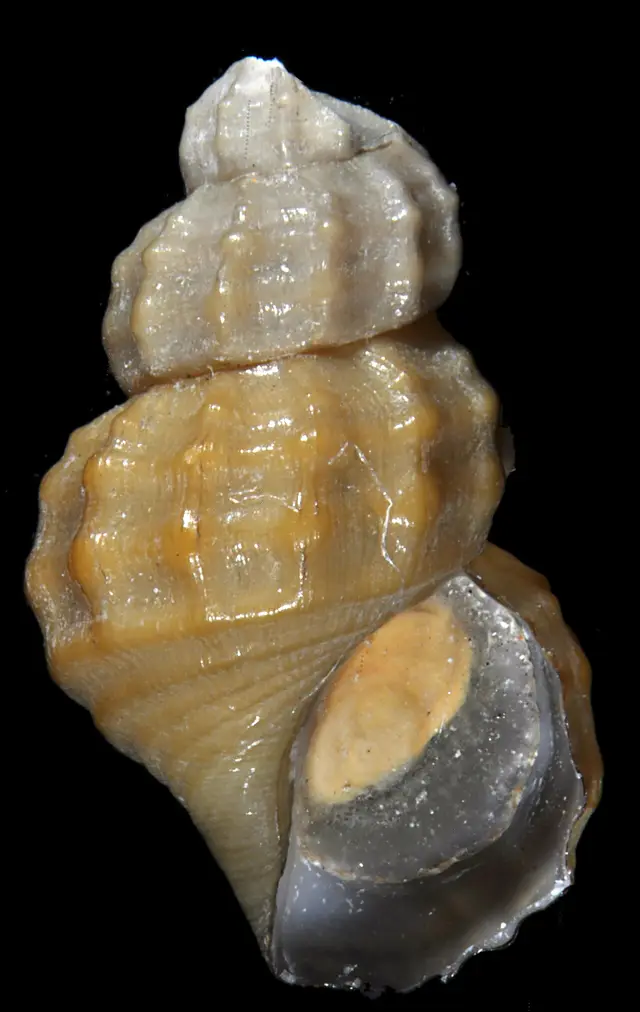
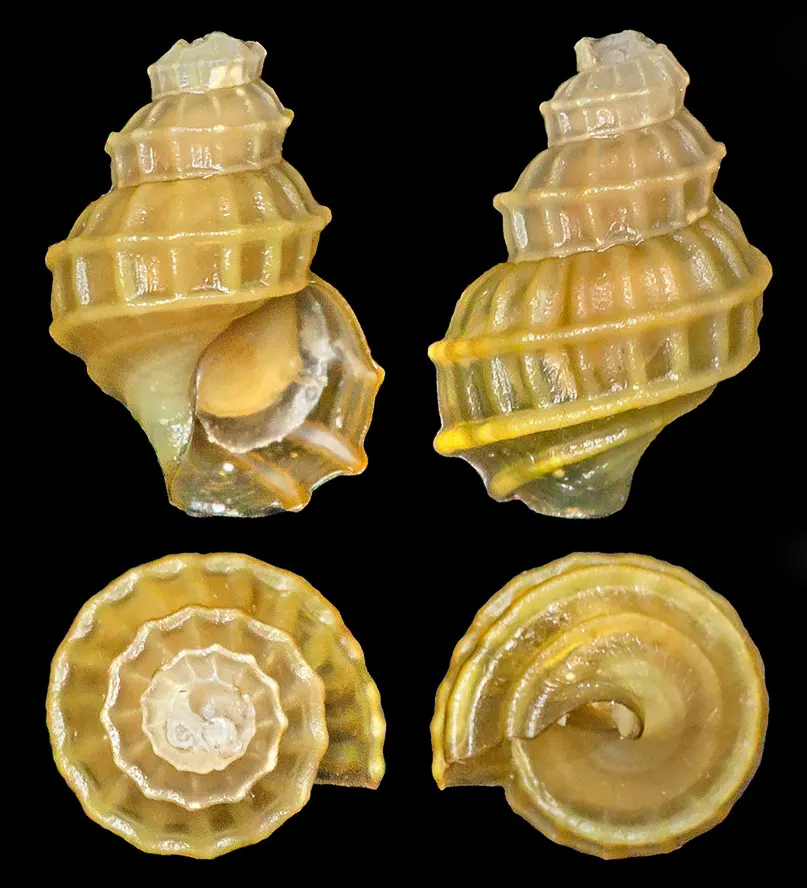
This is a medium-sized member of its genus, with a shell up to about 7.2 mm tall. The shell is thin and translucent, with a thick yellowish-green outer skin. The whorls are tall and swollen, and the sculpture is the giveaway: two or three spiral ribs cross 16 to 20 axial ribs of similar strength, forming a neat rectangular lattice.
The scientific name comes from the Latin for 'furnished with windows', after that grid. The shell's chalky inner layer is often partly or fully corroded on the last whorl, leaving only the outer skin.
Where it lives
Only two places are on record. One is the Crane site on Tarama Hill, at 1,973 m, where the type specimens were collected in October 2015. The other is the Sakai hydrothermal vent field, at 1,559 m, sampled the following month. Both lie in the middle of the Okinawa Trough. The IUCN assessment counts two locations, estimates the area it occupies at just 8 km2, and treats the species as native to Japan alone.
That depth range, 1,559 to 1,973 m, is deeper than any of the other Provanna species compared in earlier population studies from Japanese vents and seeps. DNA places its closest relative as Provanna subglabra, which has a smooth shell.
Pins are Wikidata “endemic to” fields. Orange dots, when present, are GBIF occurrence tiles — survey bias included.
How it lives
Very little has been published about its daily life. Most snails in the genus graze on bacteria growing at vents and seeps, but that has not been documented for this species. Its soft body fills only the first two whorls or so of the shell, with a large foot and a single gill.
Why it is in trouble
The Red List assessment bases the Endangered listing on a small, restricted range, with mining and quarrying as the one recorded threat. Its impact is rated unknown. A 2021 engineering report describes a pilot test run by Japan's state metals agency, JOGMEC, to excavate seafloor sulphide deposits and lift the ore, off Okinawa.
The population trend is listed as unknown, and no population estimate exists.
What is being done
The assessment records no recovery plan, no monitoring scheme and no protected area covering the species. Resource and habitat protection are listed as actions needed, along with international-level action. Research into its life history, population size and habitat trends is also called for.
Sources
Written for this catalog in our own words from the sources below, checked against them on 12 November 2026. Population figures are estimates and carry the year they were made. Status and assessment year: IUCN. 2026. The IUCN Red List of Threatened Species. Version 2026-1. iucnredlist.org.