Endangered
Wine robber frog
Wine robber frog
Wine robber frog, the wine robber frog, is a small cloud-forest frog found only on the western slopes of Colombia's Cordillera Oriental, in Santander. The IUCN Red List rated it Endangered in 2017. Its name refers to the Roman god of wine and loosely echoes its blood-red eyes.
How to recognise it
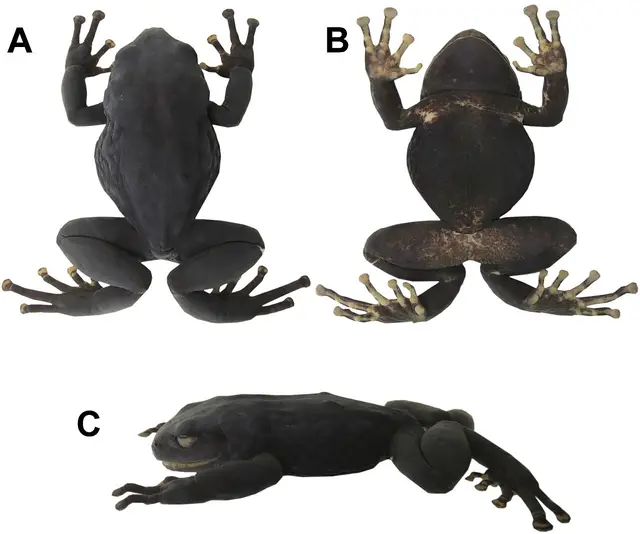
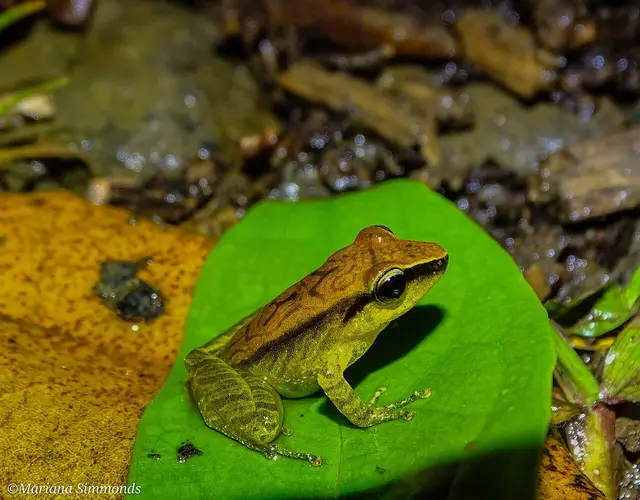
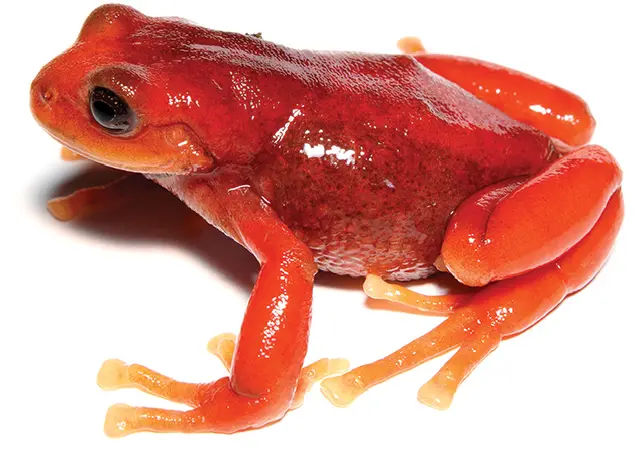
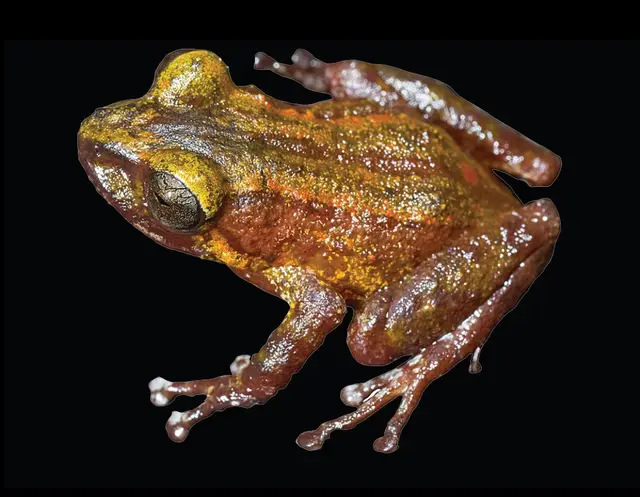
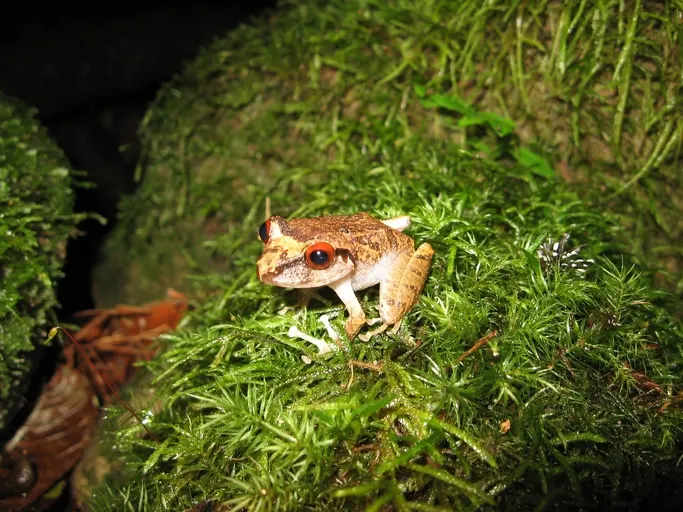
Lynch described the frog in 1984 as Eleutherodactylus bacchus. Adult males measure about 22 to 29 mm from snout to vent and females about 32 to 35 mm. The skin is smooth and the back is rust brown with dull yellow flecks and faint stripes down the sides. A black stripe runs from the snout over the eardrum, the belly is whitish with dark brown flecks, and the iris is a vivid red with black flecks. The toes are not webbed, and males have a vocal sac under the throat.
Where it lives
The species is endemic to the western slopes of the Cordillera Oriental in Santander Department. It lives in the undergrowth of tropical cloud forest between 1,450 and 2,300 m, and it also turns up at forest edges and among shrubs in pastures. The IUCN estimates an extent of occurrence of about 2,993 square kilometres, counts three locations, and notes that the species occurs in at least one protected area. It has reportedly been recorded in the Guanentá Alto Río Fonce fauna and flora sanctuary.
Pins are Wikidata “endemic to” fields. Orange dots, when present, are GBIF occurrence tiles — survey bias included.
How it lives
A study by Chinchilla-Lemus, Serrano-Cardozo and Ramírez-Pinilla in Amphibia-Reptilia (2020) followed a Santander population. Frogs in every reproductive condition were found through the sampling period, and numbers peaked at the start of the first rainy season, so breeding looks continuous with a seasonal high point.
Males used a wider range of perches, and higher ones, than females. They favoured calling sites about 41 to 120 cm up, in vegetation that holds humidity. Females stayed mostly on leaf litter and leaves low down, though egg-carrying females were mostly on perches above 120 cm. Juveniles were scarcer than adults and stayed in forest litter. Development is direct, so eggs hatch as small frogs with no tadpole stage.
Why it is in trouble
Habitat loss to farming and cattle ranching is reportedly the main threat. The IUCN records the area occupied as still declining, though it describes the population trend as stable and the frog can be locally common. The Endangered rating (criterion B1ab(iii)) rests on a restricted range, few locations and that continuing decline in habitat area.
The IUCN assessment lists no specific conservation actions for the species.
Sources
Written for this catalog in our own words from the sources below, checked against them on 12 November 2026. Population figures are estimates and carry the year they were made. Status and assessment year: IUCN. 2026. The IUCN Red List of Threatened Species. Version 2026-1. iucnredlist.org.