Endangered
Polyommatus golgus
Polyommatus golgus
The Sierra Nevada blue is a small butterfly of high mountains in southern Spain. It flies for a few weeks in midsummer over sparse scrub and rocky grassland in the Sierra Nevada and a few other ranges. The IUCN Red List lists it as Endangered (assessed 2025), with a small range and a declining population.
How to recognise it
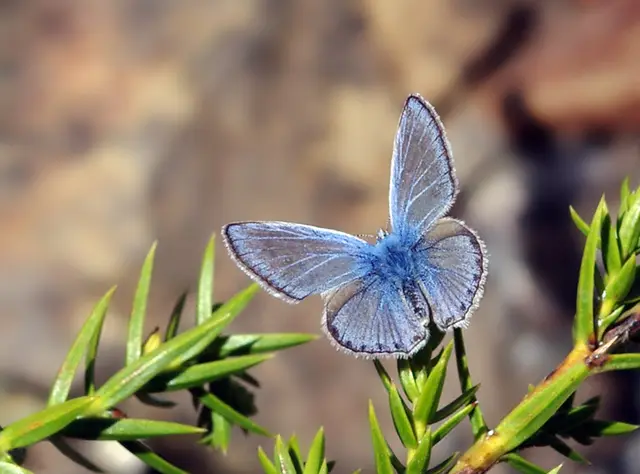
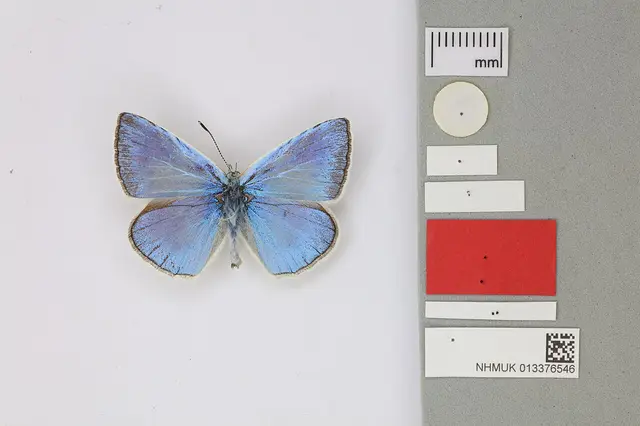
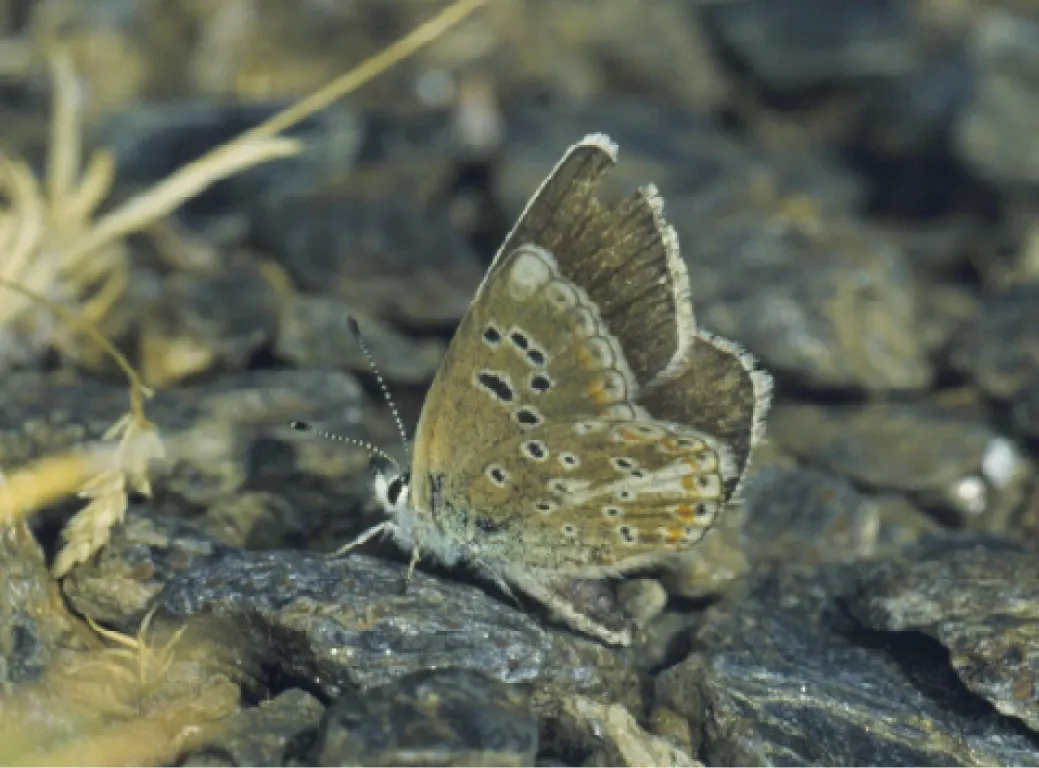
It's a small blue, with a forewing length of 11 to 16 mm. The sexes differ. Males are bright blue above, with a black edge to the wings. Females are dark brown above, with a few orange spots near the hindwing edge. Underneath, males are brownish grey with rows of dark-centred spots, and females are a lighter yellowish brown with small orange crescents along the margin.
In Spanish it's called niña de Sierra Nevada. Spanish and EU sources also use the genus name Plebicula, and the Bern Convention and Habitats Directive annexes list it as Plebicula golgus. A 2015 recovery plan places it in Polyommatus, subgenus Plebicula, following a 2010 molecular study.
Where it lives
The butterfly is found only in Spain. The nominate form lives in the Sierra Nevada of Granada and Almeria, mostly on north-facing slopes and summits. A second form, sagratrox, lives in the Sierra de la Sagra and Sierra Guillimona in northern Granada province, and in Sierra Seca and the Sierra de Cazorla. The 2015 plan counted the species in 14 squares of 10 by 10 km.
Whether the northern populations belong to the same species has been debated. A Spanish atlas of threatened invertebrates, compiled in the 2000s, kept the name for the Sierra Nevada only while waiting for firmer evidence. The 2015 plan treats them as a subspecies and notes that some authors would give them species rank. The Red List puts the extent of occurrence at about 4,324 square kilometres and the area actually occupied at about 124.
In the Sierra Nevada it favours thin, low shrubland among dwarf juniper and broom and, higher up, grassland between schist rubble. The habitat lies under snow for at least half the year. The plan's samples there were at 2,150 to 2,750 m, with older records up to 3,100 m. Northern populations live in clearings in black pine woodland and among cushion shrubs on limestone and dolomite, at roughly 1,800 to 2,400 m. The Red List gives an overall range of 1,400 to 3,000 m.
Pins are Wikidata “endemic to” fields. Orange dots, when present, are GBIF occurrence tiles — survey bias included.
How it lives
There's one generation a year. Adults fly in July, with a few in June. Perching males wait for females and defend small territories, while others patrol suitable habitat. Females lay eggs one at a time on the upper side of curled leaves of a perennial kidney vetch, Anthyllis vulneraria (in the Sierra Nevada, the high-mountain subspecies pseudoarundana). The caterpillars hatch in late July, feed on leaf tissue, and spend the winter as third-stage larvae.
In spring the older caterpillars are tended by ants, Tapinoma nigerrimum and also Lasius niger, whose nests are often beside the food plants. Caterpillars carry a working nectary organ on the back from the third stage. They pupate on the ground in June. Adults visit flowers such as thyme, sandwort, sheep's-bit and white stonecrop, and nectar doesn't seem to limit them.
Why it is in trouble
Its range is small and fragmented. At Veleta in the Sierra Nevada, a ski resort enlargement in 1995 diverted the Monachil river, added snow cannons and levelled ground where the butterfly lived, destroying habitat for part of that population. A road also crosses the area. Trampling by visitors, grazing and drought that damages the food plant affect some sites. The Red List names tourism and recreation, roads and utility lines as ongoing threats, and expects shifting habitat conditions in future.
The 2015 plan calls climate change the main problem the species already faces. If warming continues, suitable habitat may shift uphill into places that don't suit it, and populations on the highest peaks could die out.
Numbers are hard to pin down. Transect counts in 2012 to 2014 averaged about 20 adults per kilometre. The plan judged that populations range from hundreds of butterflies at the smallest sites to tens of thousands at the largest, Río San Juan. Counts at one Sierra Nevada site since 2008 swing widely from year to year.
What is being done
The butterfly is covered by the EU Habitats Directive (annexes II and IV) and Annex II of the Bern Convention, and is listed as endangered on Spain's national catalogue (since 2000) and Andalusia's. The 2015 plan says all its populations lie inside protected areas, including the Sierra Nevada National Park and other Natura 2000 sites.
That plan, produced by Butterfly Conservation Europe with Spanish university, park and regional government partners, proposes restoring footpaths to stop trampling, preventing new development and restoring damaged habitat at Veleta, trial grazing exclosures, research on genetics and trends, and information panels for visitors. The Red List records the recovery plan and conservation sites across the whole range.
Sources
Written for this catalog in our own words from the sources below, checked against them on 12 November 2026. Population figures are estimates and carry the year they were made. Status and assessment year: IUCN. 2026. The IUCN Red List of Threatened Species. Version 2026-1. iucnredlist.org.