Endangered
Whitelip Cichlid
Placidochromis phenochilus
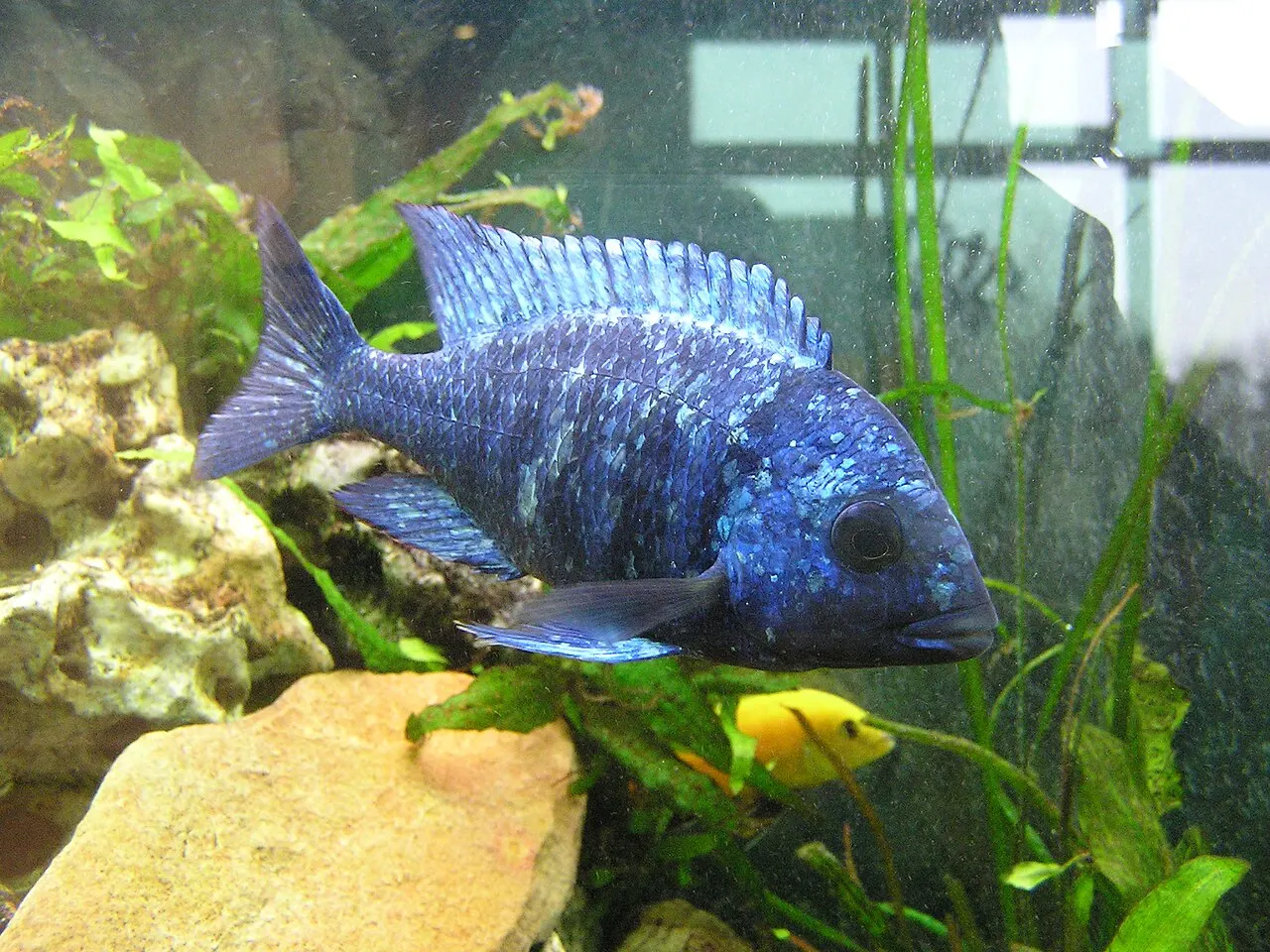
Placidochromis phenochilus is a Lake Malawi cichlid, endemic to the northern part of the lake. Males are larger than females and dark blue with black-blue barring. FishBase gives a maximum length of 15.7 cm. The IUCN Red List classed it as Endangered in 2018 because of small-scale harvest and a falling population.
How to recognise it
Adults are dark blue with black-blue barring, and males and females look alike. Males are larger, with a steeper forehead. Colour shifts from light to deep blue with mood, and a dominant male is often very dark. One male variant from Mdoka is known to hobbyists as the white lip form.
FishBase gives a maximum length of 15.7 cm. Aquarium writers give larger sizes, around 18 to 21 cm for males and 14 to 17 cm for females.
Where it lives
It lives only in Lake Malawi, in the northern part of the lake. Trewavas described it in 1935, and FishBase says it is known from a holotype collected at Vua. Hobbyist records list populations at Mdoka, Chesese and Chirwa Island, while a form from Lupingu and Makonde in Tanzania is sold as a separate type.
The Red List places it in permanent freshwater lake habitat and records a single location in Malawi.
Pins are Wikidata “endemic to” fields. Orange dots, when present, are GBIF occurrence tiles — survey bias included.
How it lives
It is a sand-dweller, reported from zones where large rocks meet open sand. Fish follow larger sand-sifting species and pick up small invertebrates, insects and worms stirred up in the sand cloud. Females are maternal mouthbrooders and carry the eggs in the mouth.
Juveniles are described as peaceful and travel as a group. Breeding males hold territories, usually on large flat rocks, and defend them hard.
Why it is in trouble
The 2018 assessment (criteria A2a; B2ab(v)) lists a decreasing population and a continuing decline. Generation length is 2 to 3 years. The one listed threat is small-scale harvest, and the Red List records use as both food and as a pet or display fish. In 2006 the species had been rated Least Concern, so its status has worsened since.
No conservation actions are recorded in the assessment.
In aquariums
The species is kept by cichlid hobbyists, who treat it as a large, territorial fish that needs a big tank with sand to sift. One hobbyist guide advises a tank at least 200 cm long, a group of about three males to five females, and sturdy tankmates.
Sources
Written for this catalog in our own words from the sources below, checked against them on 12 November 2026. Population figures are estimates and carry the year they were made. Status and assessment year: IUCN. 2026. The IUCN Red List of Threatened Species. Version 2026-1. iucnredlist.org.




