Endangered
South Philippine hawk-eagle
Nisaetus pinskeri
Pinsker's hawk-eagle (Nisaetus pinskeri), also called the south Philippine or Mindanao hawk-eagle, is a crested forest raptor found only in the Philippines. The IUCN Red List assessed it as Endangered in 2024, estimating 1,300 to 3,600 mature birds, with farming, logging and hunting still cutting into its forest home.
How to recognise it
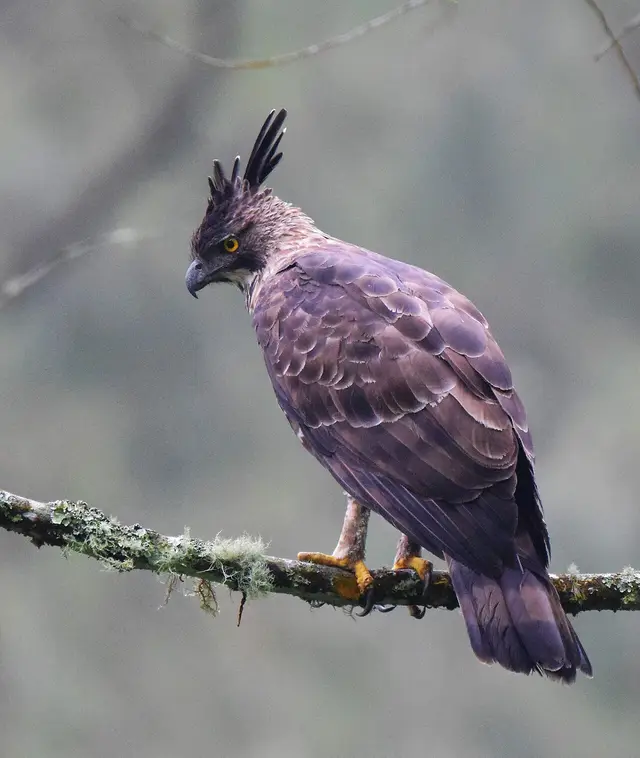
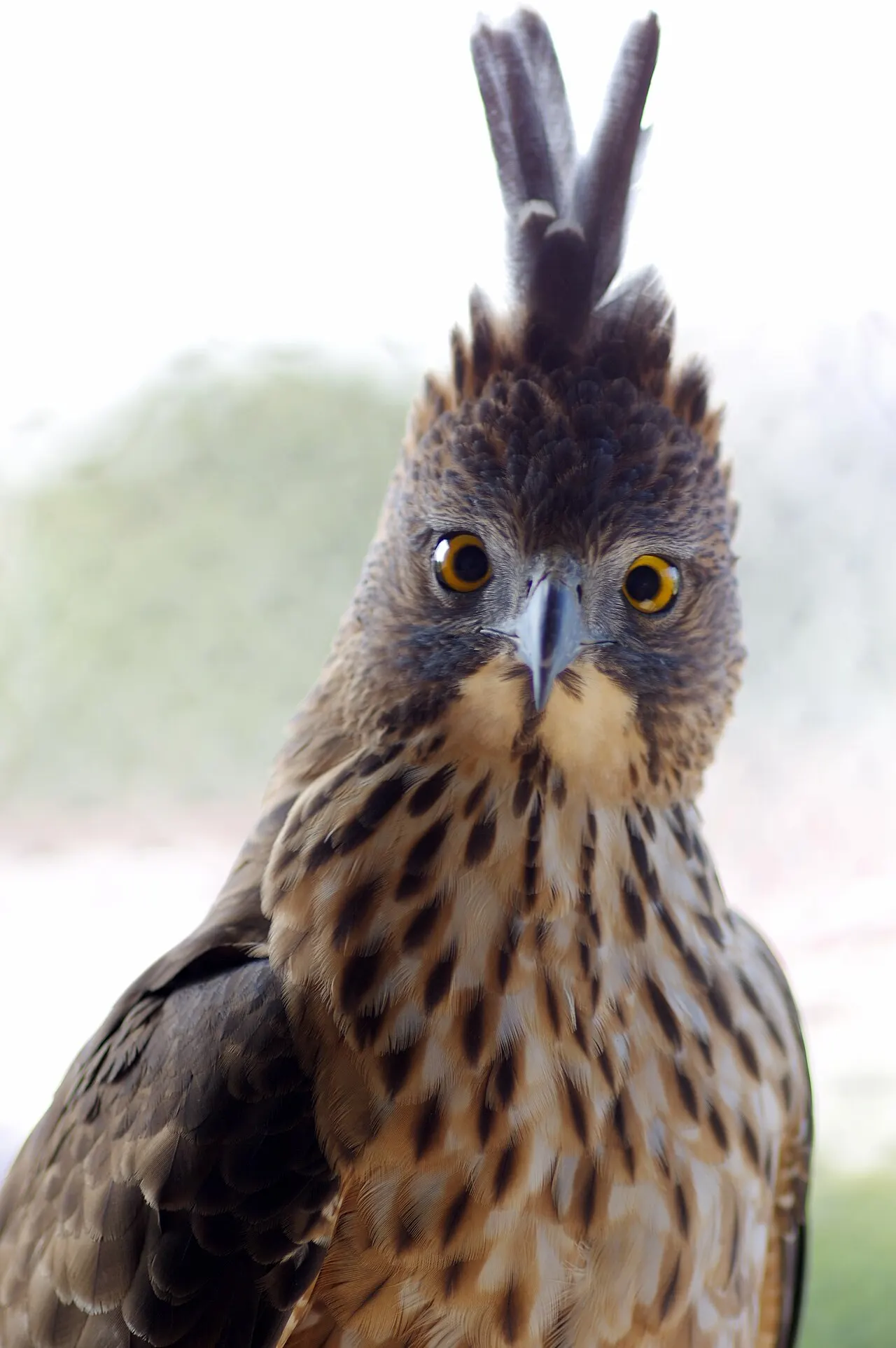
It is a crested eagle of the forest. Its closest relative is the Philippine hawk-eagle, which it was once considered a form of. It differs by having a longer crest, a smaller body, greyer plumage, and a heavily barred belly and legs.
Some taxonomists have still treated it as a subspecies of that bird. A captive-bred chick at the Philippine Eagle Foundation weighed 57 grams at hatching, and its sex was expected to show only after four to five years, when it matures.
Where it lives
The species is endemic to the Philippines. It has been recorded on Mindanao, Basilan, Negros, Bohol, Leyte and Samar. It lives in tropical moist forest, both in the lowlands and in the mountains, up to about 1,900 m. Birds are mostly seen at forest edges or soaring over the canopy.
The IUCN gives an extent of occurrence of about 287,000 square kilometres, but that figure covers the whole range on paper, not the forest left standing, and the assessment treats the population as severely fragmented.
Pins are Wikidata “endemic to” fields. Orange dots, when present, are GBIF occurrence tiles — survey bias included.
How it lives
Very little has been written about its life in the wild. Its diet is thought to be mainly birds. What is known about breeding comes mostly from captive pairs, which reportedly lay a single egg a year and incubate for about 47 days. In captivity the male is said to build the nest and bring food, and the chick starts to fledge at about five months.
Generation length is estimated at roughly 8.7 years, so a population that loses adults takes a long time to rebuild.
Why it is in trouble
Forest loss is the central problem. The IUCN lists agricultural plantations and farming as ongoing threats, along with the unintended effects of harvesting and direct targeting of the species. It records a continuing decline, estimates a reduction of 15 to 30 percent, and projects a further 10 to 15 percent.
Hunting and trapping add to the pressure. In August 2025 a hawk-eagle with a gunshot wound to the right leg was rescued at Baybay City on Leyte and treated at a university veterinary hospital, and was still recovering on 24 August. Several protected areas hold the bird, including Mount Apo, Mount Kitanglad and Samar Island Natural Park, but protection from deforestation is reportedly lax.
What is being done
The IUCN records that the bird occurs in at least one protected area, that conservation sites cover its entire range, and that it is subject to international trade controls. It also records no recovery plan and no systematic monitoring scheme. Its listed needs include better enforcement of hunting and trade laws, research on hunting and trade through interviews and market visits, further surveys on Samar, and continued remote sensing of habitat loss.
The Philippine Eagle Foundation hatched the first captive Pinsker's hawk-eagle chick at its centre in Malagos, Davao, on April 2, 2012, after about 48 days of incubation. The parents were rehabilitated wild birds that had been injured. The foundation's director said at the time that nothing was known about the bird's breeding biology.
Sources
Written for this catalog in our own words from the sources below, checked against them on 12 November 2026. Population figures are estimates and carry the year they were made. Status and assessment year: IUCN. 2026. The IUCN Red List of Threatened Species. Version 2026-1. iucnredlist.org.
- IUCN Red List assessment (2024)
- Pinsker's hawk-eagle (encyclopedia article)
- GBIF species record 6066198
- Philstar, first Pinsker's hawk-eagle hatched at Davao centre (15 April 2012)
- Scientific American, Extinction Countdown (April 2012)
- Visayas State University veterinary college, saving the south Philippine hawk-eagle