Critically Endangered
Pimelodus grosskopfii
Pimelodus grosskopfii
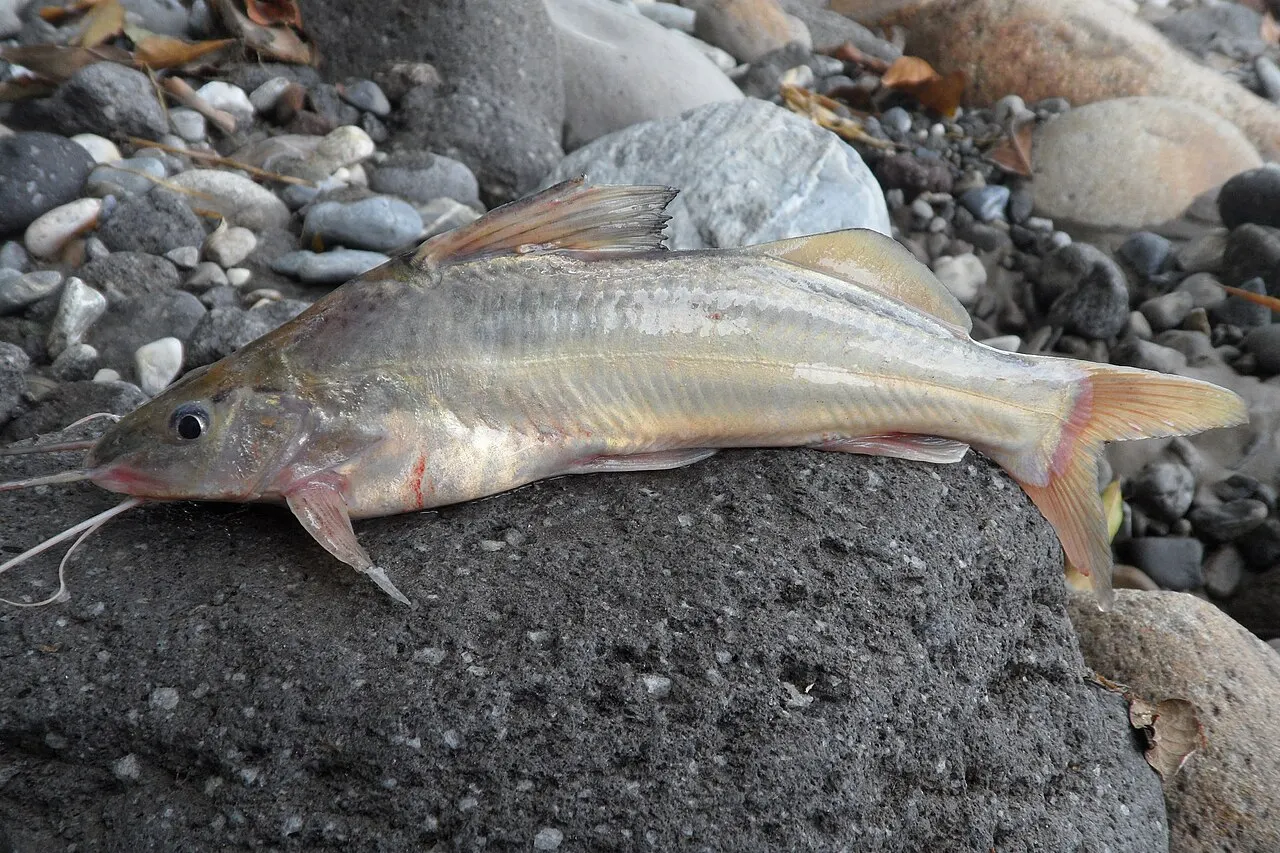
The capaz (Pimelodus grosskopfii) is a medium-sized catfish found only in Colombia's Magdalena and Cauca river basin, where it is a regular catch for local fishers. The IUCN Red List rated it Critically Endangered in 2016, after catches and populations fell steeply.
How to recognise it
The capaz is a catfish of the family Pimelodidae, also known in Spanish as barbudo. In a 2023 study in Neotropical Ichthyology, the sampled fish measured about 12 to 31 cm in standard length.
It looks a lot like its relative Pimelodus yuma, which shares the lower Magdalena and Cauca. The capaz has a longer adipose fin and a more streamlined body, while P. yuma is slightly taller and sturdier. Large capaz carry separate, well-defined black spots, but small fish can resemble P. yuma, so pattern alone is a weak guide. Researchers have used body measurements and DNA to tell the two apart.
Where it lives
The species is endemic to Colombia and lives in the Magdalena and Cauca rivers, in both river channels and large lakes. A 2026 genetic study gave its range as roughly 26 to 1,036 m above sea level, wider than that of Pimelodus yuma (about 26 to 587 m). The two overlap in the lower basin.
Some accounts also list the Lake Maracaibo basin, across the border in Venezuela. The IUCN assessment records the capaz in Colombia only.
Pins are Wikidata “endemic to” fields. Orange dots, when present, are GBIF occurrence tiles — survey bias included.
How it lives
The capaz is a migratory fish. Within the Magdalena-Cauca basin it travels upstream over roughly 100 to 500 km, with runs lasting about 30 to 45 days. Spawning follows the two annual flood pulses, April to June and October to December. After spawning, adults either stay in the river or drop back toward floodplain lakes that serve as feeding and nursery areas.
A 2026 study in PLOS One analysed DNA from 58 capaz (64 were collected between 2014 and 2021) and found two genetic stocks living side by side, kept apart by restricted gene flow that tracks adaptation rather than location. One stock is far older, dating to roughly 4.5 to 5.5 million years ago, against 1.7 to 2.5 million years for the other. Gene flow ran mainly from the younger stock into the older one. The study argued each stock should be managed as its own unit. For the older stock, effective population size was put at about 379 breeding fish, though the confidence range ran from 134 to infinity.
Why it is in trouble
The Red List assessment, made in 2014 and published in 2016, estimated a population reduction of about 90 percent, with levels of exploitation as the stated basis (a generation is put at about five years). The trend is decreasing. The fish is taken for food, and the Magdalena fishery as a whole has shrunk. Basin-wide yields of several flagship species fell by about 56 percent between 1975 and 2015, and fishing pressure has since shifted toward the capaz and Pimelodus yuma.
Dams, large and small, are listed as threats, along with erosion and sedimentation. The Magdalena has one of the highest erosion rates recorded for a major river, and pollution from the oil industry, including heavy metals such as mercury, adds to the pressure. Two 2021 studies found raised inbreeding in capaz from the Cauca sub-basin.
What is being done
The assessment records a harvest management plan as in place, but it found no identified conservation sites and could not say whether the species lives in a protected area. It called for more research on population size, distribution, trends and threats.
Colombian researchers have also tested captive breeding. A 2010 preliminary report in Orinoquia induced spawning in captive capaz with carp pituitary extract, with an average of about 14,800 eggs per female and hatching around 80 percent. The work was pitched as a way to broaden Colombian fish farming, not as a rescue programme.
Sources
Written for this catalog in our own words from the sources below, checked against them on 12 November 2026. Population figures are estimates and carry the year they were made. Status and assessment year: IUCN. 2026. The IUCN Red List of Threatened Species. Version 2026-1. iucnredlist.org.
- IUCN Red List assessment, Pimelodus grosskopfii (2016)
- Joya et al. 2023, Neotropical Ichthyology: Morphometric and molecular differentiation of P. grosskopfii and P. yuma
- Arcila et al. 2026, PLOS One: Genomic insights into Pimelodus yuma and P. grosskopfii (Europe PMC full text)
- Wikipedia, Pimelodus grosskopfii
- Valbuena-Villarreal et al. 2010, Orinoquia 14(2): Induced breeding of capaz with carp pituitary extract




