Critically Endangered
Phrynopus juninensis
Phrynopus juninensis
The Junin Andes frog (Phrynopus juninensis) is a brown, ground-dwelling frog of high Andean cloud forest in Junin, Peru. The IUCN Red List rated it Critically Endangered in 2018 because it is known from just one location, where its forest is being converted to farmland.
How to recognise it
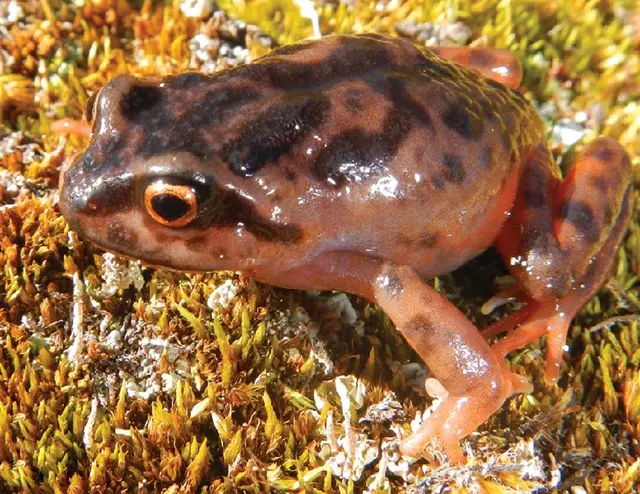
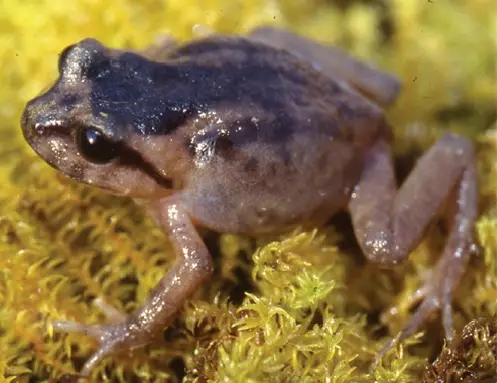
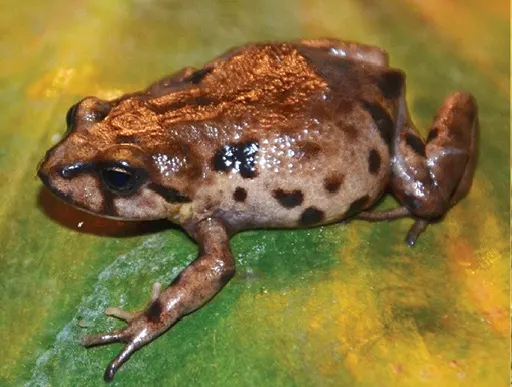
Males measure 22 to 31 mm from snout to vent and females 33 to 41 mm. The back is dark brown with tan spots, the underside is flecked with silvery white, and the lips are pale grey-tan with dark brown bars. The iris is bronze, and there is no visible eardrum. The toes have no webbing.
Where it lives
The type locality is Cascas, near Huasihuasi, in the Department of Junin, Peru. The IUCN treats this as the only known location, estimates the range at about 10 square km, and gives an elevation of about 3,525 m. Records from the neighbouring Department of Pasco probably belong to a different species.
Its habitat is primary montane cloud forest and forest edges.
Pins are Wikidata “endemic to” fields. Orange dots, when present, are GBIF occurrence tiles — survey bias included.
How it lives
It is a terrestrial frog. It reportedly develops directly, so there is no free-swimming tadpole stage and eggs hatch as small froglets. Little else is documented about its diet, breeding or numbers, and the IUCN gives no population estimate.
Discovery and naming
Shreve described it in 1938 as Syrrhopus juninensis. The type specimen was collected at Cascas on 31 August 1936 by Warren F. Walker Jr. and is held at Harvard's Museum of Comparative Zoology. The species has since been placed in the genera Eupsophus and Telmatobius, and Cannatella examined its systematic status in 1985. It now sits in Phrynopus.
Why it is in trouble
The IUCN names small-holder farming and grazing as ongoing threats and records a continuing decline in forest area at its single site. Unintentional disturbance is listed as a minor threat, and harvesting of Sphagnum moss may also be a concern. The population is judged to be decreasing.
The frog is not known to occur in any protected area. The IUCN lists protecting the habitat and the site as the conservation actions needed.
Sources
Written for this catalog in our own words from the sources below, checked against them on 12 November 2026. Population figures are estimates and carry the year they were made. Status and assessment year: IUCN. 2026. The IUCN Red List of Threatened Species. Version 2026-1. iucnredlist.org.