Endangered
Inti Andes frog
Phrynopus inti
The Inti Andes frog (Phrynopus inti) is a small, rough-skinned frog from the high Andes of central Peru, known from only a handful of cold mountain sites at 3,350 to 3,890 m. The IUCN listed it as Endangered in 2018. Its golden-orange eyes inspired a name honouring the Inca sun god.
How to recognise it
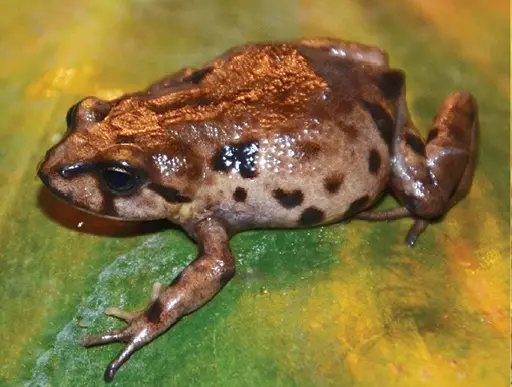
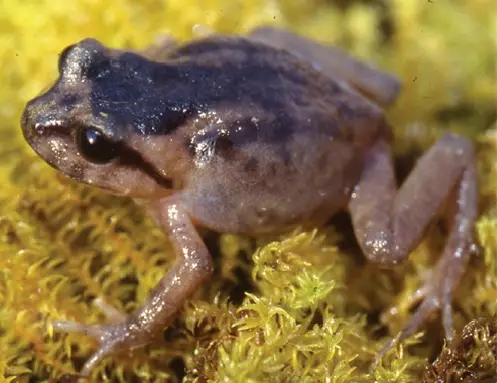
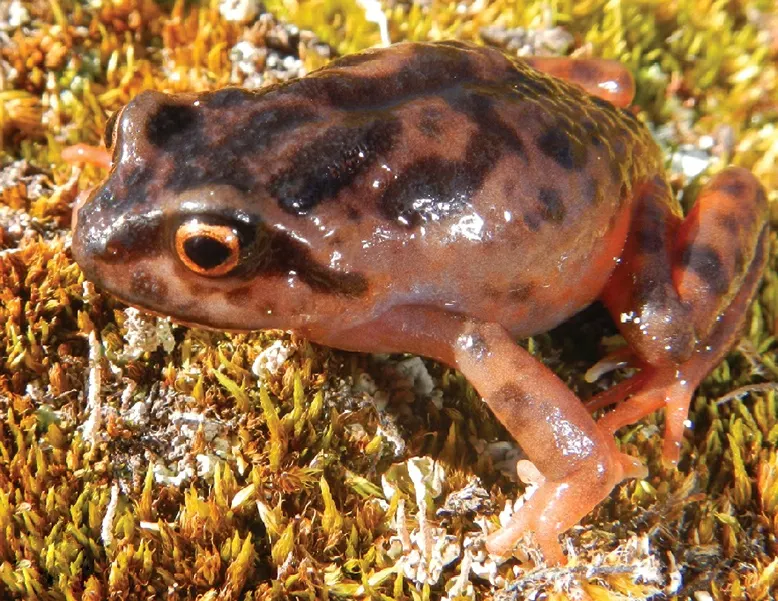
This is a modest frog. The six adult males measured in the original description ranged from 27 to 35 mm from snout to vent, and the single adult female was larger at 40 mm. The back and flanks are roughened with low bumps, while the belly is smooth. There is no visible eardrum, and males have no vocal slits.
Colour varies. The holotype, a male, was pale grayish brown with dark brown blotches and salmon mottling underneath. Another male was a plain grayish brown, and a third was blackish brown with small yellow flecks. The iris is golden orange with fine dark lines, the feature that inspired the species name: Inti was the Inca sun god.
Where it lives
The frog was described in 2017 in the journal ZooKeys by Edgar Lehr, Rudolf von May, Jiri Moravec and Juan Carlos Cusi, from specimens gathered during fieldwork in 2012 and 2013. It lives in Peru, on the eastern Andean slope in and around the Pui Pui Protected Forest, a reserve of 60,000 hectares that is about 70% high grassland and 30% montane forest.
Six localities were known at the time of description, four outside the reserve (in its buffer zone) and two inside it. The type locality, at 3,609 m in the Quebrada Tasta valley, is a patch of Polylepis woodland with small bushes, ferns, moss and tussock grass. The Red List counts two locations for the species and gives an extent of occurrence of about 231 square kilometers, while the description paper estimated about 101 square kilometers. The range is small by either measure.
Pins are Wikidata “endemic to” fields. Orange dots, when present, are GBIF occurrence tiles — survey bias included.
How it lives
Little has been recorded. The original frogs were found under rocks and in moss, and the Red List names montane forest and high-altitude grassland as its habitats. The call, eggs and breeding have not been described. Its relatives in the family Craugastoridae develop directly from eggs laid on land, so a free-swimming tadpole stage is not expected.
It shares its habitat with other frogs, including the marsupial frog Gastrotheca griswoldi and several Pristimantis species. One male carried five tiny parasitic mites near the top of the arm.
Why it is in trouble
The Red List assessment lists small-holder farming and grazing as the main pressures, with forest and grassland being converted or degraded and the frog's habitat still shrinking. The describing scientists point to fires lit to extend pasture, plus fungal disease, pollution and climate change, as threats that persist even inside the reserve. Farming and cattle raising were more intense in the Toldopampa valley than in the Tasta valley.
The scientists who described it suggested Near Threatened rather than Vulnerable, on the grounds that the reserve might hold more sites than were known. The IUCN assessment instead placed it in Endangered, under criterion B1ab(iii), which covers a small range, few locations and a declining habitat.
What is being done
The species occurs in at least one protected area, and site management is the one conservation action listed for it. The describing scientists stressed that protecting the Pui Pui reserve and its wildlife matters, because habitat loss and land-use change continue in neighbouring areas, including the buffer zone. No breeding program or population count has been reported.
Sources
Written for this catalog in our own words from the sources below, checked against them on 12 November 2026. Population figures are estimates and carry the year they were made. Status and assessment year: IUCN. 2026. The IUCN Red List of Threatened Species. Version 2026-1. iucnredlist.org.