Endangered
Oreophryne cameroni
Oreophryne cameroni
Oreophryne cameroni is a tiny narrow-mouthed frog from the northern mountains of Papua New Guinea, described only in 2013. Adult males are about 2 cm long. The 2020 Red List assessment lists it as Endangered, because it is known from very few places and its forest habitat is shrinking.
How to recognise it
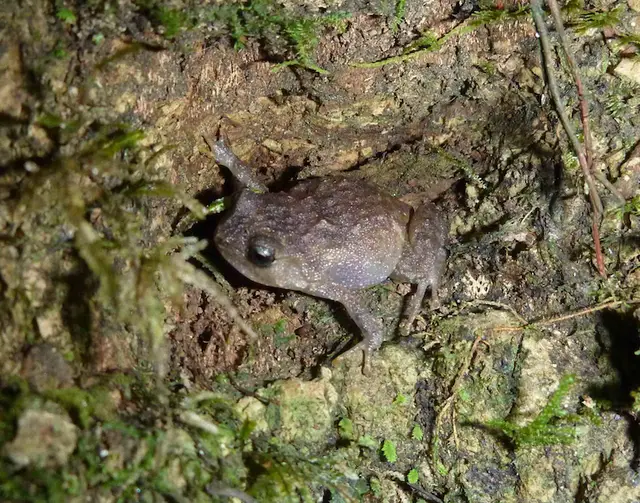
This is a very small frog. The three adult males measured when it was described were 19.5 to 20.4 mm from snout to vent, and the holotype weighed 0.7 g. No adult female has been described. It has a relatively broad head, a skin with scattered small pustules, discs on the fingers and toes, and a fifth toe longer than the third.
Colour in life is mottled dark brown over a burnt-orange base, with white flecks on the sides and a pale yellow belly stippled with brown. The iris is brown with a greenish upper half. Preserved specimens fade to dark tan above and pale straw below.
Its call helps separate it from relatives. It is a run of short peeps repeated roughly 2.6 to 2.9 times a second, pitched near 2,900 Hz, and recorded from a single male. Similar frogs in the genus differ in size, colour or in giving a rattling call.
Where it lives
It is known from two mountain ranges on the north coast of Papua New Guinea: the Adelbert Mountains in Madang Province, where the holotype came from at 850 m, and the Torricelli Mountains in West Sepik Province, at 550 to 700 m. A further specimen was collected on Mt. Nibo near Lumi, in a range of 700 to 1,550 m. The Red List gives an elevation band of 550 to 850 m, an extent of occurrence of about 1,318 square kilometres and 2 to 5 locations.
The describer expected it also to turn up in the Prince Alexander Mountains between those two ranges, and possibly further west. GBIF holds only four records for the species, two museum specimens and two DNA sequence records.
Pins are Wikidata “endemic to” fields. Orange dots, when present, are GBIF occurrence tiles — survey bias included.
How it lives
Almost nothing has been recorded beyond where it was found. Calling frogs were heard in hidden spots 2.5 to 3.5 m up at a clearing edge in remnant primary rainforest on a ridgetop, the lowest calling animals the describer heard. A subadult came from lowland primary forest on a steep slope with a canopy 30 to 35 m tall. Its breeding habits have not been described.
Lowland moist forest is the only habitat the Red List records for the species.
Why it is in trouble
The Red List cites small-holder farming as an ongoing threat, together with unintentional effects of small-scale harvest, and records a continuing decline in the area the species occupies. It is not known from any protected area. The assessment is Endangered under criterion B1ab(iii), which reflects a small range, few locations and declining habitat quality.
Describer Fred Kraus has said large portions of the region remain unsurveyed, so the true range may be larger than currently known. No population size has been estimated.
Sources
Written for this catalog in our own words from the sources below, checked against them on 12 November 2026. Population figures are estimates and carry the year they were made. Status and assessment year: IUCN. 2026. The IUCN Red List of Threatened Species. Version 2026-1. iucnredlist.org.