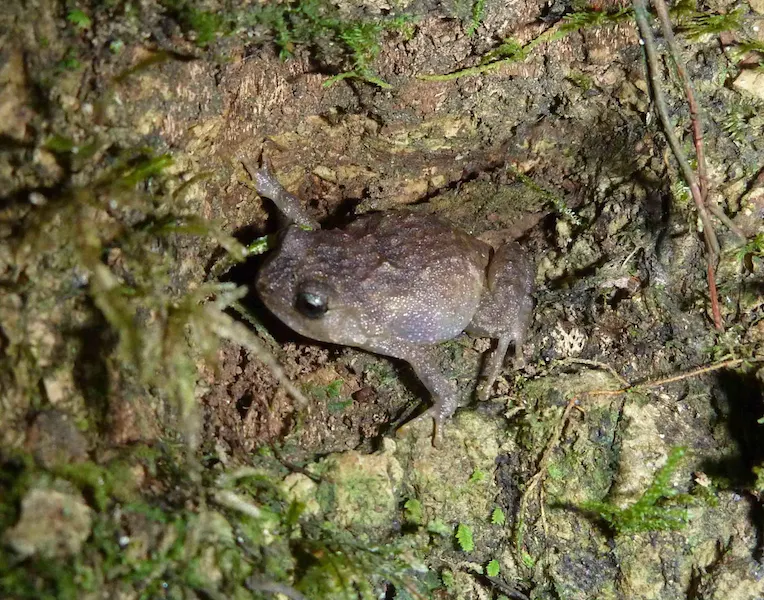
Endangered
Oreophryne monticola
Oreophryne monticola
The Lombok cross frog, Oreophryne monticola, is a small microhylid frog from the mountain forests of Lombok and Bali in Indonesia. The IUCN Red List has rated it Endangered since an assessment published in 2018. It is poorly known, and a 2016 survey found it at only one of ten sites on Lombok.
What is known about it
Oreophryne monticola belongs to the family Microhylidae, the narrow-mouthed frogs. George Albert Boulenger described it in 1897 from a specimen collected on Lombok at about 4,000 feet (roughly 1,200 m), under the name Sphenophryne monticola. Wikispecies gives its English name as Lombok cross frog.
Published descriptions of its appearance, call and breeding are scarce. Very little about its daily life is documented in the sources that are easy to find.
Where it lives
The species is endemic to Indonesia and lives in the Lesser Sunda Islands. The Red List lists Bali as well as Lombok, and records it only above 1,000 m (3,300 feet). On Lombok it has been reported from Mount Rinjani, and a Bali record was published in 2014.
Its habitat is subtropical or tropical moist montane forest, but the Red List also marks bogs and marshes and rural gardens as places it can occur. The Red List puts its extent of occurrence at about 4,500 square kilometres and counts only two locations.
Pins are Wikidata “endemic to” fields. Orange dots, when present, are GBIF occurrence tiles — survey bias included.
Why it is in trouble
The Red List says its population is decreasing and its habitat is still shrinking. Listed pressures are tourism and recreation areas, recreational activities, housing and urban development, and volcanic activity. Habitat loss is also named as the main threat in general summaries.
Counts are low where anyone has looked. A field survey of Lombok between March and July 2016, published in Jurnal Biologi Tropis in 2017, searched stream corridors at 10 sites covering 50,000 square metres in total and found 12 amphibian species. Oreophryne monticola was the rarest, with 5 frogs recorded at one site, a density of 0.01 per are (100 square metres). It was a snapshot of stream habitat, so it did not measure the whole population.
What is being done
The Red List notes that the frog occurs in at least one protected area, and lists site protection, habitat protection and site management as the actions in place or needed. No species-specific recovery programme turned up, and the Red List gives no population estimate.
Sources
Written for this catalog in our own words from the sources below, checked against them on 12 November 2026. Population figures are estimates and carry the year they were made. Status and assessment year: IUCN. 2026. The IUCN Red List of Threatened Species. Version 2026-1. iucnredlist.org.

