Endangered
Natron tilapia
Oreochromis alcalicus
The natron tilapia, also called the soda cichlid and listed by most fish references as Natron tilapia, is a small fish of Lake Natron and its catchment in Tanzania and Kenya. It lives in water hot and caustic enough to kill most fish. The IUCN rated it Endangered in 2006 because its range is so small.
How to recognise it
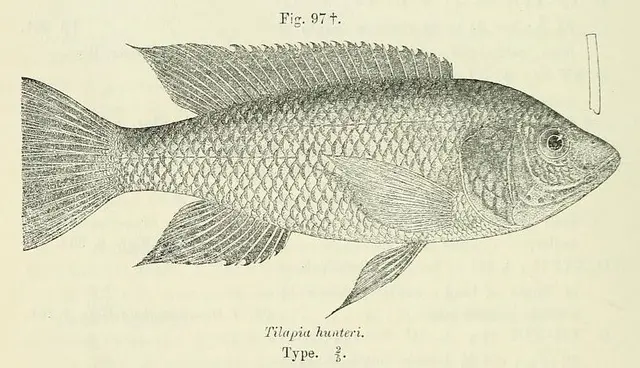
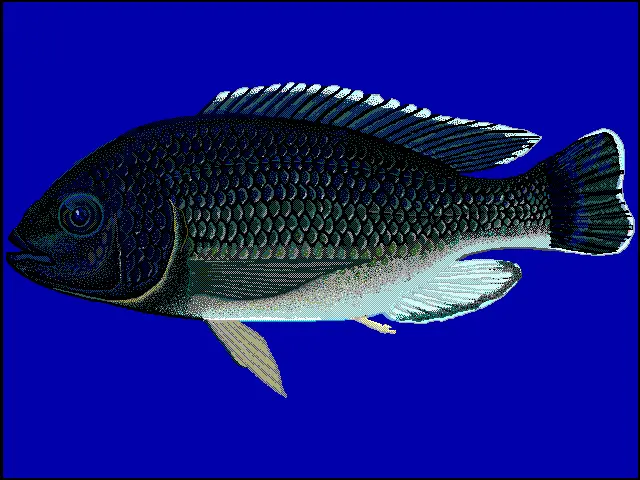
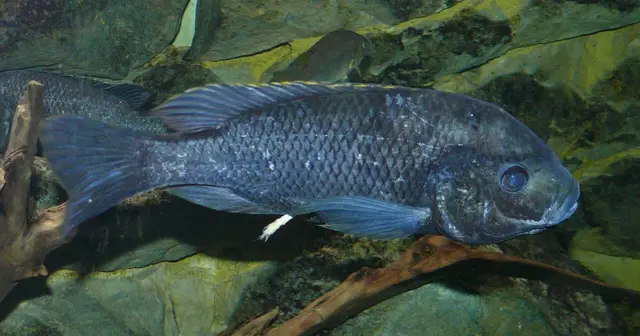
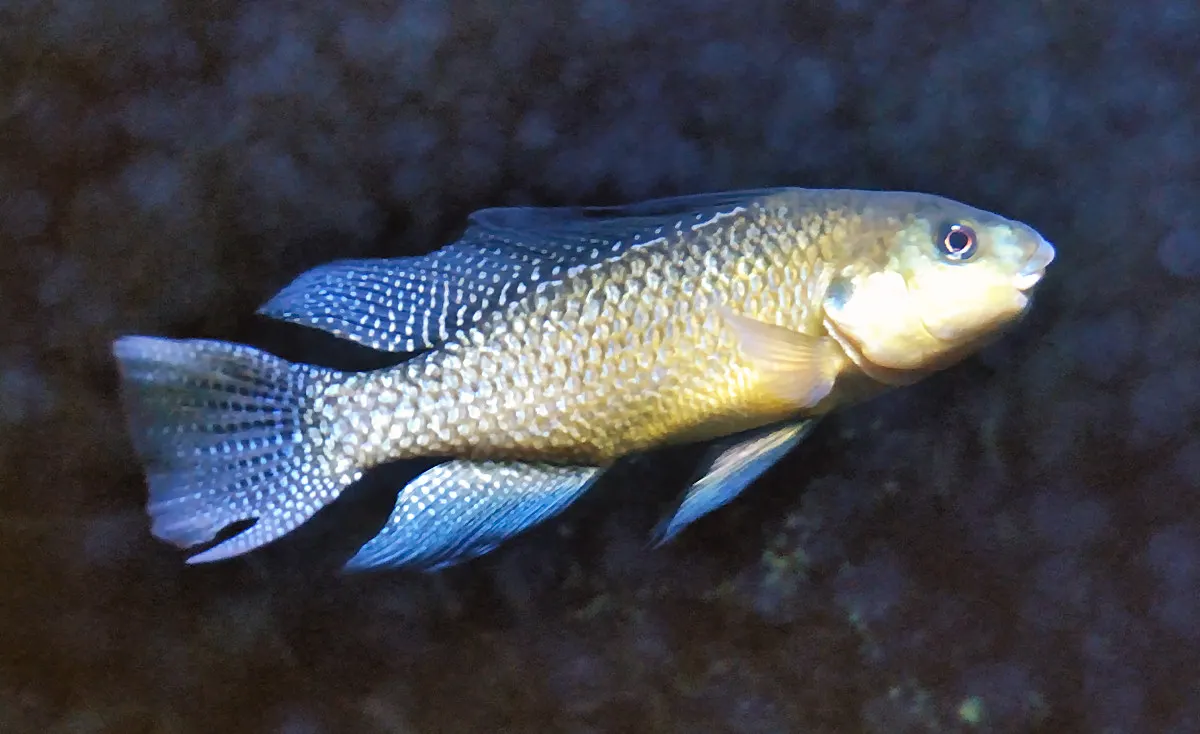
It's a short, deep-bodied cichlid that tops out around 11.6 cm in total length. Breeding males are the showy ones, with blue-white spots along the flanks, dark-edged fins and a spotted tail with a pink edge. Their throat and belly can be yellow or blue-white, and both colour forms turn up in the same place.
Females, and males that don't hold a territory, are plain sandy and pale underneath, sometimes with faint vertical bars. The mouth is normally straight, though a form with an upturned mouth lives in eastern Lake Natron alongside it. The two other fishes of the lake, Alcolapia latilabris and A. ndalalani, both have clearly downturned mouths.
Where it lives
It is known only from the Lake Natron catchment in Tanzania and Kenya, and reportedly from the Shombole Swamps on the Kenyan side. Lake Natron is a shallow soda lake in the Rift Valley, no more than about 2 m deep, and the fish stay around the shoreline, hot spring inlets and lagoons.
Conditions are harsh. Fishes of the genus Alcolapia are usually found in water of 30 to 43°C that is far saltier than seawater. Reported pH at Lake Natron is roughly 9.5 to 10.5, and hobbyist references describe water stained pink-red by bacteria and edged with thick deposits of trona, a sodium carbonate mineral.
Pins are Wikidata “endemic to” fields. Orange dots, when present, are GBIF occurrence tiles — survey bias included.
How it lives
Few fish could cope with this water, and this one has some unusual tricks. It excretes urea instead of ammonia, and it gulps air at the surface, since oxygen dissolves poorly in hot, salty water. In the wild it feeds almost entirely on the blue-green alga Spirulina, and copepods and fly larvae are also eaten. Males feed on algae in the early morning before they take over their pits.
It's a maternal mouthbrooder. Males dig pits in shallow water and guard them against juveniles that would eat the fertilised eggs as they fall from the female's mouth, and females move between pits. After spawning the female carries the eggs in her mouth for about two weeks, with no care once the young are released. A small young male may dig a pit beside a bigger male's and mate there with a small female.
Why it is in trouble
The 2006 listing rests mainly on the tiny range, under criteria B1ab(i,ii,iii)+2ab(i,ii,iii). The IUCN rated the population trend as unknown, and the one threat it recorded was soil erosion and sedimentation, scored as low impact. The assessment gives no population count.
A bigger worry is what happens to Lake Natron's water. In early 2025 a company, Ngaresero Valley Company Ltd, planned large-scale soda ash extraction there, and conservationists warned that diverting fresh water from rivers such as the Ewaso Ng'iro would alter the lake's chemistry. In August 2025 Tanzania's deputy minister for minerals said no licence for industrial mining would be issued, though the decision was described as provisional.
What is being done
Lake Natron was designated a Ramsar wetland in 2001. The IUCN records site and area management as the conservation action for the fish. Beyond that, the lake's protection against industry has been argued mostly on behalf of the lesser flamingos that breed there.
Sources
Written for this catalog in our own words from the sources below, checked against them on 12 November 2026. Population figures are estimates and carry the year they were made. Status and assessment year: IUCN. 2026. The IUCN Red List of Threatened Species. Version 2026-1. iucnredlist.org.