Endangered
Anomalous glassfrog
Anomalous glassfrog
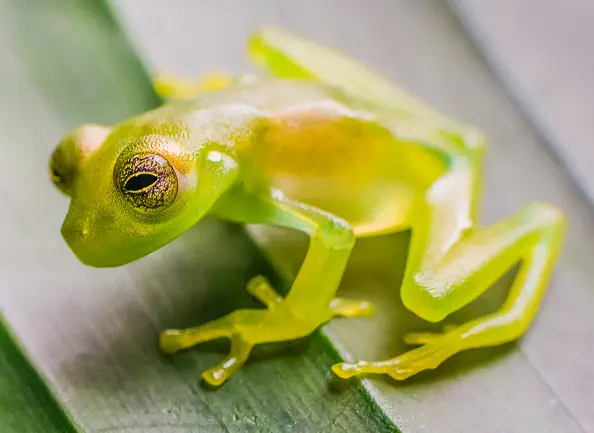
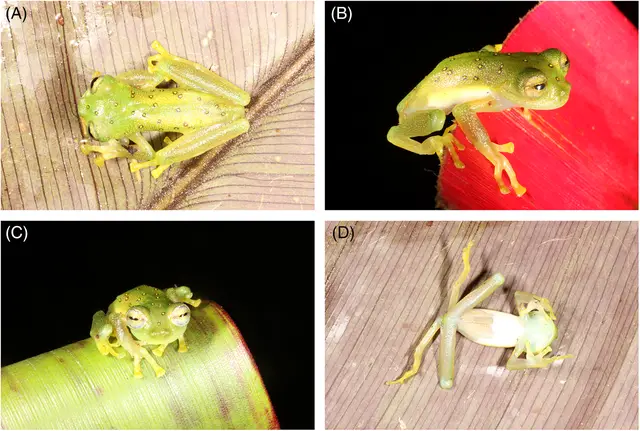
The anomalous glassfrog (Anomalous glassfrog) is a small frog from the Amazonian slopes of the Andes in Ecuador. Unlike the glassfrogs known when it was described in 1973, it is tan rather than green. The IUCN Red List assessed it as Endangered in 2022, with a decreasing population.
How to recognise it
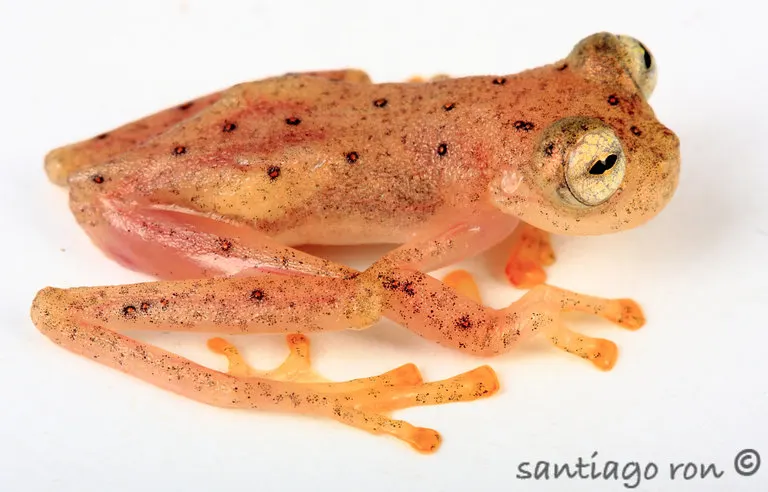
Most glassfrogs are green. This one is tan, with small black rings (ocelli) on the back that enclose orange-tan spots. Its describers, John Lynch and William Duellman, took the name anomala from a Greek word meaning unusual, in reference to that colour. The bones are white, and the iris is bronze with a black net pattern.
The snout is short and blunt when seen from above or the side. The skin of the back carries many minute spicules, with larger ones matching the dark rings. The feet are about two-thirds webbed, but the fingers carry little webbing. The original male specimen measured 24.1 mm from snout to vent. Adult males are reportedly about 21 to 25 mm and females about 26 to 27 mm.
Where it lives
The species is endemic to Ecuador. The first specimen was collected on 23 October 1971 by Duellman, from a small stream flowing into the Rio Azuela on the east slope of Volcan Reventador, along the Quito to Lago Agrio road in Napo Province, at 1,740 metres. For years that stream was the only known site.
The 2022 Red List assessment counts four locations at 1,650 to 1,795 metres above sea level, with an estimated extent of occurrence of about 4,370 square kilometres. Surveys in 2009 reportedly found populations near Llanganates National Park and on the Sumaco volcano. The assessment records the species in at least one protected area.
Pins are Wikidata “endemic to” fields. Orange dots, when present, are GBIF occurrence tiles — survey bias included.
How it lives
It lives in cloud forest and is active at night. The first frog was found sitting on a mossy branch about 1.5 metres above a cascading rivulet. Males reportedly call from vegetation beside mountain streams, and females attach their eggs to mossy branches over the water.
That first frog stayed tan during two days in captivity, ruling out a colour change to green. A treefrog and four other glassfrog species shared the same stream and nearby ones, but no second anomalous glassfrog turned up on that trip.
Why it is in trouble
The IUCN classes the population as decreasing and says the area it occupies is still shrinking. The threats it lists are small-holder farming and grazing, roads, small-scale wood harvest, dams and housing, each ongoing and rated as a low impact.
No population size has been estimated.
What is being done
The IUCN lists protection of resources, habitat and sites, and site management, as actions needed, and calls for research on population size, distribution and trends. The frog occurs in at least one protected area.
Sources
Written for this catalog in our own words from the sources below, checked against them on 12 November 2026. Population figures are estimates and carry the year they were made. Status and assessment year: IUCN. 2026. The IUCN Red List of Threatened Species. Version 2026-1. iucnredlist.org.
- IUCN Red List assessment, Anomalous glassfrog (2022)
- Lynch and Duellman 1973, A review of the centrolenid frogs of Ecuador, Occasional Papers of the Museum of Natural History, University of Kansas 16 (BioStor scan)
- Anomalous glassfrog (encyclopedia article)
- GBIF, Anomalous glassfrog
- IUCN Red List API, taxon record for Anomalous glassfrog