Endangered
Las Gralarias glassfrog
Nymphargus lasgralarias
The Las Gralarias glassfrog (Nymphargus lasgralarias) is a small, uniformly green frog from the cloud forests of Pichincha province, Ecuador. The IUCN Red List lists it as Endangered (2022 assessment), with a decreasing population. It was described only in 2012, and it looks very like a close relative.
How to recognise it
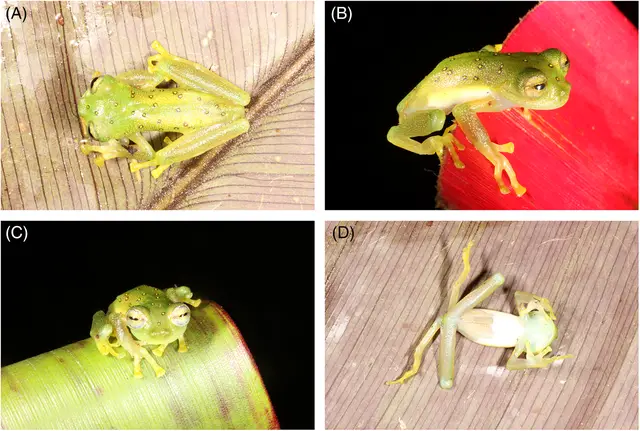
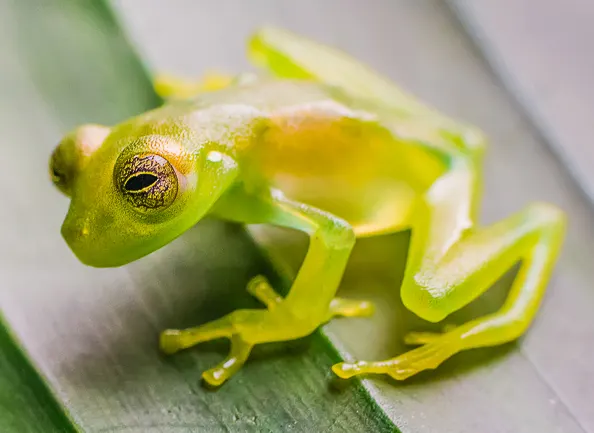
Adult males measure about 25 mm from snout to vent (24.6 to 26.5 mm in the seven males measured when the species was described in 2012). The back is light green, the flanks yellowish white, and the fingers and toes yellow with a faint green tint. The belly is white at the front and see-through towards the rear. Translucent belly skin is what gives glassfrogs their name. Females were unknown at the time of the original description.
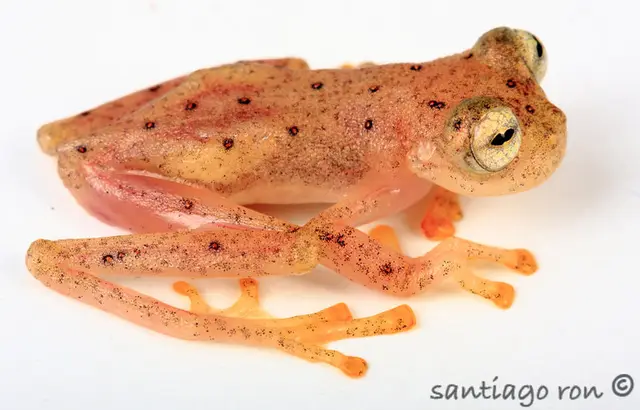
The eyes help most. The iris is golden with many small dark spots and a faint net of lighter lines. Its closest lookalike, the Pepper glassfrog (Nymphargus griffithsi), has a silvery white iris with fewer, larger spots. The Pepper glassfrog is also a little smaller (23.0 mm on average against 25.3 mm) and has small black spots on its back, which the Las Gralarias glassfrog lacks.
Where it lives
The species was described from Reserva Las Gralarias, a private cloud forest reserve in the Mindo region on the western slope of the Andes. The 2012 description recorded it between 1,850 and 2,200 m above sea level, and the Red List gives a range of 1,850 to 2,300 m. The Red List counts three to five locations and an extent of occurrence of about 1,150 square km.
Within the reserve it was described as widespread. It was recorded along Five Frog Creek, Kathy's Creek, Lucy's Creek, Heloderma Creek, Hercules Giant Tree Frog Creek and the Chalguayacu Grande River, but not along the Santa Rosa River.
Pins are Wikidata “endemic to” fields. Orange dots, when present, are GBIF occurrence tiles — survey bias included.
How it lives
It lives along small permanent streams, around 3 m wide, in primary montane forest with little disturbance. Males call from the tops of small ferns, leaves and palm fronds, 1 to 6 m above the water. The call is a short tick or click, 0.026 seconds long on average, against about 0.12 seconds for the Pepper glassfrog's whistle. In 2011 males were recorded calling between April and early July.
Eggs are laid on the tips of leaves hanging over the stream. Each clutch swells into a dangling jelly mass, and the 23 masses counted in 2011 held 12 to 36 eggs, 25 on average. The two glassfrogs share some streams, though the Las Gralarias glassfrog also occupies several creeks where the Pepper glassfrog was not found.
Why it is in trouble
The Red List names small-scale farming and small-scale grazing as ongoing threats, and temperature extremes as a future one. It records a continuing decline in the area the frog occupies. The species is known from only a handful of places.
Its status has shifted. It was listed as Data Deficient on the 2017 Red List, then assessed as Endangered in 2022. A 2020 call survey of 13 streams around Mindo, published in Amphibian and Reptile Conservation, found seven glassfrog species, including this one. Sites beside rainbow trout farms averaged 1.7 glassfrog species against 3.0 at sites without farms, and differed in canopy openness and water chemistry. The survey did not single out the Las Gralarias glassfrog.
What is being done
The Red List records that the frog occurs in at least one protected area, and lists site and area management, site and area protection, and resource and habitat protection as conservation actions. The reserve where it was described is privately owned and run for conservation.
Sources
Written for this catalog in our own words from the sources below, checked against them on 12 November 2026. Population figures are estimates and carry the year they were made. Status and assessment year: IUCN. 2026. The IUCN Red List of Threatened Species. Version 2026-1. iucnredlist.org.
- IUCN Red List assessment, Nymphargus lasgralarias (2022)
- Hutter and Guayasamin 2012, Zootaxa 3257 (original description, text via GBIF species descriptions)
- Call survey indicates rainbow trout farming alters glassfrog community composition, Amphibian and Reptile Conservation 2020
- Mongabay, private reserve safeguards newly discovered frogs (2012)
- Wikipedia, Glass frog