Critically Endangered
Noblella madreselva
Noblella madreselva
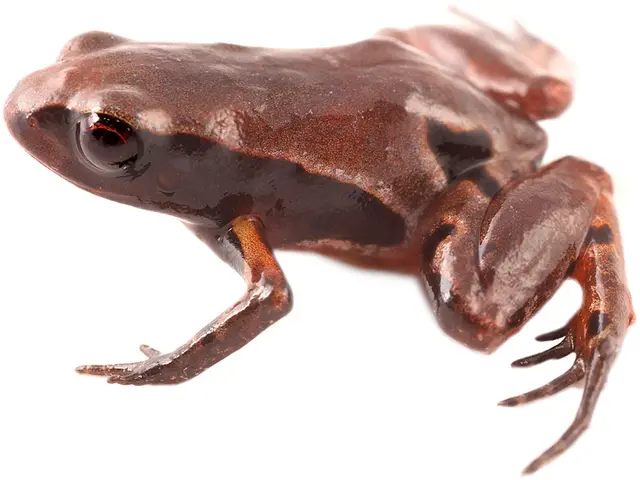
Noblella madreselva is a thumbnail-sized frog known from a single patch of cloud forest at Madre Selva in the Cusco region of Peru. The IUCN Red List rated it Critically Endangered in 2018. It has a plain brown back and a striking black and white belly.
How to recognise it
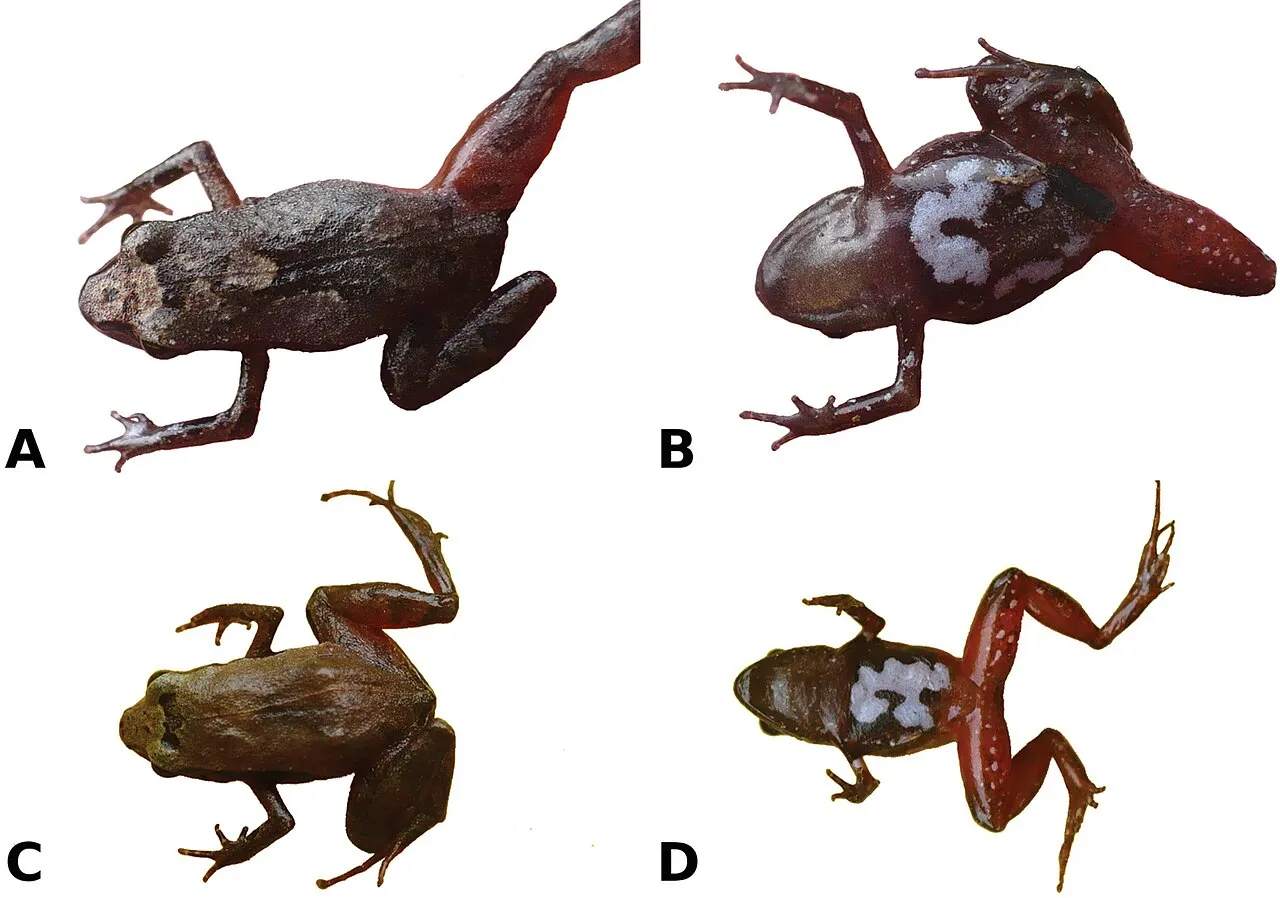
It is tiny. The male used to describe the species measured about 16 mm from snout to vent and the female about 18 mm. The back is tan to dull brown, sometimes with darker markings or faint brown stripes above the hips, and a dark brown mask crosses the face.
The belly is the giveaway. A broad, irregular white mark sits on a black background across the chest and belly, and the undersides of the limbs are red with small white spots. It is the only member of its genus with white markings on the belly.
Where it lives
Only one place is known: Madre Selva, in La Convención Province, Cusco, at 2,330 to 2,370 m above sea level. The IUCN estimates the known range at about 10 square km, counts it as a single location and lists Peru as the only country.
The habitat is humid montane forest, the cloud forest of the eastern Andes. It may also occur in the upper watersheds of the valleys beside the discovery site, but that has not been shown.
Pins are Wikidata “endemic to” fields. Orange dots, when present, are GBIF occurrence tiles — survey bias included.
How it lives
It is mostly a ground dweller. Specimens have turned up in leaf litter and under rocks and logs, and the frog is active by day. Researchers found it common in unlogged cloud forest.
Like its closest relatives, it probably develops directly, with eggs hatching into tiny frogs and no tadpole stage.
Discovery and name
Peruvian researcher Vanessa Uscapi found the first specimen in leaf litter in January 2011, on the property of an ecolodge. Alessandro Catenazzi, Uscapi and Rudolf von May described it as a new species in the journal ZooKeys in 2015. The name means mother jungle in Spanish and honours local conservation efforts, including that lodge, Madre Selva.
Why it is in trouble
With one site and a tiny range, any clearing could do serious harm. The IUCN records a continuing decline in forest area at the site and lists small-holder grazing and farming and larger agricultural operations as ongoing, low-impact threats. The describers also worried about deforestation, disease and agriculture.
The species is not known from any protected area, and the IUCN lists resource and habitat protection as the conservation action needed. Roughly half of La Convención Province is protected by a national park and a communal reserve, according to a 2015 Mongabay report, but the frog's own site is not known to be inside either.
Sources
Written for this catalog in our own words from the sources below, checked against them on 12 November 2026. Population figures are estimates and carry the year they were made. Status and assessment year: IUCN. 2026. The IUCN Red List of Threatened Species. Version 2026-1. iucnredlist.org.