Critically Endangered
Phyllonastes coloma
Noblella coloma
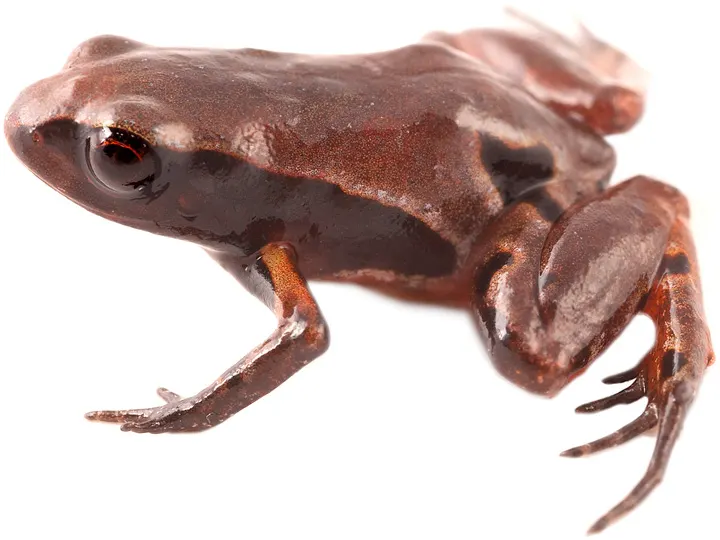
Coloma's noble rainfrog (Phyllonastes coloma, long known as Noblella coloma) is a tiny cloud forest frog found only in western Ecuador. The IUCN Red List rated it Critically Endangered in 2022: it is known from a single location, with an estimated range of about 29 square kilometres, outside any protected area, and its numbers are falling.
How to recognise it
This is a rainfrog in the family Craugastoridae, a large family of New World frogs. Biologists Juan Manuel Guayasamin and Anderson Terán-Valdez described it as a new species in 2009 in the journal Zootaxa, under the genus Noblella. It has since been moved to Phyllonastes, and both names appear in the literature.
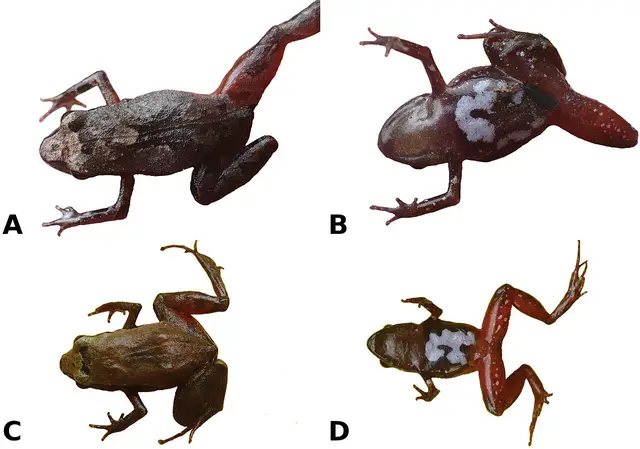
The back has no dark markings: no bar between the eyes and no chevrons over the shoulders or hips, which sets it apart from every other Noblella described at the time. The belly is bright orange.
Where it lives
The species is endemic to Ecuador and lives on the western slope of the Andes, in the Cordillera Occidental. Along with one other Noblella, it is among the few members of the group reported from the Pacific side of the Andes.
The IUCN assessment places it between 1,800 and 1,880 metres above sea level, in moist montane forest, and counts a single location. The estimated extent of occurrence is about 29 square kilometres.
Pins are Wikidata “endemic to” fields. Orange dots, when present, are GBIF occurrence tiles — survey bias included.
How it lives
Frogs of its family develop directly, skipping the free-swimming tadpole stage, so the eggs hatch as tiny froglets. That is documented for the family as a whole, and this species is assumed to follow it. Its own breeding, diet and call have not been described in the sources available.
Why it is in trouble
The 2022 assessment rates the population as decreasing and records a continuing decline in the area of forest it occupies, under criterion B1ab(iii). With everything in one small patch, a single event could wipe out much of the species.
The threats are small-holder farming, small-holder grazing, ranching or farming, small-scale harvesting, and utility and service lines. Each is rated low impact on its own, but together they eat away at cloud forest, which the assessment records as ecosystem conversion and degradation.
What is being done
The assessment records that the frog does not occur in any protected area. The conservation actions it lists as needed are protecting and managing its site, and captive breeding or other artificial propagation. No breeding programme is described in the sources available.
Sources
Written for this catalog in our own words from the sources below, checked against them on 12 November 2026. Population figures are estimates and carry the year they were made. Status and assessment year: IUCN. 2026. The IUCN Red List of Threatened Species. Version 2026-1. iucnredlist.org.