Endangered
Neretvan nase
Chondrostoma knerii
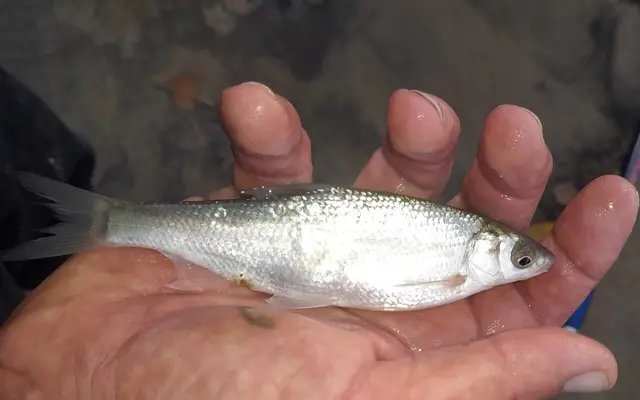
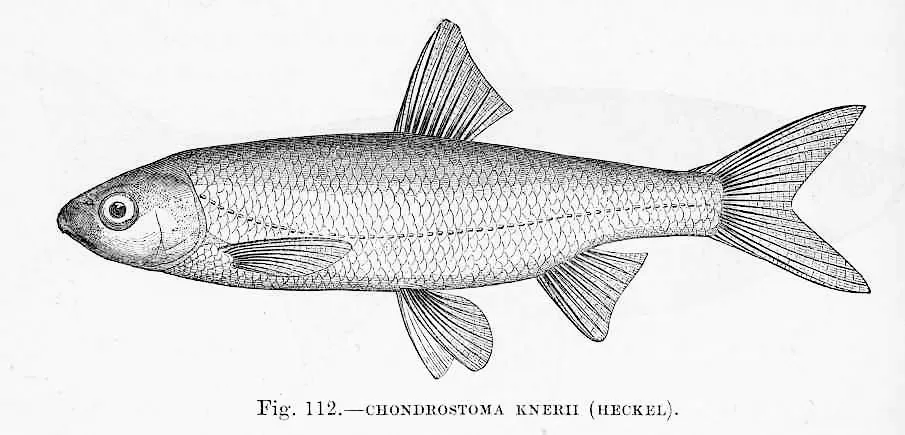
The Neretvan nase (Chondrostoma knerii), also called the Dalmatian nase, is a silvery freshwater fish found nowhere except the Neretva river basin of Croatia and Bosnia and Herzegovina. The IUCN Red List rated it Endangered in 2024. Dams, falling spring flows and introduced predators have thinned its numbers.
How to recognise it
It is a medium-sized, slender fish, grey to brown on the back and silvery white to slightly rosy on the sides, with reddish or pale fins and a thin grey line along each flank. The snout is thick and rounded, and the small mouth sits low on the head, with a hard, horn-like sheath on the lower lip. The eye is yellowish in life.
Counting lateral-line scales (50 to 59) helps separate it from nearby Balkan nases. The largest recorded fish measured 29.4 cm. In a sample from the Neretva in Bosnia and Herzegovina, females reached about 29 cm, while the largest males were about 23 cm.
Where it lives
Its whole range is the middle and lower Neretva catchment. In Bosnia and Herzegovina that includes the river itself and tributaries such as the Buna, Bregava, Krupa and Trebižat, plus the Hutovo Blato wetland. In Croatia it lives in the lower Neretva, the Crna rijeka and Norin, and lakes such as Modro oko and Baćinska jezera.
It does not occur in the reservoirs of the middle and upper Neretva. Old records from the Zadar area and from the Cetina river are reported to have disappeared.
Pins are Wikidata “endemic to” fields. Orange dots, when present, are GBIF occurrence tiles — survey bias included.
How it lives
Outside the breeding season it lives in small schools, and one part of the year it is reported to live in underground karst waters. It feeds mostly on periphyton, the film of algae on stones and plants, along with small bottom-living invertebrates. Age studies estimated a longevity of about 7.5 years.
Spawning runs from January to April. Adults migrate in large schools from the Neretva to springs in the Hutovo Blato wetland, which appears to be the main spawning area, and egg-laying begins around mid-February at roughly 13 degrees C. The sticky orange-red eggs are attached to plants, stones and submerged wood in fast-flowing water. Fecundity was 2,000 to 16,000 eggs per female in one study (another source gives 8,000 to 40,000). Larvae spend roughly a month in the springs before young fish move on to larger lakes.
Why it is in trouble
A 2019 review in Acta Ichthyologica et Piscatoria traced a decline since the 1970s to changes in the Neretva's flow after hydropower works, damaged spawning habitat and introduced fish. Lower spring discharge in Hutovo Blato was judged the main threat. In dry years, eggs were exposed to air as water levels dropped, and the fish failed to spawn in most springs several times in two decades. Flooded years such as 2010, 2013 and 2018 gave good survival of young.
Introduced pumpkinseed and ruffe eat the young, and introduced pikeperch affect the adults. The IUCN also lists dams, pollution, sewage, water abstraction and drought. The assessment counts two locations, with an extent of occurrence of about 2,346 square kilometres, and gives the population trend as unknown.
What is being done
The species is strictly protected on paper in Croatia and appears in the EU Habitats Directive, yet the 2019 review found no conservation action had ever been carried out, and in Bosnia and Herzegovina it was not protected. Part of its range lies in Hutovo Blato, a nature park since 1995 and a Ramsar wetland since 2001.
The review's recommendations were to restore natural flooding and spring flow, curb invasive species, ban fishing during spawning (the large ovaries are prized) and start long-term monitoring.
Sources
Written for this catalog in our own words from the sources below, checked against them on 12 November 2026. Population figures are estimates and carry the year they were made. Status and assessment year: IUCN. 2026. The IUCN Red List of Threatened Species. Version 2026-1. iucnredlist.org.