Endangered
Nemacheilus pulchellus
Nemacheilus pulchellus
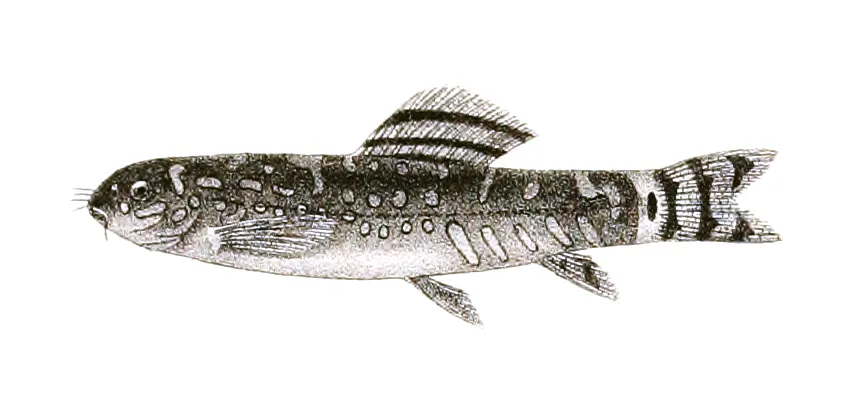
Nemacheilus pulchellus, which many fish catalogues now place in the genus Mesonoemacheilus, is a tiny stone loach from the rivers of the Western Ghats in southern India. The IUCN Red List has rated it Endangered since its 2011 assessment, with a decreasing population, and it is known from only a handful of sites in Tamil Nadu and Kerala.
How to recognise it
This is a small, bottom-dwelling freshwater fish of the family Nemacheilidae, the stone loaches. The largest size on record is 4.6 cm in standard length (nose to the base of the tail), a figure FishBase takes from a 1991 Indian fish handbook.
Day described it in 1873 as Nemacheilus pulchellus, from the Bhavani River at the foot of the Nilgiri Hills. Its name is unsettled. The Red List and GBIF still use Nemacheilus, while the Catalog of Fishes treats it as valid in Mesonoemacheilus, a genus of Western Ghats loaches whose members have two pairs of snout barbels joined at their bases.
Where it lives
It is endemic to India. The Red List records it from Tamil Nadu and Kerala and counts four locations in total. Its range is described as the Bhavani River in Tamil Nadu and the Periyar and Chalakudy Rivers in Kerala, all in the Western Ghats.
It lives in permanent rivers and streams, including waterfalls, in a tropical climate, and stays near the bottom of the water column.
Pins are Wikidata “endemic to” fields. Orange dots, when present, are GBIF occurrence tiles — survey bias included.
How it lives
Very little has been written about its daily life. FishBase gives an estimated trophic level of 2.8, worked out from its closest relatives rather than measured, and lists no length at maturity. Breeding habits are not described in the sources available.
Why it is in trouble
The Red List places it in the Endangered category under criterion B1ab(iii). That means a small range split into few locations, with the quality of its habitat still declining. The assessment, made in 2010 and published in 2011, also records a decreasing population and a continuing decline in the area it occupies.
Three threats were scored, each as low impact for now. They are persecution or control, herbicides and pesticides washing into streams, and introduced tilapia. The listed effects on the loach are degraded habitat, direct deaths, disturbance and competition.
What is being done
Protection so far is thin. At the time of the assessment, conservation sites had been identified over part of its range, but the species was not recorded from any protected area. There was no recovery plan, no monitoring scheme and no captive breeding programme.
The Red List calls for protection of sites and habitat, and for research on its taxonomy, how many there are, where they live, whether numbers are falling and what is driving that.
Sources
Written for this catalog in our own words from the sources below, checked against them on 12 November 2026. Population figures are estimates and carry the year they were made. Status and assessment year: IUCN. 2026. The IUCN Red List of Threatened Species. Version 2026-1. iucnredlist.org.




