Endangered
Mosaic gulper shark
Centrophorus tessellatus
The mosaic gulper shark (Centrophorus tessellatus) is a little-known deepwater dogfish of island slopes in the Pacific and Indian oceans, recorded off Japan, Hawaii and the Maldives. The IUCN Red List lists it as Endangered (2021 assessment), with a decreasing population. Its name refers to block-like, widely spaced skin denticles.
How to recognise it
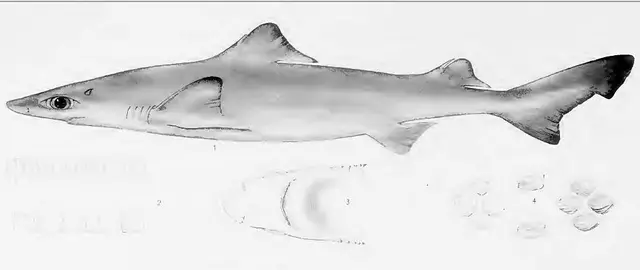
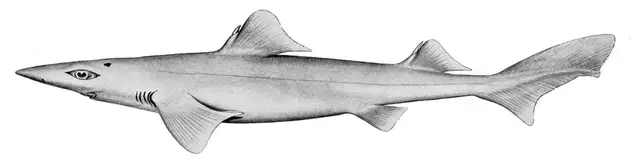
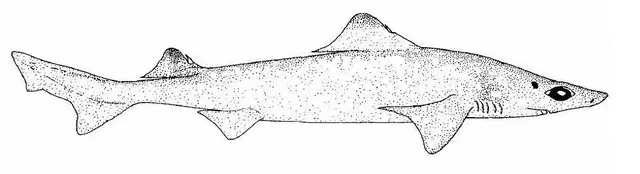
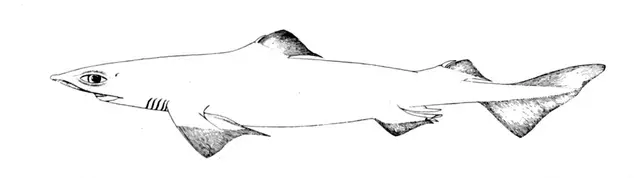
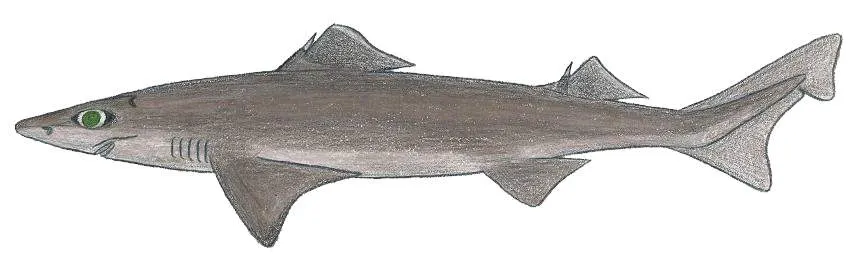
This is a dogfish with no anal fin and two dorsal fins, each carrying a large spine. The second dorsal is nearly as tall as the first. The snout is moderately long, broad and parabolic, the eyes are large, and the pectoral fins end in narrow, angular tips that reach well past the first dorsal spine.
Both jaws hold blade-like, single-cusped teeth, and those in the lower jaw are much larger than the upper ones. The skin is covered in block-shaped denticles that don't overlap, which is the feature behind the species name. The largest known animal is the original museum specimen, an adult male of 887 mm (about 89 cm).
Where it lives
Garman described the species in 1906 from a single specimen taken in deep water off Honshu, Japan. Since then it has been recorded from southern Japan, the Hawaiian Islands and the Maldives, and a fish catalogue also lists Taiwan and Dongsha Atoll. Some of those records are labelled only as similar to this species, so identifications in a few regions may be uncertain.
It lives on or near the seabed of island slopes. The Red List gives depths of about 260 to 820 m, over both hard and soft bottoms. FishBase gives a broader range of 20 to 732 m, but most records sit in the deeper slope zone.
Pins are Wikidata “endemic to” fields. Orange dots, when present, are GBIF occurrence tiles — survey bias included.
How it lives
Very little has been written about its daily life. It is ovoviviparous, meaning the young develop inside the mother nourished by yolk, and the one reference to litter size gives one or two pups. The size at which it matures is not known.
Gulper sharks as a group are slow to recover from losses. FishBase rates this species' resilience as low, with a population doubling time of 4.5 to 14 years, and the Red List puts its generation length at about 27.8 years. That is a long time between a pup being born and its own offspring taking its place.
Why it is in trouble
The 2021 assessment estimates a past population reduction of 50 to 79 percent, based on actual or potential levels of exploitation, and lists the trend as decreasing. The threats it names are unintentional catch in deep-sea fisheries, both small-scale and large-scale, each affecting the majority of the population. The Red List also records use of the species for human food, medicine, fuel and research. An earlier assessment in 2006 had rated it Data Deficient.
Rarity does not help. Older references call it of no interest to fisheries, meaning nobody targeted it. But a rare animal with a generation time of nearly 28 years can still be pushed down by accidental catch.
What is being done
No species recovery plan or systematic monitoring scheme is in place, and the Red List records no ex-situ programme. The assessment calls for harvest and trade management, area protection and a recovery plan, and lists population size and trends, life history and harvest levels as research priorities. Those are the basics still missing.
Sources
Written for this catalog in our own words from the sources below, checked against them on 12 November 2026. Population figures are estimates and carry the year they were made. Status and assessment year: IUCN. 2026. The IUCN Red List of Threatened Species. Version 2026-1. iucnredlist.org.