Endangered
Little gulper shark
Centrophorus uyato
The little gulper shark (Centrophorus uyato) is a slender deepwater dogfish that lives on or near the sea floor along continental slopes in the Atlantic, Mediterranean and Indian Ocean. The IUCN Red List assessed it as Endangered in 2024. It breeds slowly, usually one pup at a time, which leaves it exposed to fishing.
How to recognise it
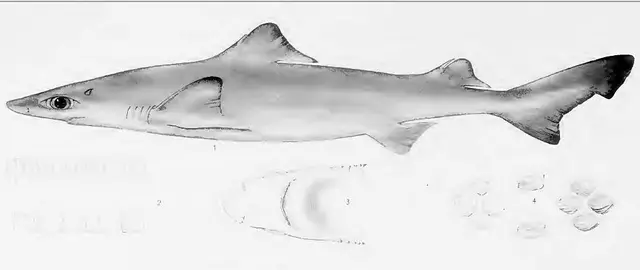
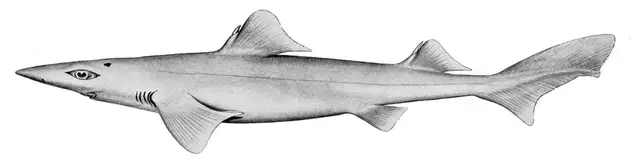
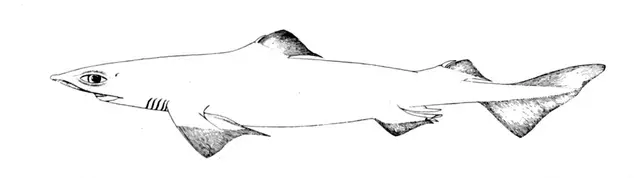
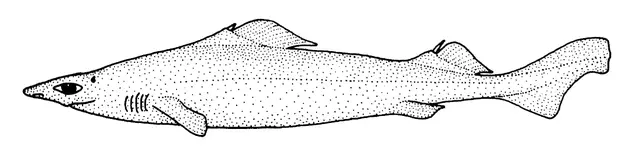
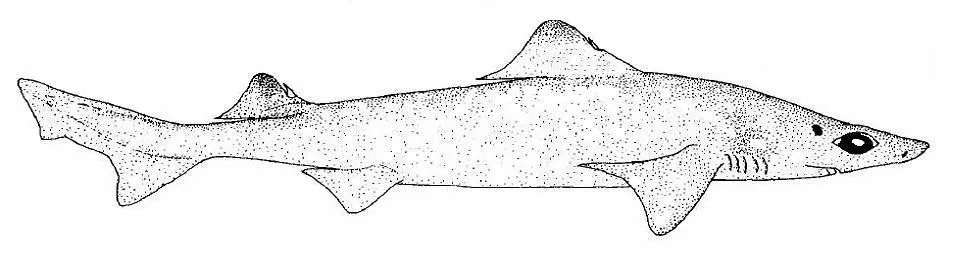
This is a slim, grayish-brown shark that reaches roughly 1 m in length, with maximum sizes given as about 100 to 110 cm. It has two dorsal fins, each with a long spine in front, and no anal fin. The back is slightly humped ahead of the first dorsal fin, and the pectoral fins end in long, free rear tips.
The teeth are blade-shaped and interlock to form a cutting edge in each jaw. Constantine Rafinesque described the species in 1810, first under the name Squalus uyato.
Where it lives
It has a patchy but very wide range. The IUCN lists it from the eastern Atlantic, including Spain, Morocco, Senegal, Angola, Namibia and South Africa, and from the Mediterranean. It also appears in the Caribbean and Gulf of Mexico, the western Indian Ocean (Mozambique and Madagascar), and India and Sri Lanka, among more than 80 countries and territories in all.
Adults live near the bottom on the outer continental shelf and upper slope. FishBase gives a depth range of 50 to 1,400 m, usually deeper than 200 m, and the IUCN assessment gives 210 to 1,400 m. Both rocky and soft sea floor are used, as are seamounts.
Pins are Wikidata “endemic to” fields. Orange dots, when present, are GBIF occurrence tiles — survey bias included.
How it lives
The shark eats bony fishes and squid. It gives birth to live young, although the embryos live on yolk rather than being fed by the mother. Females usually carry a single pup, born at about 40 to 50 cm. Females mature at roughly 75 to 89 cm and males at about 80 to 94 cm, depending on the source.
One young at a time, with late maturity, is a slow way to make up losses. The IUCN puts a generation at about 60 years.
Why it is in trouble
The 2024 assessment lists fishing as the threat. Deep-water gulper sharks are caught on purpose in small-scale fisheries, and also taken by accident in both small-scale and large-scale fishing. Each of these is scored as ongoing, affecting most of the population and causing rapid declines. The IUCN estimates a past reduction of 50 to 79 percent, and the overall trend is decreasing.
People eat the meat dried and salted, and the catch is probably also turned into fishmeal and liver oil. A separate 2016 IUCN assessment of the Mediterranean population rates it Critically Endangered.
What is being done
The assessment records a recovery plan and a harvest management plan as in place, along with action at national level. Some of the species' range lies inside protected areas, but only about 1 to 10 percent of the population is estimated to be covered, and no systematic monitoring scheme exists.
Sources
Written for this catalog in our own words from the sources below, checked against them on 12 November 2026. Population figures are estimates and carry the year they were made. Status and assessment year: IUCN. 2026. The IUCN Red List of Threatened Species. Version 2026-1. iucnredlist.org.