Endangered
Leafscale gulper shark
Centrophorus squamosus
The leafscale gulper shark (Centrophorus squamosus) is a deep-sea dogfish that can reach about 1.6 m and live for around 70 years. It ranges across the Atlantic, Indian and Pacific oceans, mostly on the slopes far below the surface. The IUCN Red List rated it Endangered in 2024 after steep declines driven by fishing.
How to recognise it
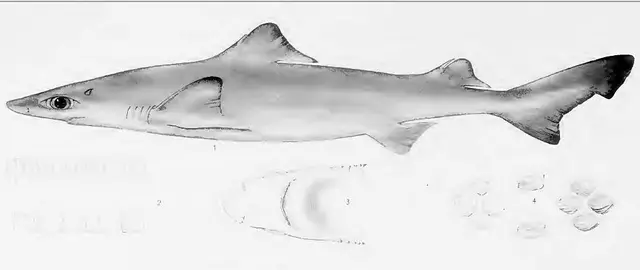
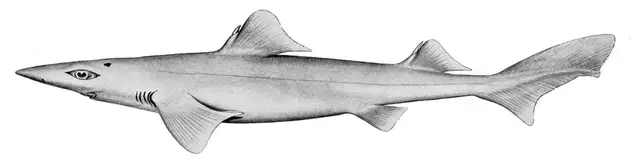
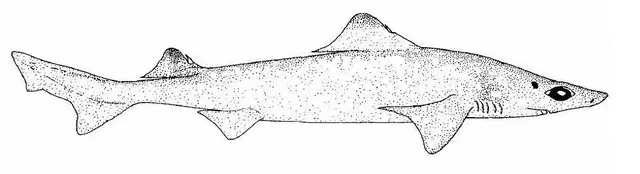
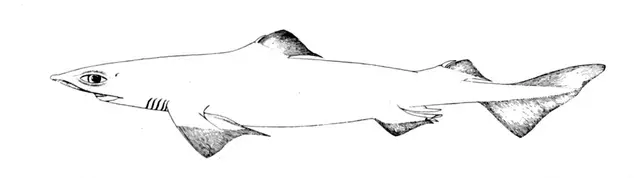
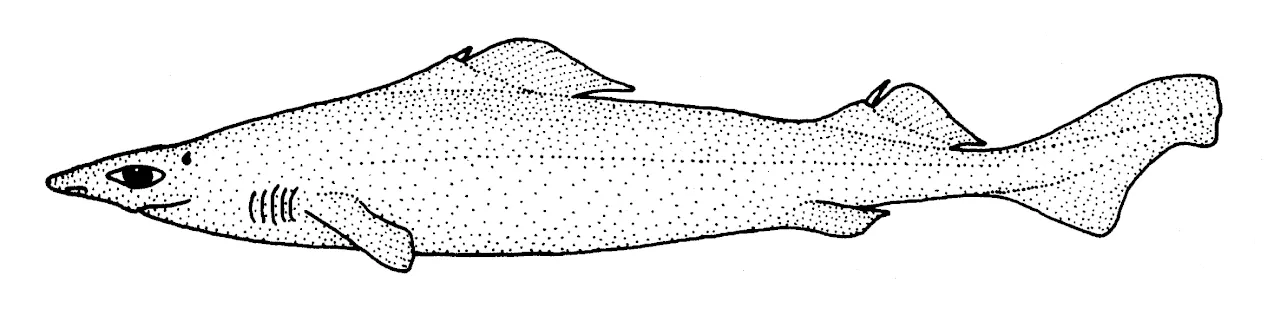
It's a large, dark grey to chocolate brown shark with a short, broad snout. It has two dorsal fins with a spine in front of each, and no anal fin. The first dorsal fin is long and low. The skin is covered in large, rough, leaf-like scales, which gives the species its name.
Maximum length is given as 158 to 166 cm depending on the source. Newborns measure about 35 to 43 cm. Males mature at roughly 100 to 126 cm and females at about 125 cm, so a shark has to grow a long way before it can breed.
Where it lives
It is a widespread but patchy species. In the eastern Atlantic it has been recorded from Iceland to southern Africa, and it also occurs in the western Indian Ocean and in the western and southeastern Pacific, including waters off Japan, the Philippines, New Zealand and south-east Australia. The IUCN assessment lists more than 40 countries and territories, from Ireland and Portugal to Namibia, Chile and Australia.
Mostly it lives on or near the bottom of continental slopes and seamounts. The depth records run from about 230 m down past 2,000 m, and the IUCN gives a range of 0 to 3,366 m overall. It has also been caught in open water above much deeper seabed.
Pins are Wikidata “endemic to” fields. Orange dots, when present, are GBIF occurrence tiles — survey bias included.
How it lives
It probably feeds on fish and squid. The young develop inside the mother, nourished by yolk, and are born live. Litters are small, with 5 to 8 pups reported, though one source gives a maximum of five.
Ring counts in the ear bones suggest a lifespan of about 70 years. The IUCN uses a generation length of 52.5 years. A slow-growing, long-lived shark with few young recovers from overfishing very slowly.
Why it is in trouble
The main threat is fishing. The IUCN scores accidental catch in large-scale and small-scale fisheries as the biggest pressures, each affecting over half the population. Targeted small-scale fishing adds to it. The shark is taken both on purpose and as bycatch. Its liver oil is highly valued, its meat is sometimes dried and salted, and some is turned into fishmeal.
The IUCN estimates the global population fell by 50 to 79 percent over three generations (generation length 52.5 years). The causes are understood and have not stopped. In the Northeast Atlantic, the International Council for the Exploration of the Sea advised in 2024 that there should be zero catches in each year from 2024 to 2027.
What is being done
The IUCN notes that a recovery plan and a harvest management plan are in place somewhere in its range, and it lists national-level policy action as a conservation measure. There is no systematic monitoring scheme or captive population, and it is unknown whether the species occurs in a protected area.
Not every region sees the same pressure. Catches in south-eastern Australia and New Zealand are relatively low, and New Zealand's Department of Conservation classes the shark as Not Threatened, with a note that it is secure overseas.
Sources
Written for this catalog in our own words from the sources below, checked against them on 12 November 2026. Population figures are estimates and carry the year they were made. Status and assessment year: IUCN. 2026. The IUCN Red List of Threatened Species. Version 2026-1. iucnredlist.org.