Critically Endangered
Dwarf gulper shark
Centrophorus atromarginatus
The dwarf gulper shark (Centrophorus atromarginatus) is a little-known deepwater dogfish of the Indo-West Pacific, living on the upper continental slope. Its black-tipped fins give it a second common name, the blackfin gulper. The IUCN Red List rated it Critically Endangered in 2024, with a decreasing population.
How to recognise it
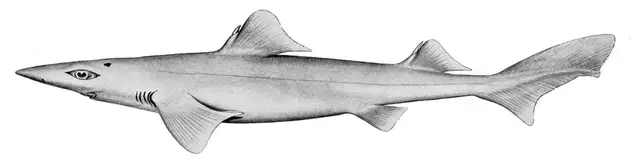
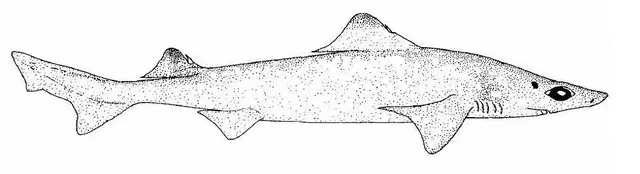
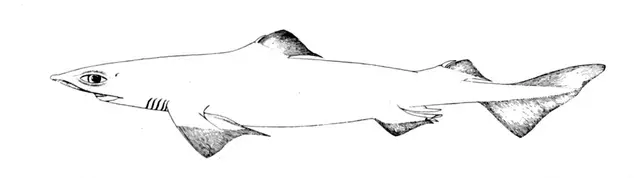
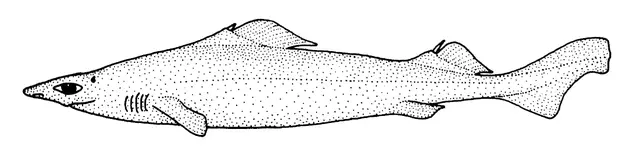
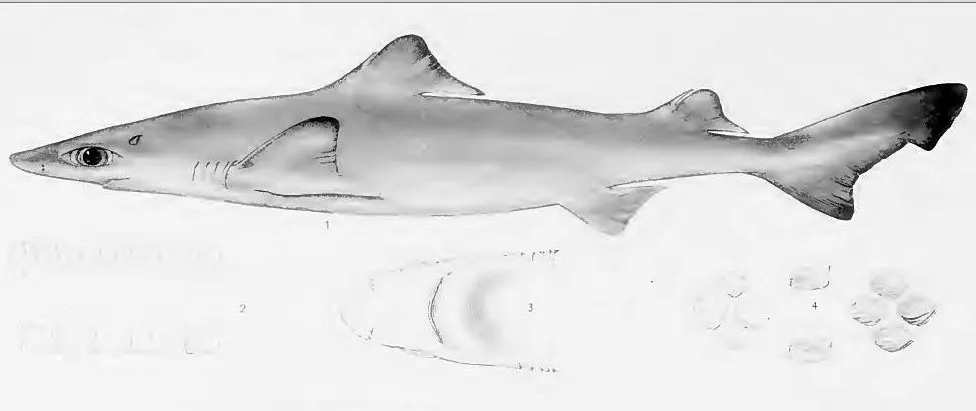
Like its relatives in the gulper shark family (Centrophoridae), it is a slim dogfish with two dorsal fins, each with a long grooved spine. Adults are olive-grey or brownish above and paler below, with the tips of the dorsal fins marked in black. Younger fish may look paler, with dusky fin tips.
It is a small gulper. FishBase and the shark literature give a maximum length of 87 cm, though some references quote up to 150 cm. It was described by Samuel Garman in 1913 and is often confused with the gulper shark (Centrophorus granulosus), which makes records hard to sort out.
Where it lives
The range runs through the Indo-West Pacific, from the Gulf of Aden to Japan, Taiwan and northern Papua New Guinea. The Red List names eight countries and territories: Papua New Guinea, India, Indonesia, Sri Lanka, Somalia, Oman, Japan and Taiwan.
It is a bottom dweller of the upper continental slope. FishBase gives depths of 183 to 450 m, while the IUCN lists a range of 100 to 540 m. The habitats listed are sandy, sandy-mud and muddy seabed, plus hard and soft substrates.
Pins are Wikidata “endemic to” fields. Orange dots, when present, are GBIF occurrence tiles — survey bias included.
How it lives
Reproduction is the best-documented part of its biology. Females give birth to a single pup, at about 28 to 36 cm. The embryo feeds on its yolk during development, and pairs are reported to embrace when mating. The generation length used in the assessment is almost 28 years, so a population recovers slowly from any losses.
What it eats is not well recorded.
Why it is in trouble
Fishing is the threat. FishBase reports it taken often as bycatch in deepwater bottom longline fisheries, and probably in bottom trawls. The Red List lists both targeted and accidental catch, in small-scale and large-scale fisheries. The meat is used, the fins are of low value, and FishBase rates the liver oil as very high in value.
With one pup per litter and a generation time of nearly 28 years, there is little room for recovery. The Red List lists it under criteria A2bd (2024), which cover a population decline linked to exploitation.
What is being done
Very little that is specific. The assessment records no recovery plan, no monitoring scheme and no harvest management plan for this shark, and FishBase notes it has not been evaluated by CITES or CMS. Recommended actions include harvest and trade management, species recovery work, site protection and national-level measures.
Sources
Written for this catalog in our own words from the sources below, checked against them on 12 November 2026. Population figures are estimates and carry the year they were made. Status and assessment year: IUCN. 2026. The IUCN Red List of Threatened Species. Version 2026-1. iucnredlist.org.