Critically Endangered
Meladema imbricata
Meladema imbricata
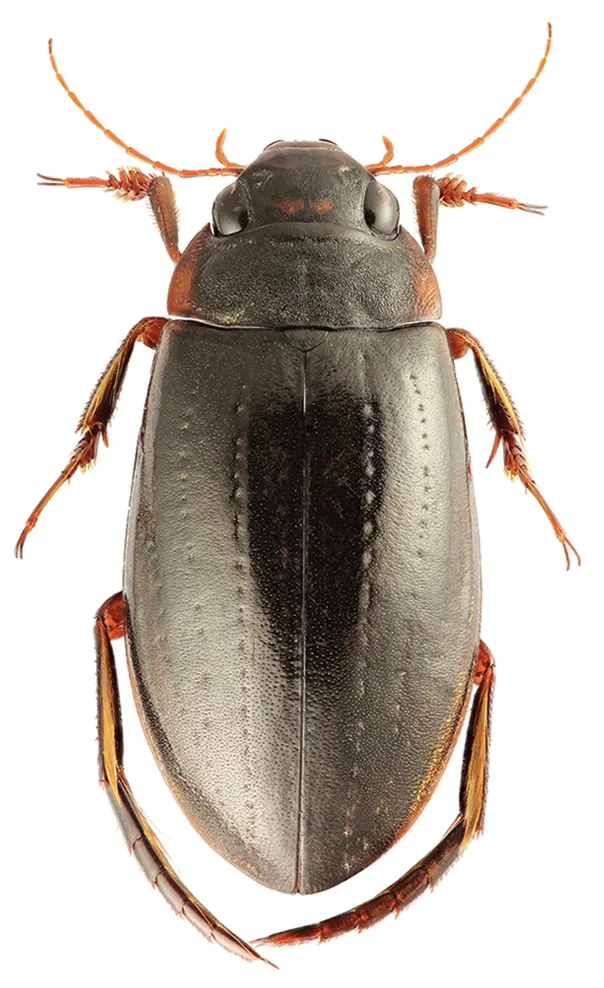
Meladema imbricata is a large diving beetle in the family Dytiscidae, found only on the western Canary Islands, Spain. The IUCN Red List classed it as Critically Endangered in 1996, an assessment that is now very old. Little has been published about how it lives or how many remain.
Where it lives
Thomas Vernon Wollaston described the beetle in 1871. It is endemic to the Canary Islands, which the IUCN lists under Spain, and a 2003 DNA study describes it as a species of the western islands. The Red List places it in freshwater systems, but its record gives no habitat details or elevation.
That 2003 study, in Molecular Ecology, found that beetles on La Gomera and La Palma probably descend from colonists that arrived from Tenerife. A colonisation of La Palma from La Gomera could not be ruled out.
Pins are Wikidata “endemic to” fields. Orange dots, when present, are GBIF occurrence tiles — survey bias included.
How it lives
Almost nothing is published on this species alone. A 2017 paper in Zoologica Scripta, by Sykora and colleagues, describes the genus Meladema as including some of the largest macroinvertebrates of the western Palearctic region, and as top predators in fishless streams.
The same paper modelled climate and found that the island lineages, including M. imbricata, occur in places with low seasonality. Mainland M. coriacea has spread into more seasonal, drier regions.
Relatives and origins
Meladema is a small genus. Besides M. imbricata it holds M. coriacea, which is widespread around the western Mediterranean and also on the Canaries, and M. lanio, which is found on Madeira. A 2003 study by Ribera, Bilton and Vogler sequenced mitochondrial DNA from 51 beetles in 22 populations. It found that the two Atlantic island species, M. imbricata and M. lanio, are each other's closest relatives.
On Tenerife, the only island where M. coriacea and M. imbricata overlap widely, the DNA showed evidence of hybridisation in both directions. The study also dated the splitting of the species to the early Pleistocene, which undercut an older idea that the island beetles were ancient relics.
The 2017 paper added nuclear markers and dated the origin of the genus to the Middle Miocene. It found that the living lineages began diverging in the early Pleistocene, and that the Macaronesian islands were colonised independently of the Mediterranean ones.
Why it is listed
The 1996 assessment used criterion A1c, from the older version 2.3 Red List system, which concerns a reduction linked to loss of habitat area or quality. The record holds no population figure, no list of threats, no habitat entries and no conservation actions, so the reasons behind the listing are not spelled out.
Global records are sparse. The main biodiversity database, GBIF, holds only 39 occurrence records, 19 of them in Spain. The status is best read as an old assessment awaiting review, not as a current count of how many beetles survive.
Sources
Written for this catalog in our own words from the sources below, checked against them on 12 November 2026. Population figures are estimates and carry the year they were made. Status and assessment year: IUCN. 2026. The IUCN Red List of Threatened Species. Version 2026-1. iucnredlist.org.




