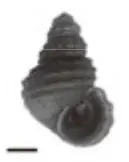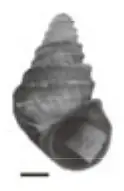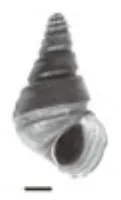
Endangered
Margarya mansuyi
Margarya mansuyi
Margarya mansuyi is a large freshwater snail from the lakes of Yunnan, China, reported now from only two of them. The IUCN Red List assessed it as Endangered in 2009 with a decreasing population, citing pollution, water abstraction and unintended harvest. Some authors place it in the genus Anularya.
What it is
This is an operculate snail in the river snail family Viviparidae, meaning it has a lid-like operculum for closing its shell. Dautzenberg and Fischer described it in 1905, and some references list it as Anularya mansuyi rather than Margarya. It belongs to a group of big snails found in the plateau lakes of Yunnan.
A 2010 redescription in Molluscan Research by Shu, Köhler and Wang, based on material from Lake Xingyun, found that the shell varies widely, especially in how well the spiral keel develops. The species is told apart from close relatives by its relative size and the number and development of its spiral keels.
Where it lives
It is reported now from Xingyun Lake and Qilu Lake in Yunnan, and is listed as a former resident of Yilong Lake, Dian Lake (Dianchi) and Datun Lake. The IUCN assessment gives two locations and describes the range as restricted, with the habitat as permanent freshwater lakes and marshes or pools.
Pins are Wikidata “endemic to” fields. Orange dots, when present, are GBIF occurrence tiles — survey bias included.
Why it is in trouble
The Red List assessment lists sewage, nutrient loads, run-off carrying herbicides and pesticides, water taken from the lakes for farming, and unintended harvest as pressures. The population and the area it occupies are both recorded as declining.
The same story runs through the genus. Shu and colleagues wrote that all recognised Margarya species are threatened or even extinct, blaming water pollution and overharvesting.
Southwest China has lost many endemic species. Yilong Lake went dry in the 1980s through excessive water extraction and lost all five of its endemic fish, according to a Sixth Tone report, and Qilu Lake's last endemic fish was reported as barely clinging on.
What is being done
Conservation measures are thin. The 2009 assessment records conservation sites identified over part of its range, and lists awareness work and habitat protection as needed actions. It also records no recovery plan, no systematic monitoring and no protected area covering the snail.
Sources
Written for this catalog in our own words from the sources below, checked against them on 12 November 2026. Population figures are estimates and carry the year they were made. Status and assessment year: IUCN. 2026. The IUCN Red List of Threatened Species. Version 2026-1. iucnredlist.org.