Critically Endangered
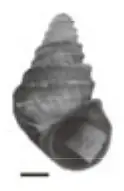
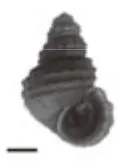
Margarya monodi
Margarya monodi
Margarya monodi is a large freshwater snail that appears to live only in Lake Dianchi, in Yunnan Province, China. It is collected for food and medicine. The IUCN Red List assessed it as Critically Endangered in 2009, and its range in the lake had shrunk to a patch near the outflow.
What kind of snail it is
It is a river snail in the family Viviparidae, with a lidded (operculate) shell that the animal can close behind it. The genus Margarya is found only in China, and only in lakes on the Yunnan Plateau. The species was described by Dautzenberg and Fischer in the early 1900s and was first named as a variety of Margarya melanioides, another Dianchi snail.
A 2010 study in Molluscan Research of two related species, M. melanioides and M. mansuyi, found that shell shape varies greatly within a species, especially in how strongly the spiral keel develops.
Where it lives
Lake Dianchi is the only place it is known from, and the IUCN lists a single location. It lives in a permanent freshwater lake, and the area it occupies is restricted and still shrinking. Snails were still found in the eastern part of the lake in 1999, but by 2009 they were limited to about 50 square kilometres near the lake's outflow.
Pins are Wikidata “endemic to” fields. Orange dots, when present, are GBIF occurrence tiles — survey bias included.
Why it is in trouble
The threats named in the 2009 assessment are organic and inorganic pollution, overharvesting, and introduced predatory fish. The IUCN's structured threat list also records sewage, nutrient loads, run-off, and herbicides and pesticides entering the lake.
People collect the snails commercially to eat and for use as medicine. Fishers reportedly took up to 20 kg each per day before the 1980s. During the open fishing season they now find only about 2 kg a day.
The 2010 Molluscan Research paper reports that all recognised Margarya species have become threatened or even extinct, mainly through water pollution and overharvesting. The IUCN lists the population trend for M. monodi as decreasing.
What is being done
Little protection is recorded. The 2009 assessment notes that conservation sites have been identified over part of the range, but the species does not occur in a protected area. There is no recovery plan, no harvest management plan, no monitoring scheme and no captive population. The IUCN does list captive breeding, awareness work, habitat restoration and habitat protection as measures needed or proposed.
Sources
Written for this catalog in our own words from the sources below, checked against them on 12 November 2026. Population figures are estimates and carry the year they were made. Status and assessment year: IUCN. 2026. The IUCN Red List of Threatened Species. Version 2026-1. iucnredlist.org.