Endangered
Margarya bicostata
Margarya bicostata
Margarya bicostata is a large freshwater snail with a lid-like operculum, found in Lake Fuxian in Yunnan, China. The IUCN Red List assessed it as Endangered in 2009. It is a lake specialist with a tiny range: the area it occupies is about the size of the lake itself.
What it is
This is a river snail (family Viviparidae), a group of large operculate freshwater snails. Tchang and Tsi named it in 1949, with its holotype originally filed as a variety of Margarya mansuyi.
Its name has shifted since. A 2015 revision of the Yunnan snails, published in the Zoological Journal of the Linnean Society by Zhang and colleagues, split Margarya into three genera. It moved this snail into a new genus, Anularya, alongside A. mansuyi. Many databases, including the IUCN and GBIF, still file it under Margarya.
How to recognise it
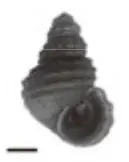
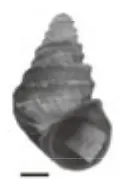
Shells of Lake Fuxian specimens photographed in that revision measure roughly 41 to 61 mm tall, while a juvenile shell is only 12 mm long. Like the rest of the river snail family, it closes its shell opening with an operculum.
Where it lives
Today the snail is known from Lake Fuxian, one of the ancient lakes of the Yunnan plateau. Fuxian covers about 212 square kilometres and reaches 155 m at its deepest, making it the deepest lake in Yunnan. The IUCN puts the snail's occupied area at 212 square kilometres across two locations, a figure that matches the lake's surface area. It is reported to have lived in Dian Lake in the past.
The Red List habitat entries cover permanent freshwater lakes, marshes and pools, and ponds. Little has been published about its diet, breeding or lifespan.
Pins are Wikidata “endemic to” fields. Orange dots, when present, are GBIF occurrence tiles — survey bias included.
Why it is in trouble
The IUCN lists sewage and run-off as the threats, and records a continuing decline in the area it occupies, in its subpopulations and in the number of locations. Fuxian's wildlife as a whole is under strain. The lake has 24 native fish species and subspecies, 11 of them endemic, and most endemic fish are reportedly at risk from water pollution, habitat damage, overfishing and 26 introduced fish species.
The 2009 assessment found no recovery plan, no systematic monitoring scheme for the snail, and no protected area covering it. Conservation sites had been identified over part of its range. The assessment listed awareness work and habitat restoration as conservation actions.
Sources
Written for this catalog in our own words from the sources below, checked against them on 12 November 2026. Population figures are estimates and carry the year they were made. Status and assessment year: IUCN. 2026. The IUCN Red List of Threatened Species. Version 2026-1. iucnredlist.org.