Endangered
Maranhão slider
Trachemys adiutrix
The Maranhão slider, also called the Brazilian slider or Carvalho's slider, is a freshwater turtle found only along the coast of northeastern Brazil. The IUCN Red List lists it as Endangered, but that assessment dates from 1996 and has not been updated. It lives in lagoons that fill and dry with the seasons.
How to recognise it
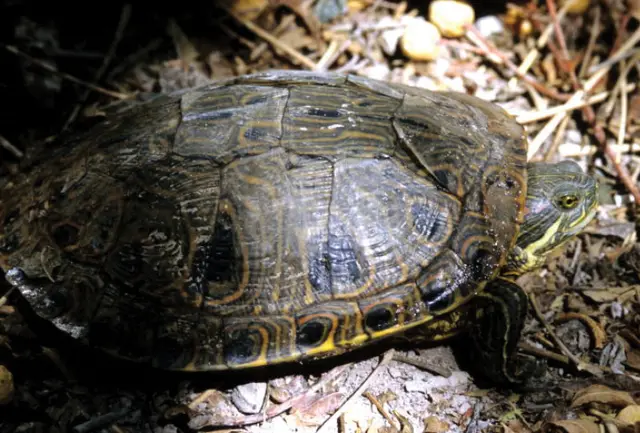
It's a pond slider in the family Emydidae. Young turtles have a green shell with yellow to red patterns, which darkens to brown with age. The plastron, the underside of the shell, is flat and yellow with thick dark lines. The head is fairly large and dark olive to brown above, with yellow-white stripes on the neck, throat, legs and tail.
Females are larger, with broader heads. Males have narrower, more protruding snouts and bigger tails. Published shell lengths run from roughly 100 mm to about 250 mm, the largest being females.
Where it lives
The turtle is endemic to Brazil, recorded from the coastal states of Maranhão and Piauí. Its type locality is Santo Amaro do Maranhão, beside Lençóis Maranhenses National Park.
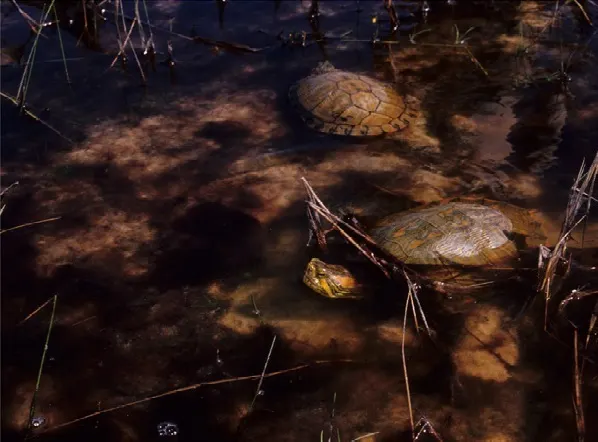
It lives in freshwater lakes, ponds and rivers. In the dune fields of Maranhão, the lagoons fill in the rainy season and shrink or vanish in the dry season. At the start of the rains the turtles leave the surrounding land and cross hot sand to reach the ponds, a trip that costs them energy and water. A layer of impermeable rock under the sand is what lets the lagoons hold water.
Pins are Wikidata “endemic to” fields. Orange dots, when present, are GBIF occurrence tiles — survey bias included.
How it lives
This is an egg-laying species, and little more is documented about its breeding or diet. It is understudied. Even its classification is debated. Paulo Vanzolini described it as a species in 1995, and the IUCN accepts it as one. Several recent references, including a 2017 turtle taxonomy checklist and a 2024 paper, treat it instead as a subspecies of D'Orbigny's slider (Trachemys dorbigni adiutrix).
Why it is in trouble
Its range is small and tied to seasonal water. Residents of poor nearby communities eat the turtles and catch many of them in the dry season, when they gather in shrinking ponds. The 1996 listing is under criteria B1+2c, which cover a restricted range with continuing decline in the extent or quality of habitat, but it records no threat details or population figures.
What is being done
Part of the range lies inside Lençóis Maranhenses National Park. The 1996 assessment records no conservation actions, and the Endangered rating has not been revisited since, so the current state of the population is unclear.
Sources
Written for this catalog in our own words from the sources below, checked against them on 12 November 2026. Population figures are estimates and carry the year they were made. Status and assessment year: IUCN. 2026. The IUCN Red List of Threatened Species. Version 2026-1. iucnredlist.org.