Endangered
Cuatro Ciénegas slider
Trachemys taylori
The Cuatro Ciénegas slider (Trachemys taylori) is a freshwater turtle found only in the spring-fed wetlands of the Cuatro Ciénegas Basin, a desert valley in Coahuila, Mexico. The IUCN Red List rated it Endangered in 2007 and records a decreasing population. Water loss and hybridisation are among the threats it lists.
How to recognise it
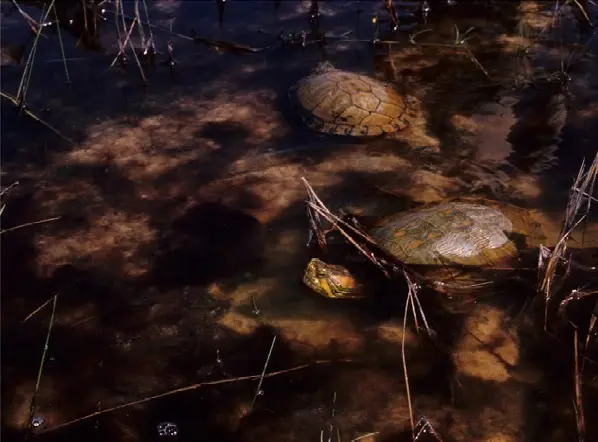
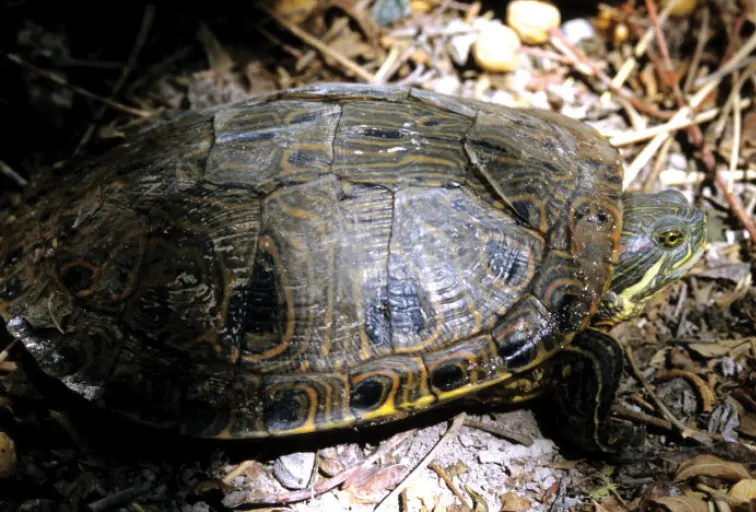
Descriptions give it an olive to dark brown shell marked in light yellow or orange. The skin is greenish with yellow stripes on the head and limbs, and the underside shell is yellow with dark markings. Males are reportedly smaller, with longer front claws and tails, while females are larger with shorter claws and tails.
Herpetologist John Legler named it in 1960 as a subspecies of the slider, Pseudemys scripta taylori, honouring Edward H. Taylor of the University of Kansas. It has carried several names since, and its placement in the genus Trachemys dates to 2002. A 2024 study by Fritz and colleagues found it nested within Trachemys venusta and reduced it to a subspecies of that turtle, so some sources now list it that way, while others still treat it as its own species.
Where it lives
It is found only in the Cuatro Ciénegas Basin, a valley in the Chihuahuan Desert in Coahuila, Mexico. It lives in warm, spring-fed pools, streams and marshes, reportedly with clear, mineral-rich water. The Red List assessment names permanent freshwater pools under 8 hectares and permanent streams as its habitats.
Pins are Wikidata “endemic to” fields. Orange dots, when present, are GBIF occurrence tiles — survey bias included.
How it lives
It's an omnivore that reportedly feeds on aquatic plants, algae, insects and small fish. It is said to breed in spring and early summer, with females laying eggs on land in sandy or soft soil and hatchlings emerging after about two to three months. Young turtles are said to be eaten by birds, fish and mammals.
Why it is in trouble
The basin's water is the issue. The Turtle Conservancy points to groundwater loss from intensive farming and industry outside the valley, along with rapid human population growth, climate change, rainfall swings and tourism. It puts the remaining wild population at fewer than 1,000 turtles, though that number carries no date.
The Red List assessment lists small-holder farming, dams, roads and railroads, groundwater abstraction and a named species among the threats, and it cites hybridisation as one of the stresses. The 2007 rating rests on criteria A4e and B1ab(iii,v)+2ab(iii,v), which cover population decline and a small range with continuing habitat decline.
What is being done
The Turtle Conservancy has worked on a parcel it manages in the valley for roughly a decade, alongside local conservationists. It says a group of property owners, government agencies and conservationists is seeking a more sustainable water-use plan for the valley. The valley is also a federally protected flora and fauna area and a UNESCO biosphere reserve.
One secondary source reports that researchers are working to restore water levels and stop illegal collecting, and that captive breeding is being explored.
Sources
Written for this catalog in our own words from the sources below, checked against them on 12 November 2026. Population figures are estimates and carry the year they were made. Status and assessment year: IUCN. 2026. The IUCN Red List of Threatened Species. Version 2026-1. iucnredlist.org.