Endangered
Parker's tree frog
Parker's tree frog
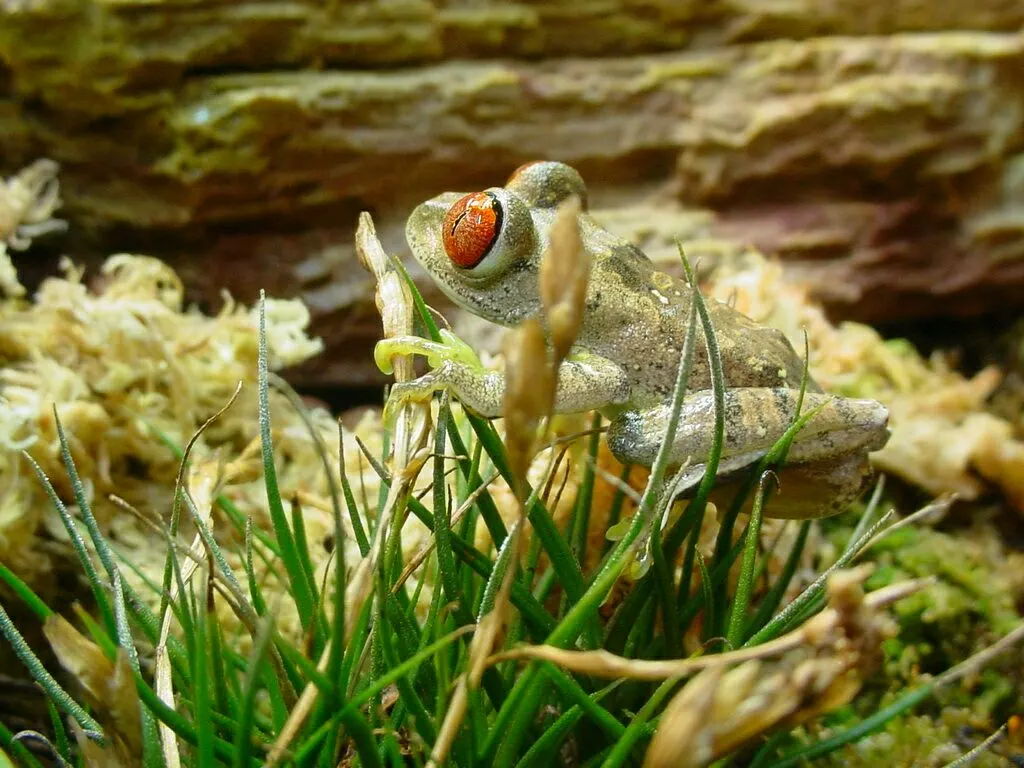
Parker's tree frog is a medium-sized forest frog found only in the Eastern Arc Mountains of Tanzania. Its bright red eyes are its calling card. The IUCN Red List assessed it as Endangered in 2013 because its range is small, its population is severely fragmented and its forest habitat is declining.
How to recognise it
Parker's tree frog has a small eardrum and extensive webbing on the fingers and toes. The eyes are bright red, a feature that helps separate it from related tree frogs.
Males and females look quite different. Adult males measure 34 to 43 mm from snout to vent and have grey, brown or olive-green backs with irregular yellowish cross-bands and a white throat. Females are bigger, at least 56 mm, with a plain olive-green back and an orange throat. In both sexes the flanks, the undersides of the limbs and the toes are yellow-orange.
Where it lives
The species is endemic to Tanzania. It is known from several mountains of the Eastern Arc chain: the Uluguru, Udzungwa, East and West Usambara, Nguru and South Pare. The IUCN thinks it is unlikely to occur much more widely than this, and puts its extent of occurrence at about 3,684 square kilometres.
It lives mainly in good-quality forest. Although it is mostly a montane frog, it is found in the foothills down to at least 300 m and up to at least 2,000 m, and the elevations it uses differ from one mountain to the next. The Red List habitat records cover lowland and montane moist forest and streams, both permanent and seasonal. The 2013 assessment counted six locations.
Pins are Wikidata “endemic to” fields. Orange dots, when present, are GBIF occurrence tiles — survey bias included.
How it lives
Little has been written about its daily life. It is locally common in some places, including Nilo, the Nguru Mountains and the Uluguru Mountains. Its breeding has not been described: the IUCN presumes eggs are laid on land and the larvae are aquatic, as in related frogs.
Why it is in trouble
The main problem is loss and degradation of forest, above all small-scale farming creeping into forest that has no protection. The IUCN also lists increased fire frequency and intensity. A 2008 survey by Menegon and colleagues in the Nguru Mountains added selective logging and the clearing of the forest shrub and herb layer to grow cardamom and yams.
The population is severely fragmented, which means separate groups are cut off from one another. Together with a small range and declining forest quality, that is why it qualifies as Endangered under criterion B1ab(iii). Its population trend is recorded as unknown. The IUCN also notes that molecular data suggest more than one species may be hidden under this name.
What is being done
It occurs in Amani, Nilo and Uluguru Nature Reserves and in several other reserves across its range, with more reserves proposed at Chome in the South Pare Mountains, on the Udzungwa scarp and at Mkingu in the Nguru Mountains. The IUCN says these reserves are relatively well protected compared with others in the region, but that protection and management still need to improve.
More information is needed on its distribution, population status and natural history.
Sources
Written for this catalog in our own words from the sources below, checked against them on 12 November 2026. Population figures are estimates and carry the year they were made. Status and assessment year: IUCN. 2026. The IUCN Red List of Threatened Species. Version 2026-1. iucnredlist.org.