Endangered
Scott's sportive lemur
Lepilemur scottorum
Scott's sportive lemur (Lepilemur scottorum), also called the Masoala sportive lemur, is a small nocturnal primate of northeastern Madagascar. It was described only in 2008 from Masoala National Park and is listed as Endangered by the IUCN Red List (2020 assessment, criteria B1ab(i,iii,v)), a code that points to a small and shrinking range.
How to recognise it
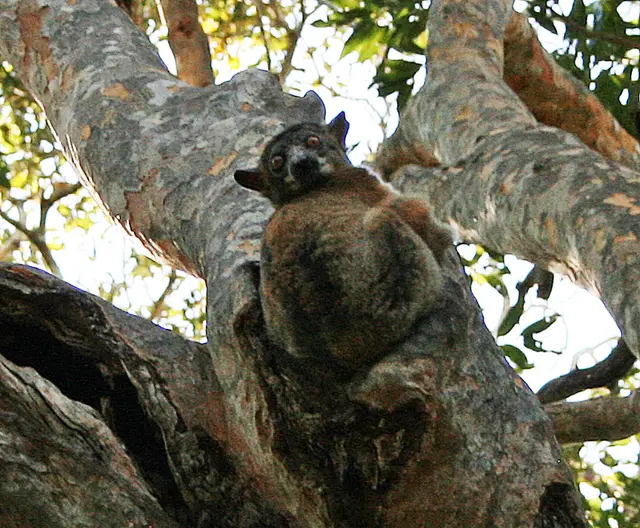
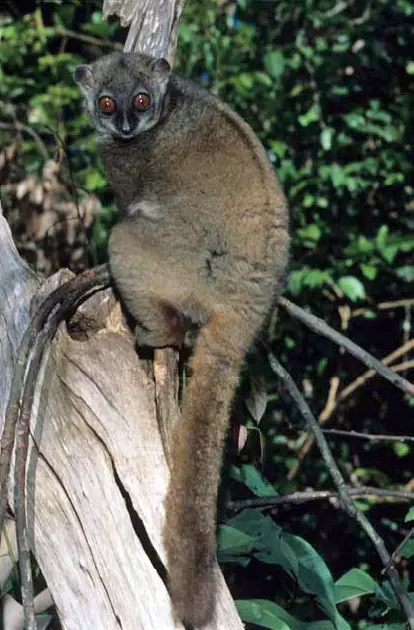
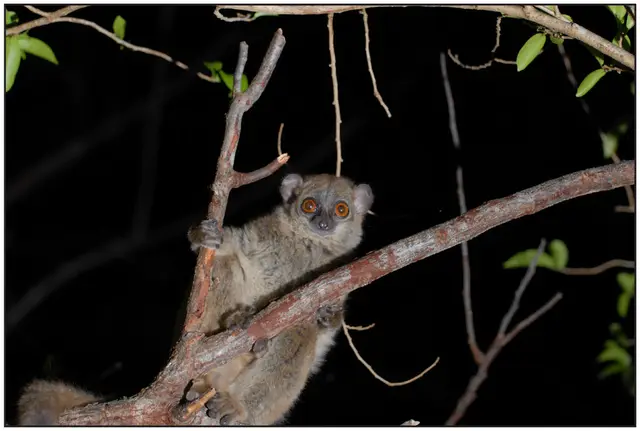
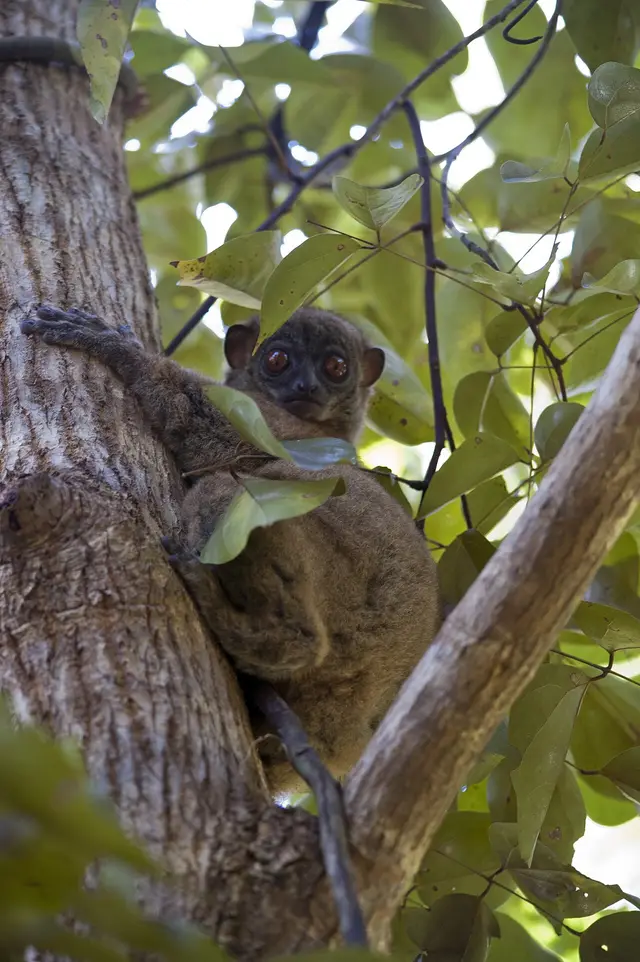
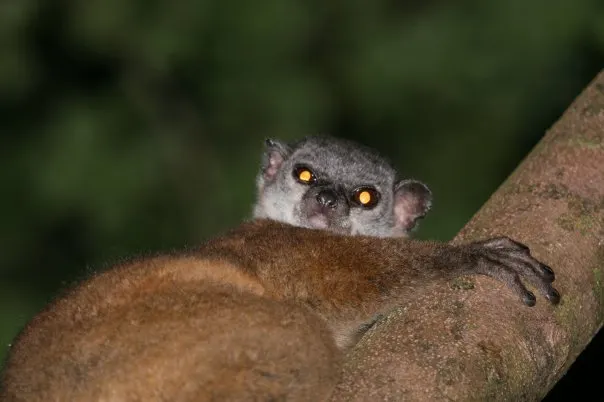
It is a medium-sized sportive lemur. The type series, described in 2008, gave a weight of about 0.88 kilograms, lighter than its relatives Seal's, weasel and Wright's sportive lemurs. The fur is long, thick and uniformly reddish brown, including the belly, with a faint black stripe down the middle of the back that stops around mid-body.
The face is whitish grey with white cheeks and eyebrows, and the hands and feet are reddish brown. The tail is reddish brown at the base and fades to brownish grey, ending in a black tip. The weight comes from only three animals, so it is not a species average.
Where it lives
When it was described, the species was known only from Masiaposa Forest in Masoala National Park, in Antsiranana Province, and the describers said more survey work was needed to learn its eastern and northern limits. It is endemic to Madagascar.
Later surveys on the Masoala Peninsula found it in primary lowland forest and in more disturbed forest types, though in low numbers.
Pins are Wikidata “endemic to” fields. Orange dots, when present, are GBIF occurrence tiles — survey bias included.
How it lives
Very little has been published on its daily life. It is nocturnal, and what is known comes mainly from night surveys aimed at nocturnal lemurs. One survey on the Masoala Peninsula used 11 transects totalling 33 kilometres. It recorded Scott's sportive lemur at 0 to 1 animal per kilometre, too few sightings to calculate a density.
Why it is in trouble
The 2008 describers noted that Madagascar has lost about 90% of its original forest to human activities such as agriculture and logging, and that the remaining forest has become an unconnected mosaic of fragments. A 2017 study of the peninsula names slash-and-burn farming, land conversion for rice, illegal hardwood logging and bushmeat hunting as the main causes of habitat disturbance in the region.
In that survey, Scott's sportive lemur and Moore's woolly lemur both varied significantly in abundance between forest types, while a mouse lemur did not. The researchers linked this to the two species' specialised movement and diet, which suggests they cope poorly with disturbed forest.
What is being done
The type locality lies inside Masoala National Park, and the species has been surveyed there. It is reportedly listed in CITES Appendix I. No species-specific recovery plan was found in the sources checked.
Sources
Written for this catalog in our own words from the sources below, checked against them on 12 November 2026. Population figures are estimates and carry the year they were made. Status and assessment year: IUCN. 2026. The IUCN Red List of Threatened Species. Version 2026-1. iucnredlist.org.
- IUCN Red List assessment (status from catalog data; page could not be opened)
- Lei et al. 2008, Nocturnal Lemur Diversity at Masoala National Park, Texas Tech Museum Special Publication 53
- Effect of habitat disturbance on nocturnal lemurs, Masoala Peninsula, Primates 2017 (abstract via Europe PMC)
- Scott's sportive lemur, Wikipedia