Critically Endangered
Prince Charles stream tree frog
Hyloscirtus princecharlesi
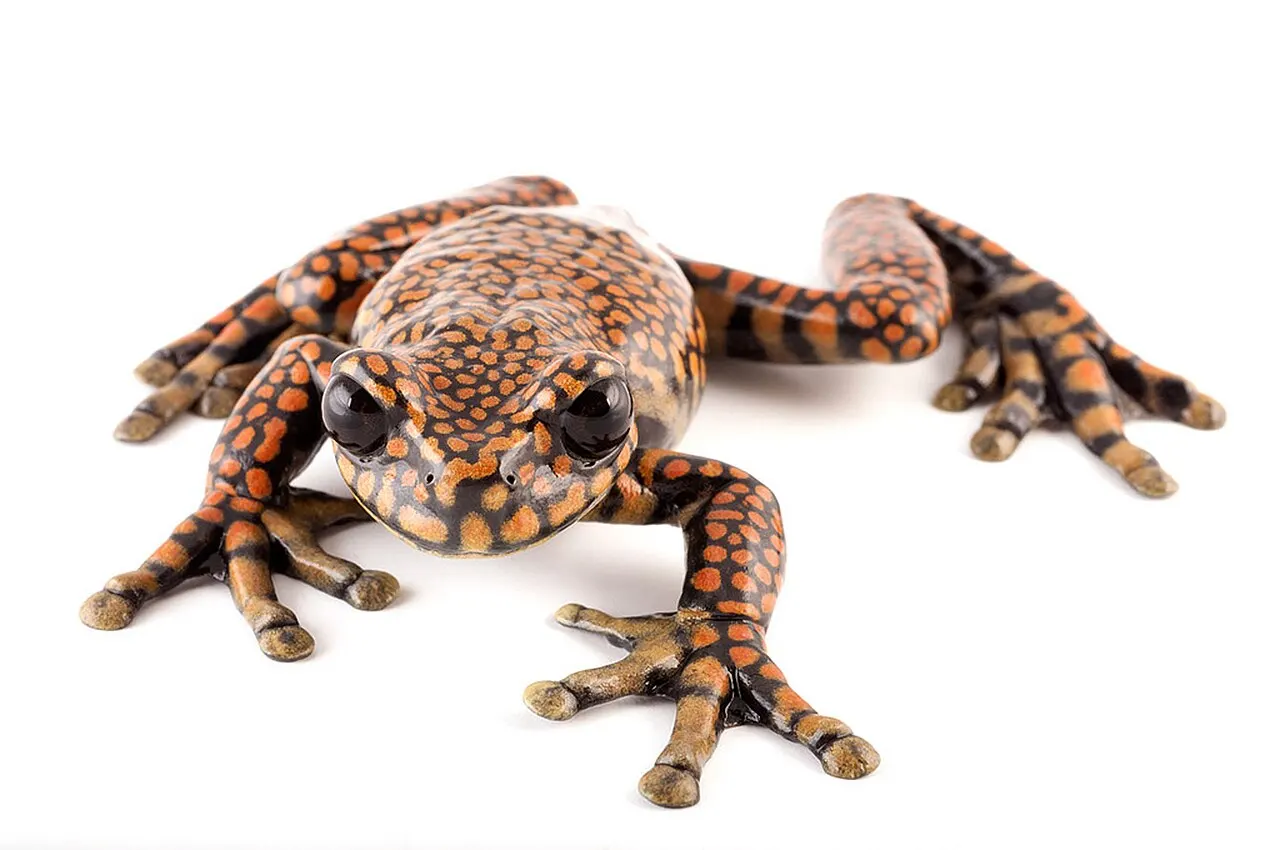
The Prince Charles stream tree frog (Hyloscirtus princecharlesi) is a black, orange-spotted frog from cloud forest streams in northern Ecuador. It was described as new to science in 2012 and is known from a single location. The IUCN Red List assessed it as Critically Endangered in 2022.
How to recognise it
The frog is black with evenly spread orange spots, a bold pattern for a stream frog. It is active at night and is found among vegetation along streamsides in montane cloud forest. Its size is not given in the sources available.
It was described, along with a second new species, Hyloscirtus cryptico, in a 2012 paper in Zootaxa by Luis Coloma and colleagues. The name honours Prince Charles, now King Charles III, for his work to support rainforest protection.
Where it lives
The species is known from the Cordillera de Toisan in the north-west Andes of Ecuador, in Imbabura Province. The Red List records one location at about 1,864 to 2,861 m and an extent of occurrence of only about 24 square kilometres. It lives along forest streams, and the assessment says it does not occur in any protected area.
Accounts differ about where living frogs were found. Mongabay reported that Coloma collected a live one in 2009 at Reserva Las Gralarias, a private reserve, while other accounts place the rediscovery in the Cotacachi-Cayapas area. Coloma first recognised the species among preserved museum specimens.
Pins are Wikidata “endemic to” fields. Orange dots, when present, are GBIF occurrence tiles — survey bias included.
Why it is in trouble
The Red List projects an 80 percent future decline and says the population is still shrinking. Listed threats are small-scale farming and cattle grazing, herbicides and pesticides, drought, accidental harm from local harvest, and an introduced species. Reptiles Magazine named invasive trout in its streams.
At the time of its description, reports also pointed to logging, burning and unregulated land use. Mongabay noted that chytrid fungus has hit amphibians in the cloud forest streams where this frog and its sister species live. In 2012 Coloma was quoted as expecting a population drop of around 50 percent within ten years.
What is being done
The Red List calls for protecting the site and its habitat, restoring habitat, and captive breeding, but no protected area covers the frog today. Amphibian Ark reportedly raised several frogs to support the wild population, though details of any captive group are thin.
Sources
Written for this catalog in our own words from the sources below, checked against them on 12 November 2026. Population figures are estimates and carry the year they were made. Status and assessment year: IUCN. 2026. The IUCN Red List of Threatened Species. Version 2026-1. iucnredlist.org.