Endangered
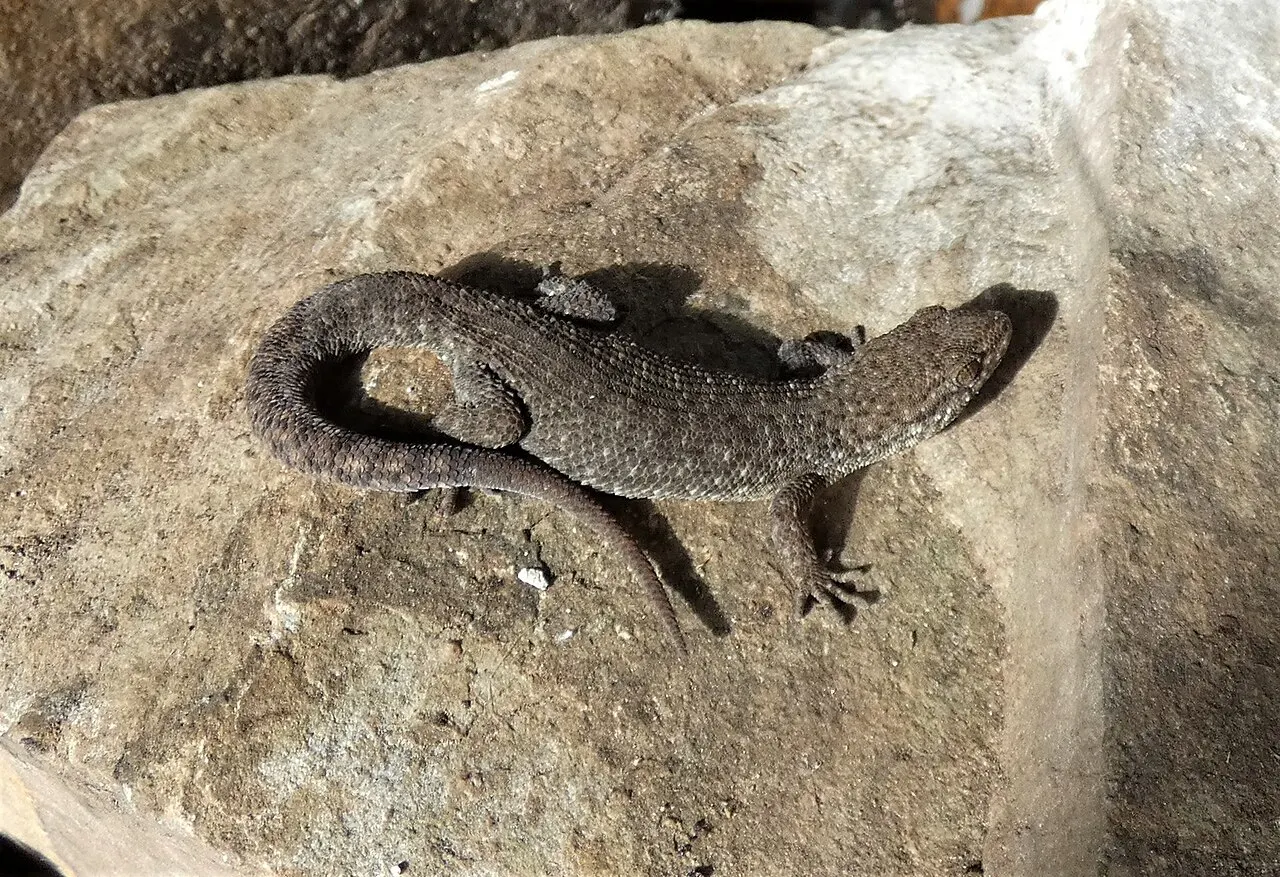
Uruguay Marked Gecko
Homonota uruguayensis
The Uruguay marked gecko (Homonota uruguayensis) is a small lizard of the Pampas, living on basalt rock outcrops in Uruguay and southern Brazil. The IUCN Red List lists it as Endangered (2021) and records a decreasing population. It stays close to home, which makes isolated groups hard to replace.
How to recognise it
This is a small gecko, under 50 mm from snout to vent. Males and females differ slightly in head, neck and toe proportions, though you'd need calipers to see it.
It was described in 1961 by Vaz-Ferreira and Sierra de Soriano, who first placed it in a different genus (Wallsaurus). It was later moved to Gymnodactylus and then to Homonota.
Where it lives
The gecko is found in the Pampas of Uruguay (including Artigas and Tacuarembó departments) and in the far south of Brazil, in Rio Grande do Sul. The Uruguay, Negro and Ibicuí rivers mark the edges of its known range. The Red List describes its habitat as temperate grassland and rocky areas, and gives an occupied area of roughly 160 to 164 km2.
Its real homes are basalt outcrops standing in the grassland like islands. A genetic study found it only on basalt outcrops, and a site suits the gecko only if the rocks are the right size to shelter and nest under.
A taxonomic split matters here. In 2023 a divergent lineage from near Alegrete in Rio Grande do Sul was described as a separate species, Homonota xiru, so older studies and range figures for H. uruguayensis may include animals now assigned to it.
Pins are Wikidata “endemic to” fields. Orange dots, when present, are GBIF occurrence tiles — survey bias included.
How it lives
It lays eggs and uses outcrops for shelter and nesting. A study on a 4-hectare rocky outcrop in Rosário do Sul, Brazil, ran in four seasonal expeditions between May 2010 and January 2011 and logged 1,541 lizards over about 1,185 hours of fieldwork. Roughly two thirds were active. Activity was highest in spring and summer. Daytime activity beat night activity in autumn, winter and spring, while in summer the two were similar. Most active animals were found at air temperatures between about 14 and 33 degrees Celsius.
Movement is limited. The longest recorded movement was about 190 m, by a female in the breeding season. A 2015 genetic study found no shared haplotypes between localities, so each outcrop's geckos form a distinct group.
Why it is in trouble
The Red List names mining and quarrying of rock, and small-holder grazing, ranching and farming, as threats. These degrade or convert the outcrops. The assessment records the population as severely fragmented and the occupied area as still shrinking, and since individuals move so little, a lost outcrop may be hard to recolonise.
What is being done
Site and area protection is the conservation action listed for the species, though whether it occurs in a protected area was recorded as unknown in the 2021 assessment. A 2025 genetic study in the Herpetological Journal found six distinct populations and assigned them to different management units. It found phylogenetic diversity highest in northern Artigas and the southernmost sites in Rio Grande do Sul, and suggested that northern Salto, together with the Valle del Lunarejo protected area, would protect the largest share of it.
Sources
Written for this catalog in our own words from the sources below, checked against them on 12 November 2026. Population figures are estimates and carry the year they were made. Status and assessment year: IUCN. 2026. The IUCN Red List of Threatened Species. Version 2026-1. iucnredlist.org.
- IUCN Red List assessment, Homonota uruguayensis
- Wikipedia, Uruguay marked gecko
- Felappi et al. 2015, PLoS ONE phylogeography
- Iheringia Serie Zoologia, activity of the gecko at Rosario do Sul
- Herpetological Journal 35(1), 2025, genetic diversity and conservation priorities
- Reptile Database, Homonota xiru
- Reptile Database, Homonota uruguayensis




