Endangered
Hewitt's ghost frog
Heleophryne hewitti
Hewitt's ghost frog (Heleophryne hewitti) is a mottled mountain-stream frog found only in a few rivers of South Africa's Eastern Cape. The IUCN Red List assessed it as Endangered in 2025, with a decreasing population estimated at 2,500 to 10,000 mature animals. Pine plantations and silt are its main problems.
How to recognise it
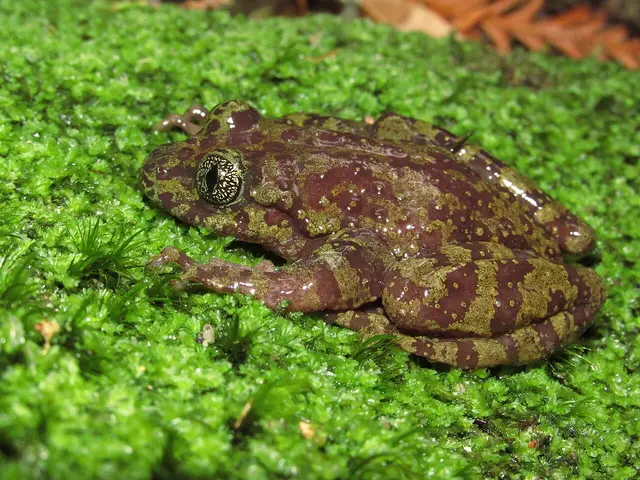
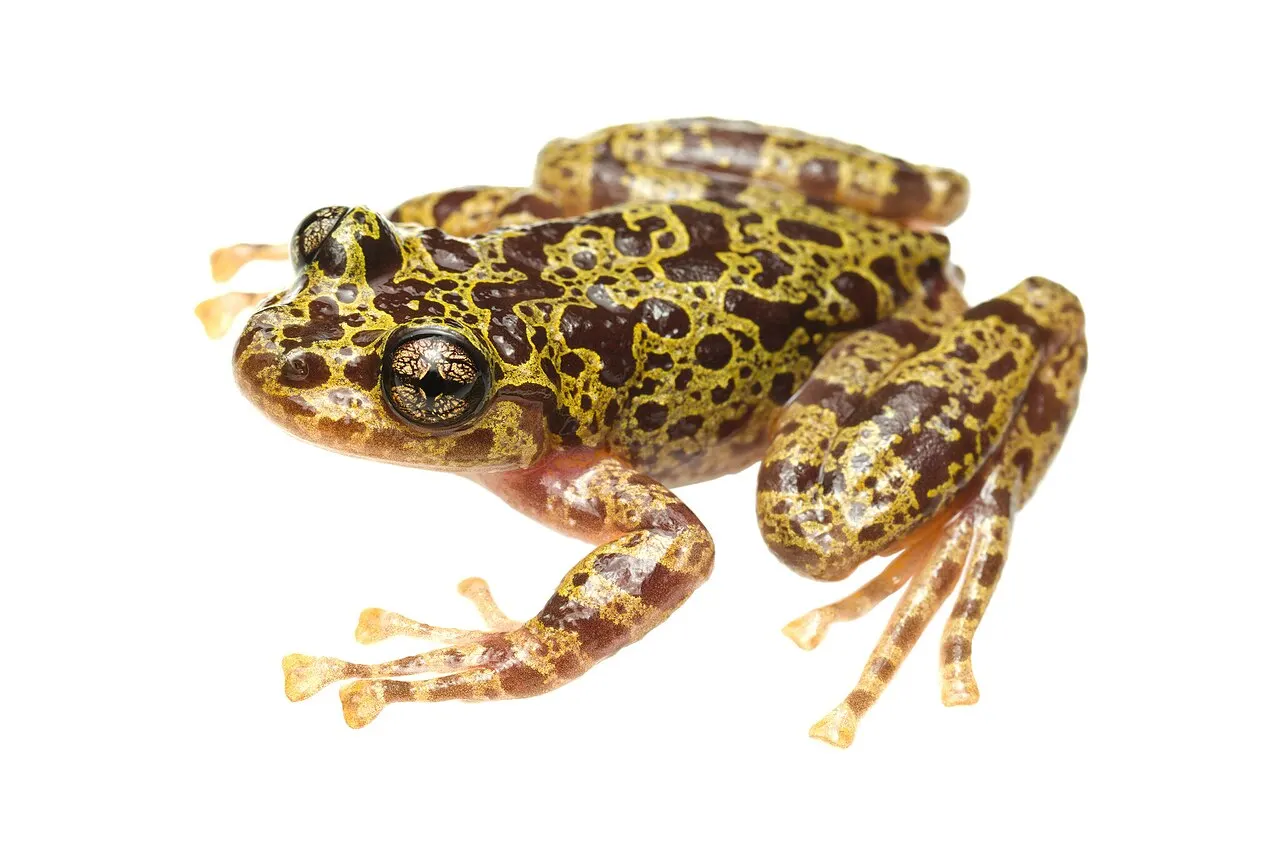
It's a medium-sized frog. Females reach about 50 mm from snout to vent and males about 47 mm. Like other ghost frogs it has long legs, a squat posture and spatula-shaped toe pads. The back is light brown to olive-brown with large dark blotches edged in thin pale lines, and the blotches form dark bands across the legs.
Tadpoles are easier to find than the adults, and some distribution records rest on tadpoles alone. They hold onto rocks with sucker-like mouthparts so the current doesn't wash them away.
Where it lives
Boycott described the species in 1988. It is found only in the Eastern Cape. The long-known sites are four perennial rivers (the Geelhoutboom, Martin's, Klein and Diepkloof) that rise in the Elandsberg range. Tadpoles from the Cockscomb mountains have been tentatively identified as this species, and conservation profiles list a fifth population there. The four Elandsberg river sources span only about 10 km, and no two of the rivers are more than 3.5 km apart.
The IUCN's 2025 assessment counts three locations, an area of occupancy of about 416 square kilometres, an extent of occurrence of about 928 square kilometres, and elevations from 400 to 930 m. Its habitats are permanent streams and the Mediterranean-type shrubland known as fynbos, mainly the moister grassy fynbos.
Pins are Wikidata “endemic to” fields. Orange dots, when present, are GBIF occurrence tiles — survey bias included.
How it lives
Adults and tadpoles shelter under submerged or partly submerged rocks in clear, fast, rocky streams, sometimes at the edges of small cascades. Adults are assumed to leave the water outside the breeding season to feed on land, but little is known about that phase. Reported prey includes insects, other arthropods, snails and smaller frogs.
Males call at night and by day from under large, flat, partly submerged rocks and from the sides of rocky gullies, and calling has been heard in October and November. Eggs are large and yellow, 93 to 150 per clutch in records from the Elandsberg, usually laid under rocks in quiet backwaters 20 to 60 cm deep. Tadpoles take up to about two years to develop. A brown water snake is a known predator of both tadpoles and adults.
Why it is in trouble
Most of the natural vegetation around its streams has been replaced by exotic pine plantations that reach the water's edge, leaving little land habitat. After fires in the 1980s, burnt timber was left in watercourses and later rains washed debris and silt into nearly every stretch of stream, including the type locality. A 2002 visit found two of the rivers invaded by alien pine and wattle, with silt burying rapids and pools.
The IUCN lists plantation forestry, soil erosion and sedimentation, water abstraction and utility lines as current threats. Dams and introduced fish are also named as threats in other accounts. The 2025 assessment reports a continuing decline in habitat area. The IUCN rated the species Critically Endangered in 2004, then Endangered in 2010 and since.
What is being done
A 2004 atlas account listed the frog as protected under Cape provincial conservation law (Ordinance 19 of 1974) and covered by the environmental policy of a state forestry company. The IUCN notes that an estimated 11 to 20 percent of the population lies inside protected areas, a systematic monitoring scheme exists, and invasive species control is under way. No captive population exists, and EDGE of Existence reported in its species profile that no conservation measures specific to this frog were in place.
From 2009 to 2011, Werner Conradie led a project on the threats to ghost frogs in the Elandsberg range. Recommended work includes hand-cutting and removing alien trees from riverbeds, monitoring known populations and searching for new ones.
Sources
Written for this catalog in our own words from the sources below, checked against them on 12 November 2026. Population figures are estimates and carry the year they were made. Status and assessment year: IUCN. 2026. The IUCN Red List of Threatened Species. Version 2026-1. iucnredlist.org.