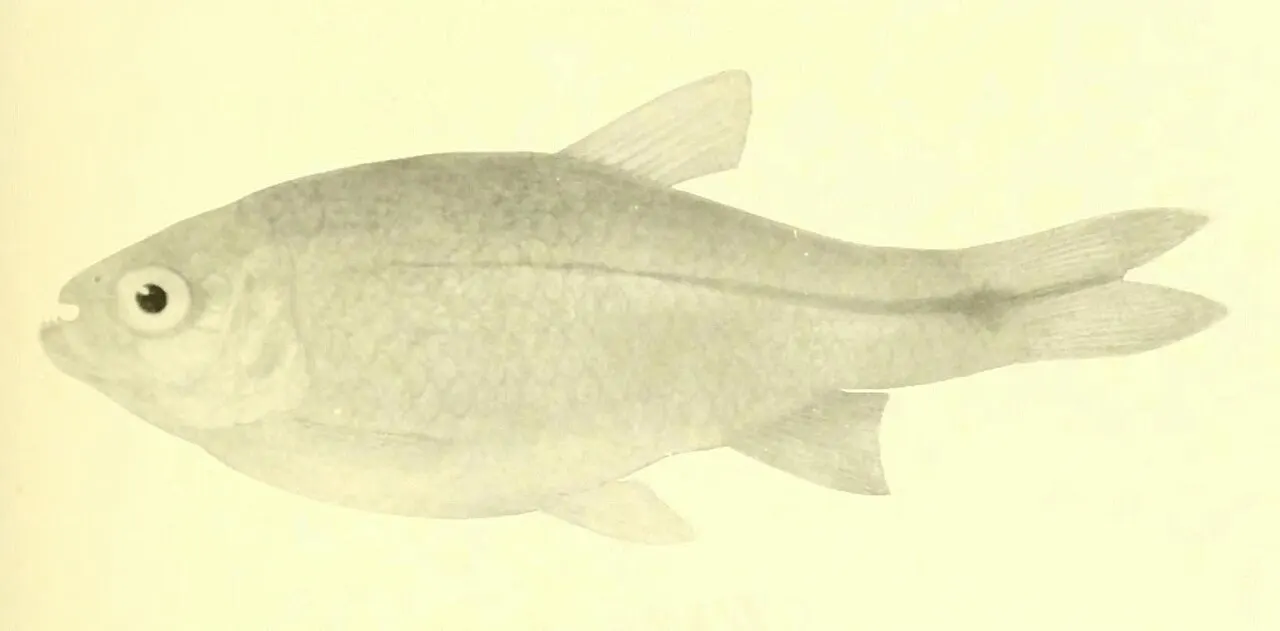
Critically Endangered
Hasemania melanura
Hasemania melanura
The copper tetra (Hasemania melanura) is a tiny freshwater fish known only from the Iguaçu River basin in southern Brazil. The IUCN Red List rates it Critically Endangered under criterion D and flags it as possibly extinct, because the only population estimate is 0 to 50 fish.
What it is
This is a small characin, the group that holds the tetras and lambaris. Adults reach about 4.4 cm in total length at most, so one fits easily in the palm of a hand. The Red List gives its common name as lambari, the Portuguese word used for many small characins.
The IUCN and GBIF place it in the family Characidae, while FishBase files it under Acestrorhamphidae, so the family depends on which database you read. Ellis described it in 1911 in the Annals of the Carnegie Museum, in a paper on fishes collected by John D. Haseman for that museum.
It became the type species of the genus Hasemania, named in Haseman's honour. The genus has seven valid species, all found only in Brazil and mostly with small ranges.
Where it lives
The copper tetra belongs to the Iguaçu River basin in southern Brazil. The Red List gives its range as the states of Paraná and Santa Catarina and its habitat as permanent rivers and streams. It is a freshwater species with no marine stage.
FishBase classes it as pelagic, meaning it swims in open water rather than near the bottom. Little else about its daily life has been published. The Red List marks life history and ecology, along with population size, distribution and trends, as research needs.
Pins are Wikidata “endemic to” fields. Orange dots, when present, are GBIF occurrence tiles — survey bias included.
Why it is in trouble
The Red List assessment was carried out in 2018 and published in 2022. It lists the population as 0 to 50 fish, with the trend unknown, and marks every recorded location as possibly extinct. A population this small qualifies a species as Critically Endangered under criterion D on its own.
The one threat the assessment names is dams, of unknown size. The assessment gives no further detail on how dams affect this fish.
What is being done
The Red List gives site protection and resource and habitat protection as the conservation actions needed, and records that it is not known whether the species occurs in a protected area.
In Brazil, ICMBio ordinance 1.560 of 24 April 2025 approved the second cycle of the national action plan for fishes of the Iguaçu basin. The plan runs from 2 May 2025 to 2 May 2030 and covers 11 nationally threatened species, five of them Critically Endangered, including the copper tetra and its relative Hasemania maxillaris.
A ministry ordinance of 27 April 2026 (GM/MMA 1.667) also lists the copper tetra as Critically Endangered on Brazil's national list.
Sources
Written for this catalog in our own words from the sources below, checked against them on 12 November 2026. Population figures are estimates and carry the year they were made. Status and assessment year: IUCN. 2026. The IUCN Red List of Threatened Species. Version 2026-1. iucnredlist.org.