Critically Endangered
Haliotis rubiginosa
Haliotis rubiginosa
The Lord Howe abalone (Haliotis rubiginosa) is a small sea snail found only around Lord Howe Island, in the Tasman Sea off eastern Australia. The IUCN Red List rates it Critically Endangered (assessment published 2022). Among the 54 abalone species assessed worldwide, it is the only unexploited one in that top category.
How to recognise it
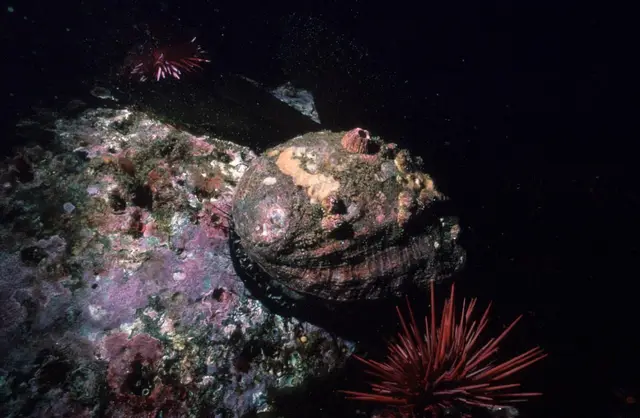
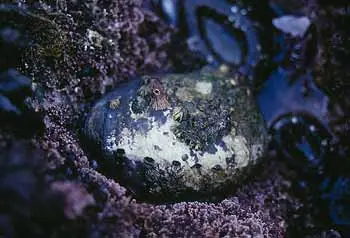
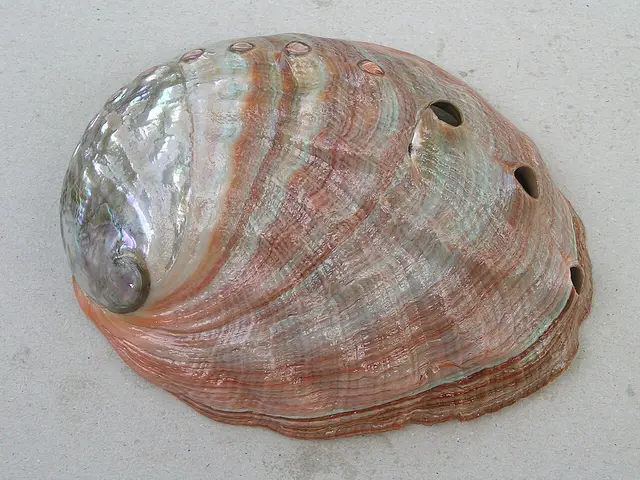
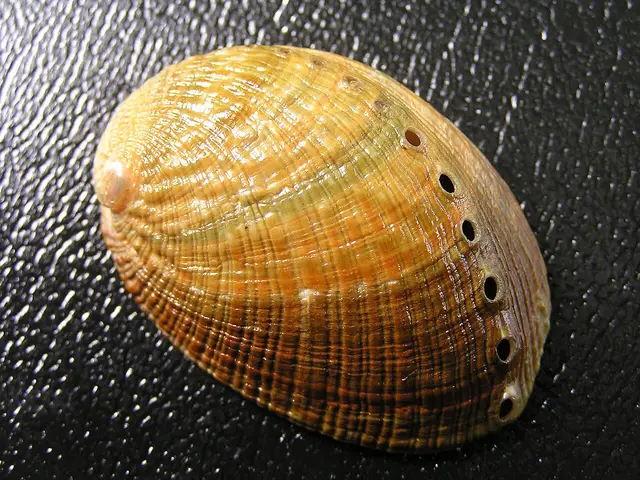
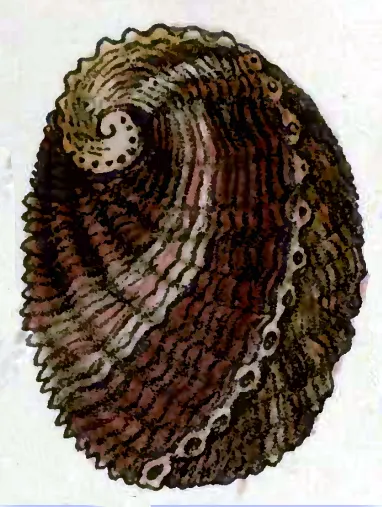
Like other abalone, it is a marine gastropod in the family Haliotidae, with a low, ear-shaped shell and a row of open holes along one edge. In this species the shell is described as oval and fairly convex, wrinkled, with spiral ridges, and carries six open holes.
The outside is rusty orange streaked with white and the inner surface is silvery. Shells are usually described as 30 to 50 mm long, while a 2024 global assessment lists the species at 56 mm, so large individuals may run bigger. The Red List calls it a small to medium-sized abalone and says it is too small to eat.
Where it lives
Lord Howe Island is a small island about 10 km long, in the Tasman Sea off New South Wales. The abalone is restricted to its waters, from the intertidal zone down to roughly 10 m, where it lives under rocks, in rubble and on ledges. The Red List describes the habitat as shallow rocky reef and macroalgal or kelp beds.
The assessment treats the whole population as one location. Both its estimated area of occupancy and its extent of occurrence are 48 square kilometres.
Pins are Wikidata “endemic to” fields. Orange dots, when present, are GBIF occurrence tiles — survey bias included.
A name with a tangled history
Lovell Reeve named the species in 1846. It was later treated as a synonym, subspecies or form of Haliotis varia, and Iredale gave it other names (Haliotis howensis) in 1929. It is now accepted as a separate species.
Why it is in trouble
A 2024 global Red List study of abalones in the journal PLOS ONE links the species' Critically Endangered rating to its rarity, its tiny range and its exposure to marine heatwaves. It is the only unexploited abalone in that category, which makes its position unusual.
The assessment lists temperature extremes as an ongoing threat across the whole population, and other unspecified impacts as a future one. Marine heatwaves in 2010 and 2011 and a bleaching event in 2019 affected the island's waters. Abalone are sensitive to thermal stress, and with such a small range there is little room to escape it.
Numbers are poorly known. Visual surveys of intertidal reefs in 2019 at ten locations covering 15,600 square metres found only six animals, at three sites, under calcium carbonate boulders. Those surveys were unpublished and did not cover deeper reef, so the assessment says they possibly indicate a collapse. The population trend is listed as unknown and no population estimate exists.
What is being done
The waters around Lord Howe Island form a marine park, and the Red List records that conservation sites cover part of the range and an area-based management plan is in place. It notes that the park's rules limiting harvest of certain species do not apply to this abalone. At the time of the assessment there was no recovery plan, no systematic monitoring scheme and no captive population.
The assessment lists population size, distribution and trends, habitat, life history and threats among its research needs.
Sources
Written for this catalog in our own words from the sources below, checked against them on 12 November 2026. Population figures are estimates and carry the year they were made. Status and assessment year: IUCN. 2026. The IUCN Red List of Threatened Species. Version 2026-1. iucnredlist.org.