Endangered
Haliotis gigantea
Haliotis gigantea
The giant abalone is a large sea snail that grazes on rocky reefs and kelp beds around Japan and Korea. The IUCN Red List rates it Endangered (assessed 2022), with a decreasing population. Overharvest has cut its numbers, and in some fishing grounds the loss of seaweed beds has left almost none.
How to recognise it
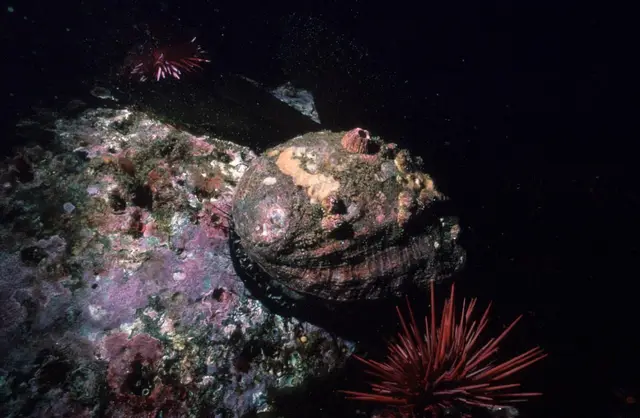
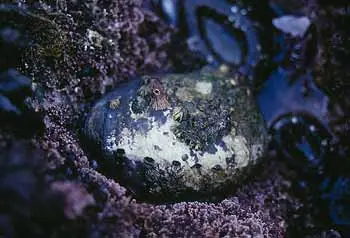
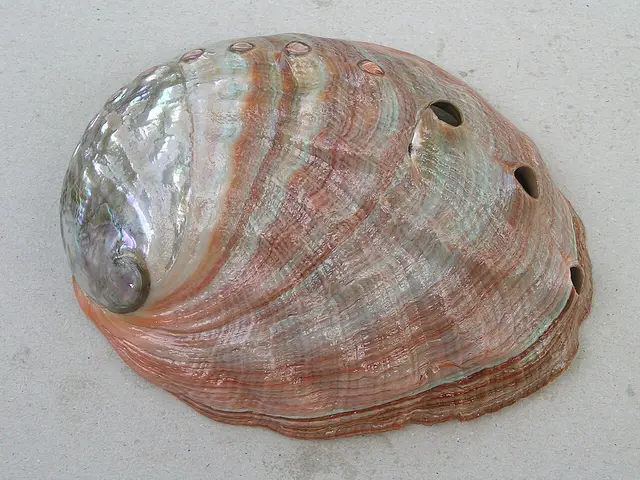
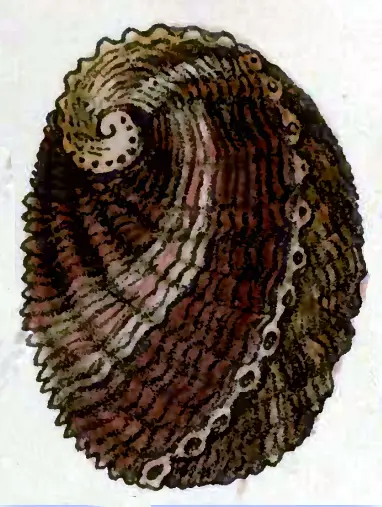
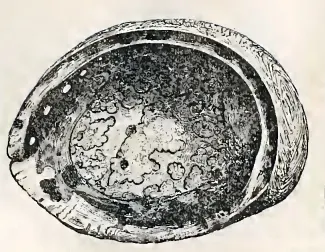
Haliotis gigantea is a true abalone, a single-shelled marine snail. The shell has a very small, low spire. Shells typically measure 80 to 200 mm across, though SeaLifeBase gives a maximum of 30 cm.
The outside is reddish brown, streaked with chocolate and green. Four open holes sit on raised bumps along a strong ridge. Inside, the mother-of-pearl is silvery and strongly iridescent, with emerald green and red flashes. A copepod, Panaietis haliotis, is reported as an external parasite of this species.
Where it lives
The species is native to the northwest Pacific. The Red List records it from the Japanese islands of Honshu, Kyushu and Shikoku and from the Republic of Korea.
It lives on shallow subtidal rock and rocky reefs, including kelp and other large seaweed beds. The IUCN gives its depth range as the surface down to 30 m, while SeaLifeBase gives 0 to 20 m.
Pins are Wikidata “endemic to” fields. Orange dots, when present, are GBIF occurrence tiles — survey bias included.
How it lives
Giant abalone feed on brown seaweeds, so they depend on healthy algal beds. The IUCN estimates a generation at about 14 years, which means a fished-down population may take a long time to recover.
The IUCN lists human food as its use, at subsistence, national and international levels.
Why it is in trouble
The IUCN estimates that the species lost about 50 percent of its numbers in the past, with harvest levels as the basis. The population is described as severely fragmented and still declining. Listed threats are large-scale harvest, industrial aquaculture, temperature extremes and other ecosystem changes, with degraded habitat and poorer breeding success among the effects.
Local records show how sharp the fall can be. A 2013 study in the Journal of Shellfish Research looked at the Ojika Islands off Nagasaki, where the abalone catch dropped from 91 tonnes in 1987 to 0.4 tonnes in 2011. Perennial kelp beds there had vanished by 2003. After 2009 the researchers found no mature giant abalone and no new juveniles at the main fishing grounds, and they concluded that rebuilding the seaweed beds is essential to restore the population.
What is being done
Juvenile abalone are released to stock fishing grounds in Japan. In a Mie Prefecture trial off Kuzaki, near Toba, twelve groups of juvenile giant abalone were released between 1992 and 2003 and recaptured by Ama divers two to seven years later. About 5.5 percent were recovered on average, and the researchers judged releases economically worthwhile, though results varied by fishing ground and season.
The Red List names resource and habitat protection and site management as conservation actions for the species.
Sources
Written for this catalog in our own words from the sources below, checked against them on 12 November 2026. Population figures are estimates and carry the year they were made. Status and assessment year: IUCN. 2026. The IUCN Red List of Threatened Species. Version 2026-1. iucnredlist.org.
- IUCN Red List assessment, Haliotis gigantea (2022)
- Haliotis gigantea, species article
- SeaLifeBase, Haliotis gigantea
- Decrease of abalone resources with disappearance of macroalgal beds around the Ojika Islands, Journal of Shellfish Research 32(1), 2013
- Stocking efficiency of juvenile abalones off Kuzaki, Mie, Bulletin of the Japanese Society of Fisheries Oceanography 74(1), 2010
- Kiyomoto et al. 2013 reference record, SeaLifeBase