Critically Endangered
Greater Bermuda land snail
Poecilozonites bermudensis
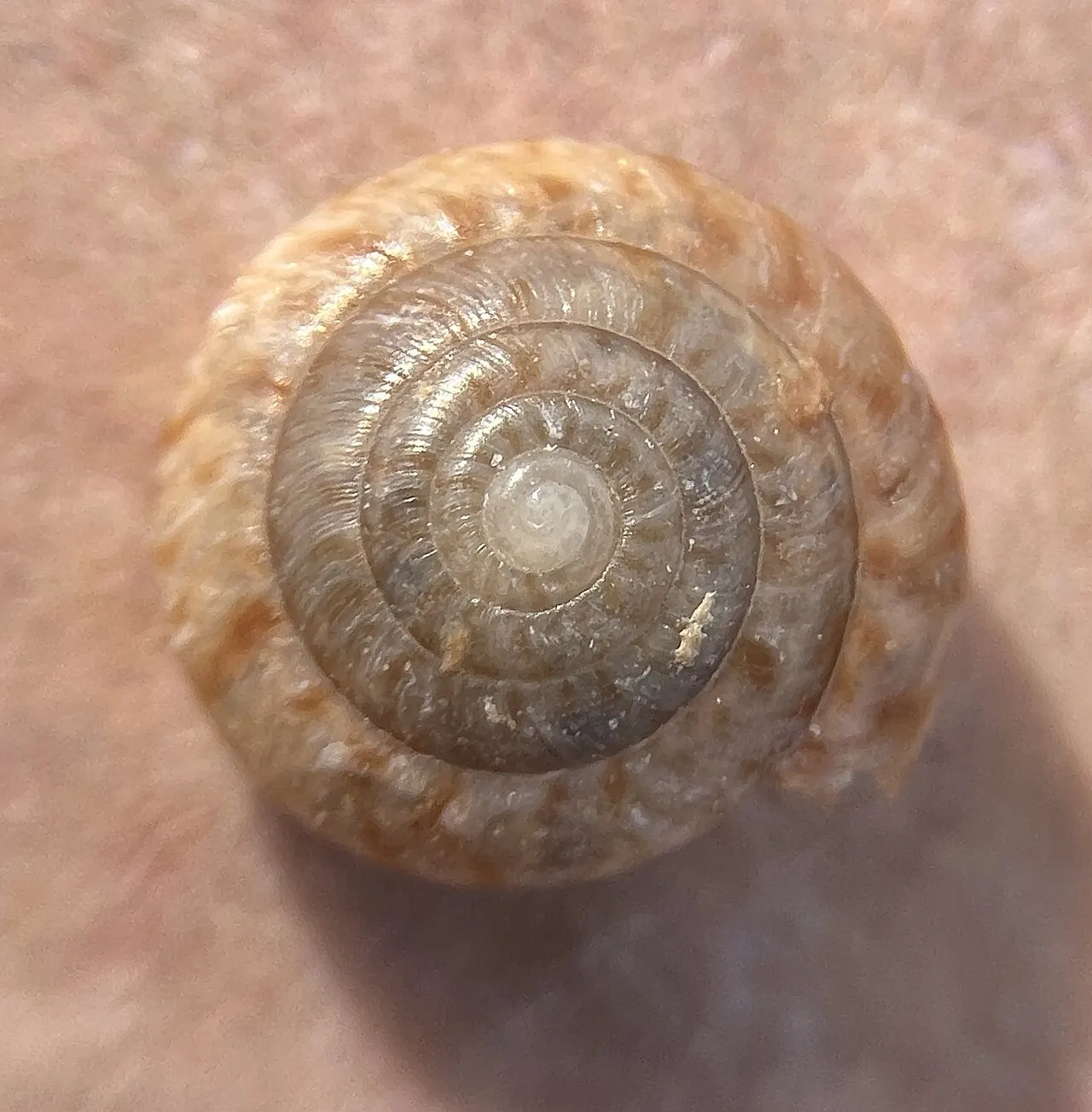
The greater Bermuda land snail (Poecilozonites bermudensis) lives only on Bermuda. It was once common, then went unseen for decades and was feared extinct until a colony turned up in a Hamilton alley in 2014. The IUCN Red List rated it Critically Endangered in 2019. Captive breeding is now rebuilding it.
Where it lives
This snail belongs to Poecilozonites, a group found nowhere but Bermuda. The genus is thought to have reached the island at least 300,000 years ago, and it reportedly makes up about 95% of the island's land fossils. Fossil shells are still seen embedded in rock along the south shore.
The IUCN assessment lists Bermuda as the only country, a single location, with the snail recorded from sea level up to about 10 m. Its habitats are subtropical moist and dry lowland forest, dry shrubland and urban areas. Both its extent of occurrence and its area of occupancy are given as about 4 km².
Pins are Wikidata “endemic to” fields. Orange dots, when present, are GBIF occurrence tiles — survey bias included.
How it lives
Reintroduced snails are mostly active on the surface at night. By day they sit in refuges such as leaf litter, fallen palmetto fronds, rocks and cracks in coral limestone, and old stone walls and building remains seem to work too. On Nonsuch Island they were associated with palmetto forest, sheltering under dead fronds and feeding on palmetto nuts.
Release surveys count a snail as an adult or subadult once its shell is at least 15 mm wide. Juveniles measure 5 to 15 mm and hatchlings are under 5 mm.
Snails released on several offshore islands have survived for years and bred, so the species can re-establish itself where predators are scarce.
Why it is in trouble
The snail was still common in the mid 1960s. Introduced predatory snails (Euglandina and Gonaxis, brought in during the 1950s and 1960s) and snail-eating flatworms then spread. By the mid 1970s the American biologist Stephen Jay Gould, who studied these snails, could no longer find a living one. The IUCN assessment lists introduced species and problem native species or diseases as ongoing threats, and past collecting and past housing and urban development as earlier ones.
Estimates of the wild population differ. The 2019 IUCN assessment gave 2,000 to 4,000 individuals in one subpopulation and recorded the trend as decreasing. A 2019 Mongabay report said fewer than 200 remained in the wild before the large releases.
What is being done
After the 2014 find, a captive breeding programme run by the Zoological Society of London and Chester Zoo, started at the Bermuda government's request, took about three years to produce enough snails for release. A first group of 204 went to Nonsuch Island in 2016, and in February 2019 around 4,000 more were repatriated. The IUCN assessment records a recovery plan, systematic monitoring, and 91 to 100% of the population inside protected areas.
A 2026 paper in Oryx by Outerbridge, Ovaska and Garcia reports 105,970 snails released between 2019 and 2022 to 11 offshore islands and 16 main island sites. By early 2024 six offshore islands (Nonsuch, Hall's, Higg's, Morgan's, Nelly's and Saltus) held breeding populations. None of the main island releases produced a viable population. The paper points to predation, especially by rats, as the likely cause, with flatworms and the introduced milk snail (Otala lactea) as possible contributors. It recommends rodent control and keeping new predators off the offshore islands.
Sources
Written for this catalog in our own words from the sources below, checked against them on 12 November 2026. Population figures are estimates and carry the year they were made. Status and assessment year: IUCN. 2026. The IUCN Red List of Threatened Species. Version 2026-1. iucnredlist.org.
- IUCN Red List assessment, Poecilozonites bermudensis (2019)
- Outerbridge, Ovaska and Garcia, Oryx: reintroduction of the land snail Poecilozonites bermudensis
- Mongabay, captive-raised snails returned to Bermuda (June 2019)
- Government of Bermuda, 4,000 snails repatriated (2019)
- Poecilozonites (encyclopedia article)




