Endangered
Gracixalus nonggangensis
Gracixalus nonggangensis
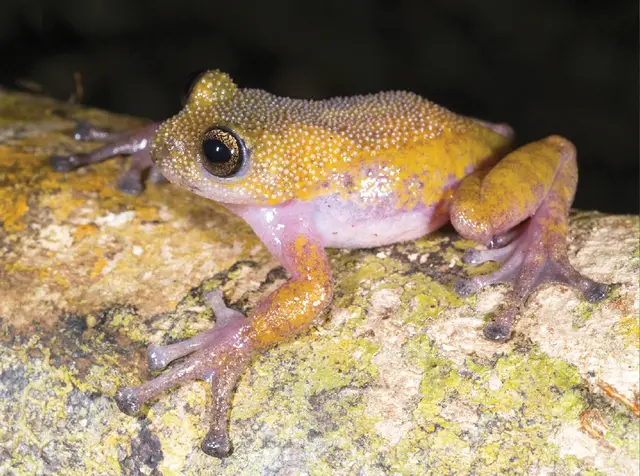
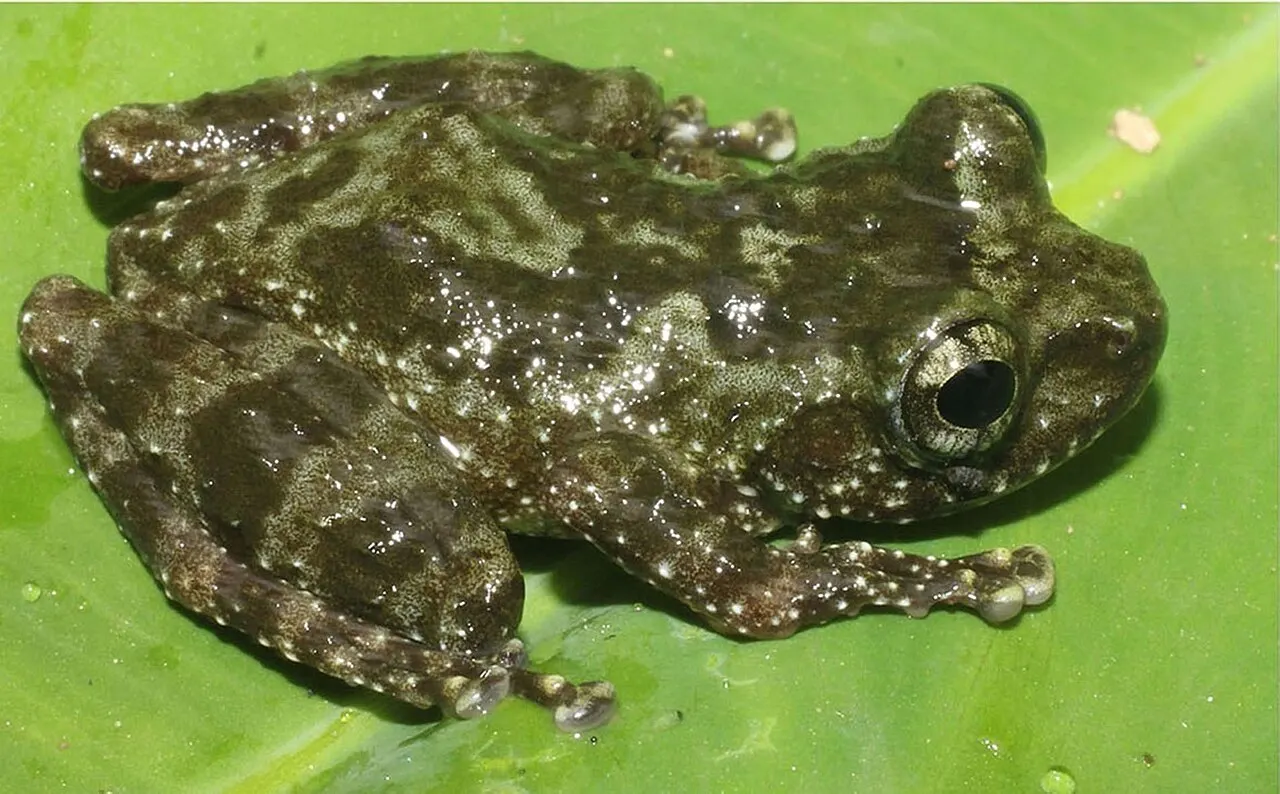
Gracixalus nonggangensis, the Nonggang small treefrog, is a medium-sized shrub frog of limestone forest in southern Guangxi, China, and northern Vietnam. It was described in 2013 and is listed as Endangered by the IUCN (assessed 2021), with a decreasing population and only two to five known locations.
How to recognise it
Males measure roughly 27 to 35 mm from snout to vent and females about 34 to 38 mm, a medium size for the genus. The two original descriptions differ a little on colour. The Chinese specimens had a yellowish olive back, while the Vietnamese frogs ranged from light greenish brown to moss green. A dark mark between the eyes splits into two bands running back along the body, forming a Y shape, and the limbs carry dark bands.
The throat and chest are pale with brown marbling, and the belly is white. The fingers have no webbing and the toes are partly webbed. Males have an internal vocal sac, although the call was not heard during Vietnamese surveys in 2011 and 2012.
Where it lives
A team from the Natural History Museum of Guangxi described the species in 2013 from eleven specimens collected in evergreen karst forest in Nonggang National Nature Reserve, on the Sino-Vietnamese border. The same year, Vietnamese and German researchers described a frog from Ha Lang District in Cao Bang Province as Gracixalus waza. The IUCN now treats that name as a synonym, which extends the range into northern Vietnam.
The Red List assessment gives an elevation range of 200 to 650 m and counts two to five locations. It lists lowland moist forest and small permanent freshwater marshes and pools as habitat, and records the species in at least one protected area.
Pins are Wikidata “endemic to” fields. Orange dots, when present, are GBIF occurrence tiles — survey bias included.
How it lives
In Cao Bang the frogs were found at night, between 7 and 11 pm, in secondary karst forest of small and medium hardwoods mixed with shrubs and vines. They sat near cave entrances and in valleys ringed by limestone cliffs, at about 480 to 650 m. Most were on trees 0.2 to 0.5 m above the ground, and two were on a cliff inside a cave. The sites were far from water, at least 200 m from the nearest source.
Why it is in trouble
The IUCN lists roads and railways, mining and quarrying, and the unintended effects of small-scale harvesting as threats. The assessment also records a continuing decline in the area of habitat the frog occupies, and a decreasing population.
What is being done
Part of the range lies inside Nonggang National Nature Reserve, and the assessment lists site protection and habitat protection among actions in place. No species-specific programme turned up in the sources used here.
Sources
Written for this catalog in our own words from the sources below, checked against them on 12 November 2026. Population figures are estimates and carry the year they were made. Status and assessment year: IUCN. 2026. The IUCN Red List of Threatened Species. Version 2026-1. iucnredlist.org.