Endangered
Gracixalus lumarius
Gracixalus lumarius
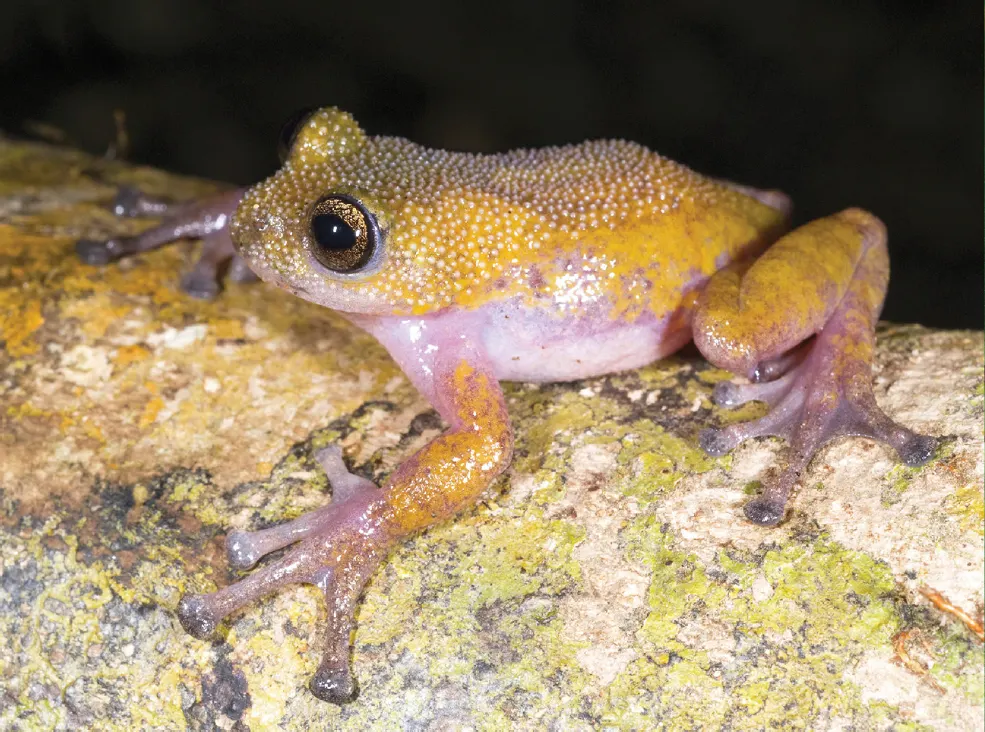
The thorny tree frog (Gracixalus lumarius) is a colourful frog from the cloud forests of Mount Ngoc Linh in central Vietnam. Males carry white thorn-like spikes on the back. The IUCN Red List classed it as Endangered in 2015 because it is known from a single area and its forest is being cleared.
How to recognise it
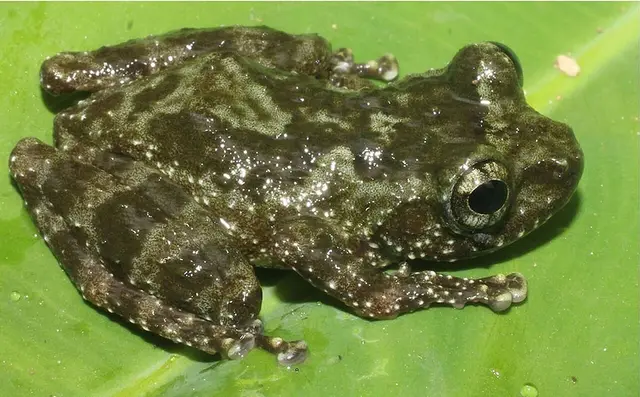
It is a small frog, about 4 cm long. Adult males measure 38.9 to 41.6 mm from snout to vent, and females average around 36.3 mm. The head is wider than long, with a rounded snout, strong forelegs and large climbing discs on the toes.
The name lumarius is Latin for 'of thorns'. Only males have the conical white tubercles on the back, and they grow more prominent in the breeding season. The frog also changes colour: brown by day, yellow at night, with bright yellow flanks and a pink belly. The iris is gold with fine black lines.
Where it lives
It was described in 2014 by Jodi Rowley and colleagues from Ngoc Linh Nature Reserve in Kon Tum Province, Vietnam, where Vietnamese and Australian biologists searched mountain forest at night for amphibians in expeditions in 2009 and 2010. The Red List records it from elevations of 1,845 to 2,160 m and counts it as a single location.
Its home is cool, wet montane evergreen and bamboo forest, and the Red List gives moist montane forest as its habitat. It is arboreal.
Pins are Wikidata “endemic to” fields. Orange dots, when present, are GBIF occurrence tiles — survey bias included.
How it lives
Females lay eggs in small pockets of water that collect in plants, such as tree hollows, rather than in streams. The eggs have two jelly layers. Researchers think the tadpoles develop in those pools, but as of 2015 no tadpoles had been seen.
Why it is in trouble
The population is decreasing. The Red List lists agro-industry farming and mining and quarrying as threats, along with intentional use of the species itself. Forest is reportedly cleared for large farms of coffee, tea and rubber, and gold mining also damages habitat. Its striking looks have led to suspicion of pet-trade collection, though no source reports how many are taken. The Australian Museum notes that a small range on a few high mountain slopes also leaves it exposed to climate change.
What is being done
The only action recorded is site protection, since the frog is known from Ngoc Linh Nature Reserve. Its discoverer Jodi Rowley has said she hopes the find will be a first step toward its conservation.
Sources
Written for this catalog in our own words from the sources below, checked against them on 12 November 2026. Population figures are estimates and carry the year they were made. Status and assessment year: IUCN. 2026. The IUCN Red List of Threatened Species. Version 2026-1. iucnredlist.org.