Endangered
Glandulocauda melanopleura
Glandulocauda melanopleura
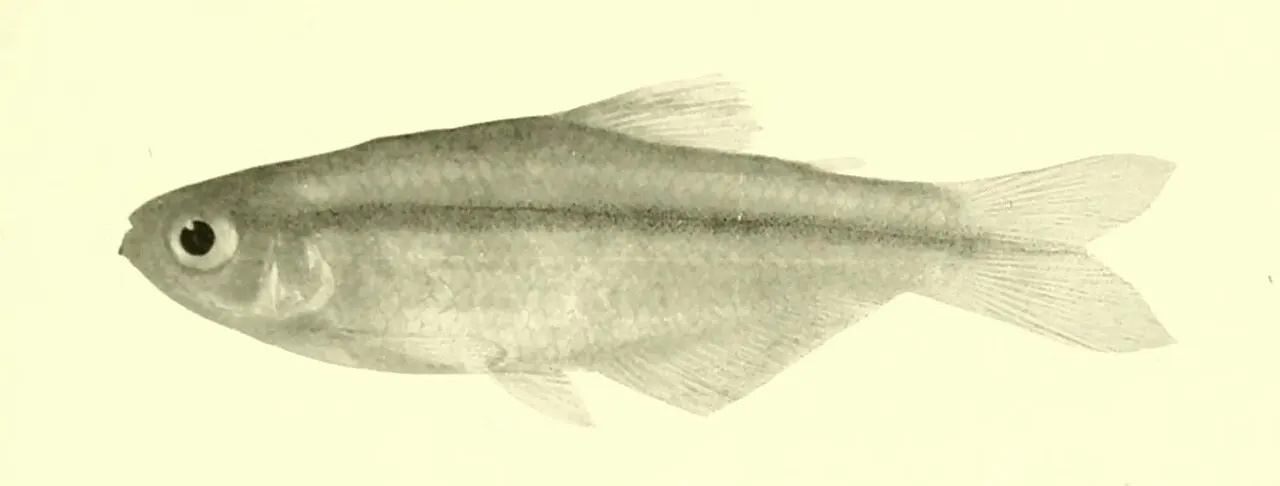
Glandulocauda melanopleura is a small stream fish of the Atlantic Forest highlands in São Paulo state, Brazil. It lives in cool, clear, forested headwaters and was assessed as Endangered on the IUCN Red List in 2021. Males are brownish to yellowish, and the genus takes its name from a gland in the tail.
How to recognise it
This is a small characin that reaches about 5.5 cm in standard length. Live males are overall brown to yellowish, which helps separate it from Glandulocauda caerulea, the only other species in the genus, whose males are mainly bluish.
Its lateral line is incomplete, and the number of pored scales along it varies a lot, from 7 to 27 in one study (against 4 to 8 in G. caerulea). The genus name comes from the Latin for gland and tail. The species was first named Hyphessobrycon melanopleurus by Ellis in 1911.
Where it lives
The species was first described from a headwater stream of the upper Rio Tietê and was long thought to occur only there. It is now known from the upper Tietê (part of the Paraná basin) and from a few neighbouring coastal basins draining to the Atlantic, including Guaratuba, Itatinga, Itanhaém and Ribeira de Iguape. All are in São Paulo state.
It favours first- and second-order streams of clear water at roughly 700 to 850 metres above sea level, on the highlands inside the Atlantic Forest. A population in the Rio Capivari, a blackwater tributary draining to the Itanhaém basin, was reported in 2018. IUCN counts four to five locations, and the fish seems to depend on cool, flowing, forested streams.
Pins are Wikidata “endemic to” fields. Orange dots, when present, are GBIF occurrence tiles — survey bias included.
A history written in river captures
A 2018 PLoS ONE study by Camelier and colleagues compared DNA from the Guaratuba, upper Tietê and Itanhaém populations. It found that no basin shares a genetic haplotype with another. The Guaratuba fish split from the others around 2.2 million years ago, and the upper Tietê and Itanhaém fish about 0.4 million years ago, with wide margins of error.
The study links these dates to headwater river captures, where erosion diverted streams from one basin to another and carried fish with them. The result is a set of isolated populations that are genetically distinct from one another.
Why it is in trouble
IUCN records a decreasing population and continuing decline in habitat area. The threats it lists are roads and railroads, large dams, housing and urban areas, commercial and industrial areas, agro-industry farming, and unintended effects of large-scale harvesting. Most of these alter or degrade the cool forested headwaters the fish relies on.
One population may already be gone. Three fish were collected in the Ribeira de Iguape basin in 1999, downstream of a dam on a farm, and none have turned up since despite later expeditions. Pollution, farming and damming are suspected causes.
What is being done
IUCN records conservation sites identified over part of the range, an area-based regional management plan, and occurrence in at least one protected area. It lists no recovery plan, no systematic monitoring scheme and no captive breeding.
Its listing has shifted over time. The 2018 study says it was once rated Vulnerable on the Red List and later fell out of Brazil's national threatened list, and argued for a reassessment. IUCN rated it Endangered in 2021.
Sources
Written for this catalog in our own words from the sources below, checked against them on 12 November 2026. Population figures are estimates and carry the year they were made. Status and assessment year: IUCN. 2026. The IUCN Red List of Threatened Species. Version 2026-1. iucnredlist.org.




